Chantilly in Fairfax County, Virginia — The American South (Mid-Atlantic)
Leeton
Historic Centreville & Chantilly
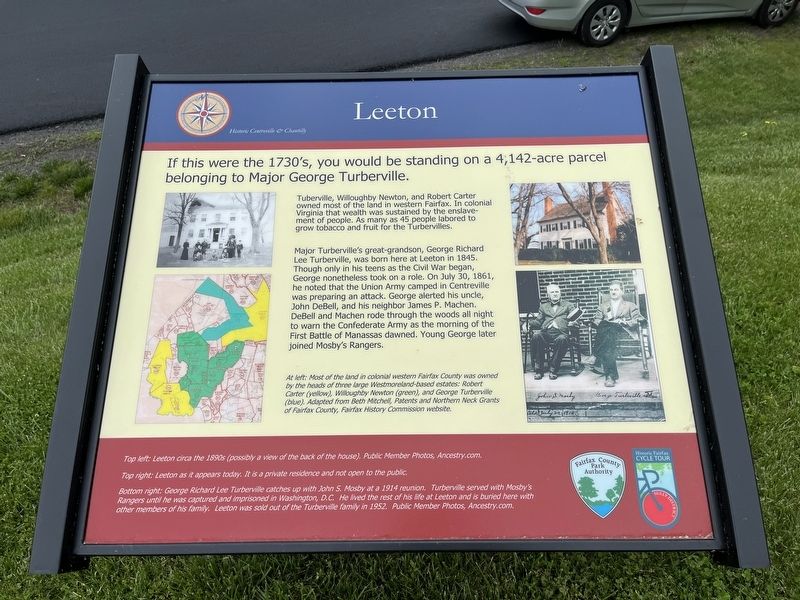
If this were the 1730's, you would be standing on a 4,142-acre parcel belonging to Major George Turberville.
Tuberville, Willoughby Newton, and Robert Carter owned most of the land in western Fairfax. In colonial Virginia that wealth was sustained by the enslavement of people. As many as 45 people labored to grow tobacco and fruit for the Turbervilles.
Major Turberville's great-grandson, George Richard Lee Turberville, was born here at Leeton in 1845. Though only in his teens as the Civil War began, George nonetheless took on a role. On July 30, 1861, he noted that the Union Army camped in Centreville was preparing an attack. George alerted his uncle, John DeBell, and his neighbor James P. Machen. DeBell and Machen rode through the woods all night to warn the Confederate Army as the morning of the First Battle of Manassas dawned. Young George later joined Mosby's Rangers.
[Captions:]
At left: Most of the land in colonial western Fairfax County was owned by the heads of three large Westmoreland-based estates: Robert Carter (yellow), Willoughby Newton (green), and George Turberville (blue). Adapted from Beth Mitchell, Patents and Northern Neck Grants of Fairfax County, Fairfax History Commission website.
Top left: Leeton circa 1890s (possibly a view of the back of the house). Public Member Photos, Ancestry.com.
Top right: Leeton as it appears today. It is a private residence and not open to the public.
Bottom right: George Richard Lee Turberville catches up with John S. Mosby at a 1914 reunion. Turberville served with Mosby's Rangers until he was captured and imprisoned in Washington, D.C. He lived the rest of his life at Leeton and is buried here with other members of his family. Leeton was sold out of the Turberville family in 1952. Public Member Photos, Ancestry.com.
Erected by Fairfax
this page online
Topics. This historical marker is listed in these topic lists: Agriculture • Colonial Era • Settlements & Settlers • War, US Civil. A significant historical date for this entry is July 30, 1861.
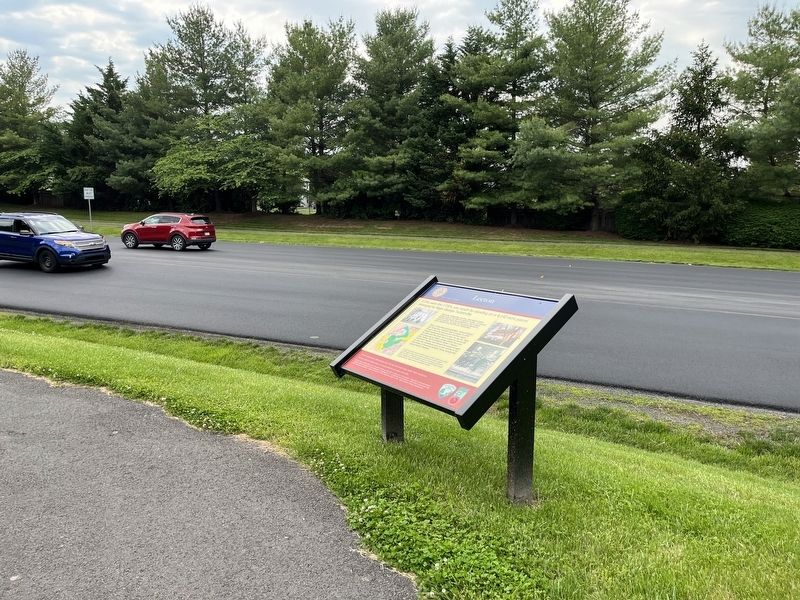
Location. 38° 52.431′ N, 77° 25.804′ W. Marker is in Chantilly, Virginia, in Fairfax County. It is on Walney Road (Virginia Route 657) 0.1 miles Lewis Leigh Court, on the right when traveling north. Touch for map. Marker is in this post office area: Chantilly VA 20151, United States of America. Touch for directions.

Regionally, this marker is in the Washington Metropolitan Area and in Northern Virginia. It is also in the American South, specifically in the Upper South, in the Mid-Atlantic, and on the Eastern Seaboard. Globally, it is in the North Atlantic Region, North America, the Western Hemisphere, the Western World, and the Anglosphere. Historically, it finds itself in what was once the territory of the Mississippian Culture, one of the original Thirteen Colonies, one of the Confederate States of America, and the Antebellum South.
Other nearby markers. At least 8 other markers are within walking
Other markers no longer nearby. The Cross Farmhouse (was approx. 0.7 miles away but has been replaced with another marker now near it); a different marker also named The Walney Dairy (was approx. 0.9 miles away but has been confirmed missing).
Credits. This page was last revised on May 22, 2022. It was originally submitted on May 22, 2022, by Devry Becker Jones of Washington, District of Columbia. This page has been viewed 980 times since then and 75 times this year. Photos: 1, 2. submitted on May 22, 2022, by Devry Becker Jones of Washington, District of Columbia.
