Lorton in Fairfax County, Virginia — The American South (Mid-Atlantic)
Colchester
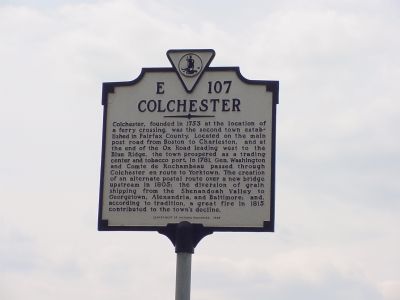
Photographed by J. J. Prats, March 26, 2006
1. Colchester Marker
Erected 1999 by Department of Historic Resources. (Marker Number E-107.)
Topics and series. This historical marker is listed in these topic lists: Colonial Era • Roads & Vehicles • Settlements & Settlers • Waterways & Vessels. In addition, it is included in the Former U.S. Presidents: #01 George Washington, the The Washington-Rochambeau Route, and the Virginia Department of Historic Resources (DHR) series lists. A significant historical year for this entry is 1753.
Location. 38° 40.203′ N,
this page online

Regionally, this marker is in the Washington Metropolitan Area and in Northern Virginia. It is also in the American South, specifically in the Upper South, in the Mid-Atlantic, and on the Eastern Seaboard. Globally, it is in the North Atlantic Region, North America, the Western Hemisphere, the Western World, and the Anglosphere. Historically, it finds itself in what was once the territory of the Mississippian Culture, one of the original Thirteen Colonies, one of the Confederate States of America, and the Antebellum South.
Other nearby markers. At least 8 other markers are within 2 miles of this marker, measured as the crow flies: A Near Tragedy (approx. 0.4 miles away); The Trail to Victory at Yorktown (approx. 0.7 miles away); Welcome to Colchester on the Occoquan (approx.
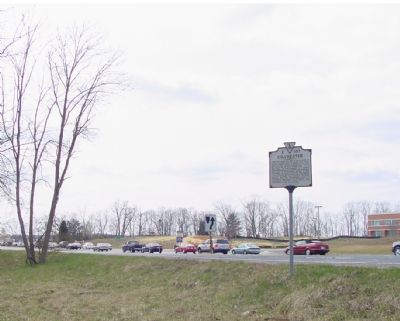
Photographed by J. J. Prats, March 26, 2006
2. Colchester Marker
Other markers no longer nearby. Fairfax County / Prince William County (was approx. half a mile away but has been permanently removed); Early Land Patents (was approx. half a mile away but has been permanently removed); Occoquan (was approx. half a mile away but has been permanently removed); The First Courthouse of Prince William County (was approx. half a mile away but has been permanently removed).
Regarding Colchester. There is not much of Colchester left. There’s just Fairfax Arms, now a private residence on the narrow lane (Old Colchester Road) leading down to the Occoquan river where the ferry used to cross.
Also see . . . A Brief History of Mason Neck. Excerpt from link concerning Colchester: “Colchester was the first town established within the borders of present-day Fairfax
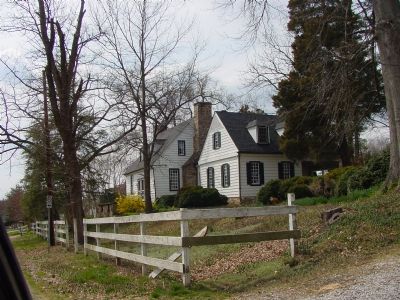
Photographed by J. J. Prats, March 26, 2006
3. Fairfax Arms
Located at 10712 Old Colchester Road, it is on the right just south of the intersection with Furnace Road.
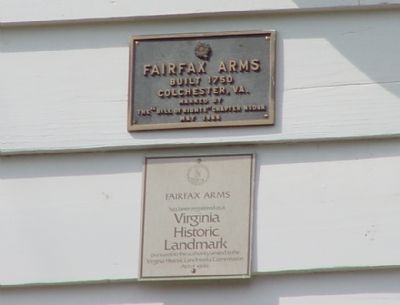
Photographed by J. J. Prats, March 26, 2006
4. Fairfax Arms Markers
The first reads Fairfax Arms. Built 1750, Colchester, VA. Marked by the "Bill of Rights" Chapter, NSDAR. May 1966. The second Fairfax Arms has been registered as a Virginia Historic Landmark pursuant to the authority vested in the Virginia Historic Landmarks Commission, Act of 1966.
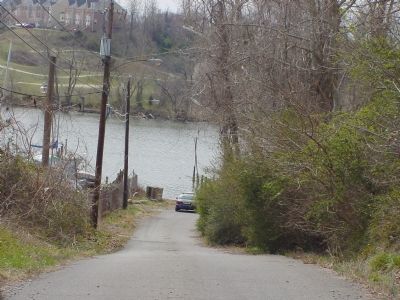
Photographed by J. J. Prats, March 26, 2006
5. The Former King's Highway at the Occoquan
Now known as Old Colchester Road, this last 1,400 feet, from its intersection with Furnace Road to the Occoquan River, is numbered County Road 823.
Credits. This page was last revised on October 30, 2021. It was originally submitted on March 26, 2006, by J. J. Prats of Powell, Ohio. This page has been viewed 7,268 times since then and 162 times this year. Photos: 1, 2, 3, 4, 5. submitted on March 26, 2006, by J. J. Prats of Powell, Ohio.
