Clifton Forge in Alleghany County, Virginia — The American South (Mid-Atlantic)
Roger Arliner Young
(1898–1964)
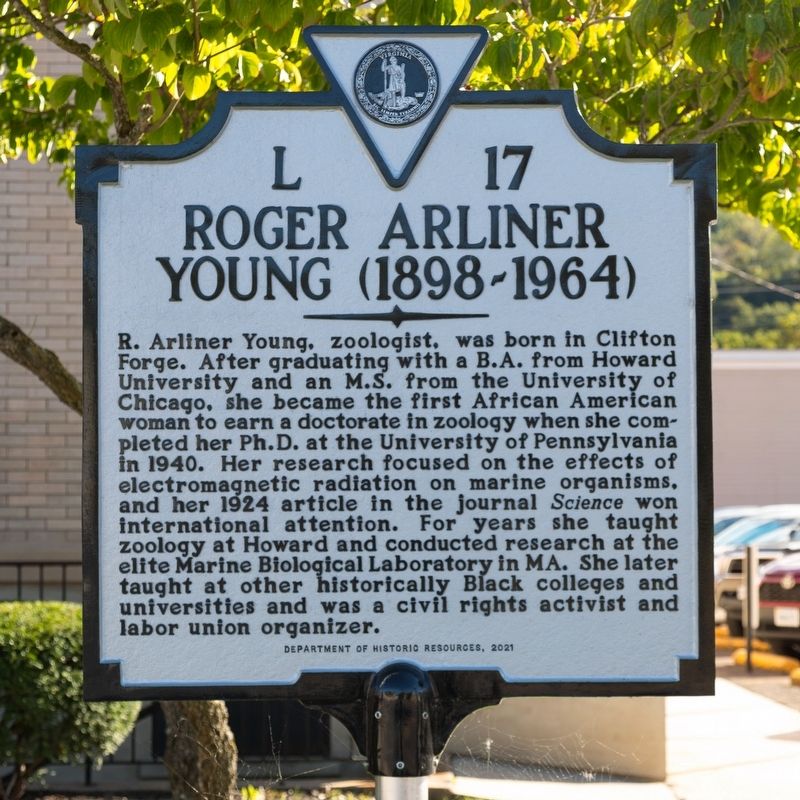
Photographed by J. J. Prats, September 23, 2022
1. Roger Arliner Young Marker
Erected 2021 by Department of Historic Resources. (Marker Number L-17.)
Topics. This historical marker is listed in these topic lists: African Americans • Civil Rights • Labor Unions • Science & Medicine • Women. A significant historical year for this entry is 1924.
Location. 37° 48.95′ N, 79° 49.428′ W. Marker is in Clifton Forge, Virginia, in Alleghany County. It is at the intersection of Main Street
this page online

Regionally, this marker is in the Mountain Region, in the Alleghany Highlands, and specifically in the Potomac Highlands. It is also in the American South, specifically in the Upper South, in Appalachia, and specifically in Southern Appalachia. Globally, it is in North America, the Western Hemisphere, the Western World, and the Anglosphere. Historically, it finds itself in what was once the territory of the Mississippian Culture, one of the original Thirteen Colonies, one of the Confederate States of America, and the Antebellum South.
Other nearby markers. At least 8 other markers are within walking distance of this marker: Robert Gallaspy Land Grant (a few steps from this marker); Veterans Memorial (about 300 feet away, measured in a direct line); Masonic Theatre (about 400 feet away); World War I Memorial (about 400 feet away); a different marker also
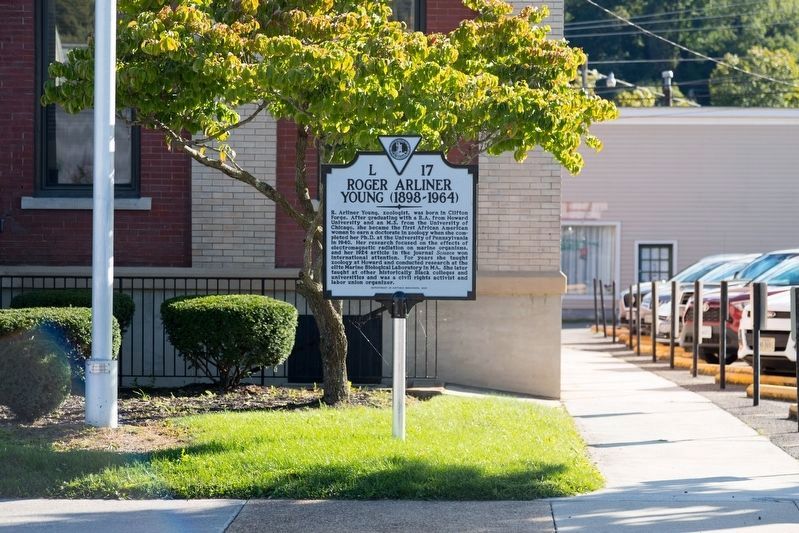
Photographed by J. J. Prats, September 23, 2022
2. Roger Arliner Young Marker
Also see . . .
1. Wikipedia entry for Roger Arliner Young. Excerpt:
In 1916, Young enrolled at Howard University in Washington, D.C. to study music. She wrote in the yearbook: “Not failure, but low aim is a crime.” She did not take her first science course until 1921. Though her grades were poor at the beginning of her college career, some of her teachers saw promise in her. One of these was Ernest Everett Just, a prominent black biologist and head of the Zoology department at Howard. Young graduated with a bachelor’s degree in 1923.(Submitted on October 12, 2022.)
2. How a brilliant biologist was failed by science. 2020 article by Leila McNeill at BBC.com. Excerpt:
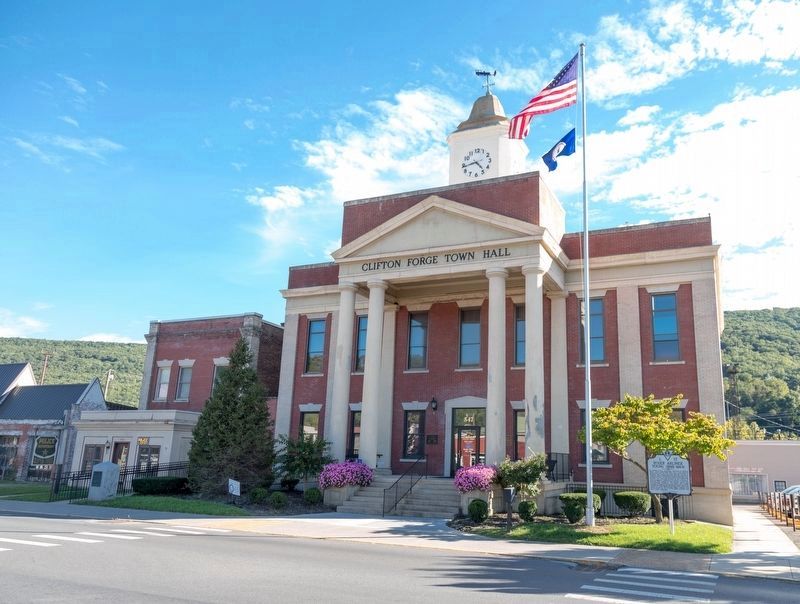
Even though Young continued to return to Woods Hole for research and to present papers there, she found it difficult to make much progress amidst the deteriorating situation at Howard. In 1935, Young confronted(Submitted on October 12, 2022.)[Ernest Everett Just] in a letter, writing: “You seem to be making a deliberate effort to keep me from doing any research... This type of thing is so averse to a true scientific or real university spirit that for a long time I have tried not to believe that is the correct expression of your sincere attitude.”Photographed by J. J. Prats, September 23, 20223. Clifton Forge Town Hall and MarkerMarker is to the right of the flagpole, in front of the small tree.
Within a year of receiving this letter, Just fired Young.
Both Chicago and Howard now were closed off to her. But at least now, she was able to finish her PhD. Under another zoologist at the University of Pennsylvania, Young received her doctoral degree in 1940, and co-authored two papers with her new mentor Lewis V Heilbrunn.
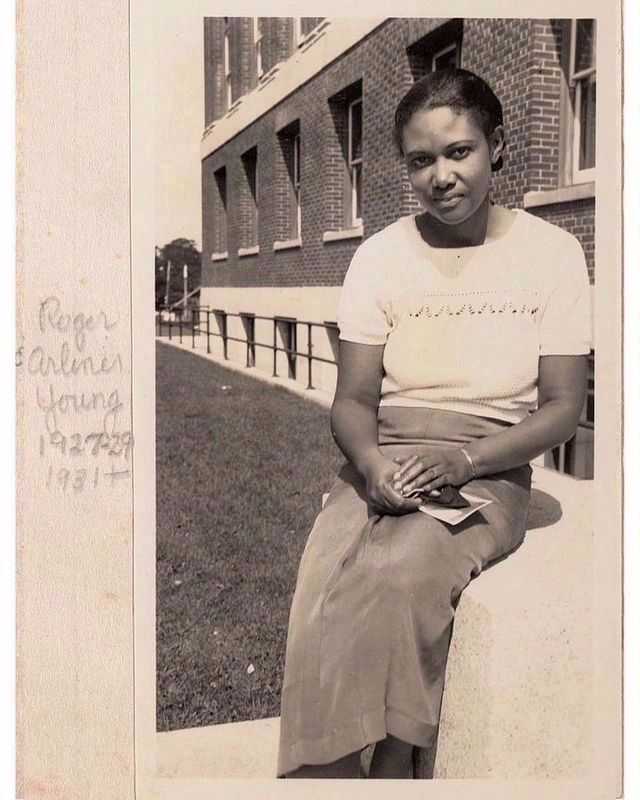
In the Marine Biological Laboratory Archives via the BBC, circa 1929
4. Roger Arliner Young in the late 1920s
Credits. This page was last revised on October 12, 2022. It was originally submitted on October 12, 2022, by J. J. Prats of Powell, Ohio. This page has been viewed 766 times since then and 100 times this year. Photos: 1, 2, 3, 4. submitted on October 12, 2022, by J. J. Prats of Powell, Ohio.
