Shockoe Slip in Richmond, Virginia — The American South (Mid-Atlantic)
Atlantic Sturgeon
Ancient Giants of the James River
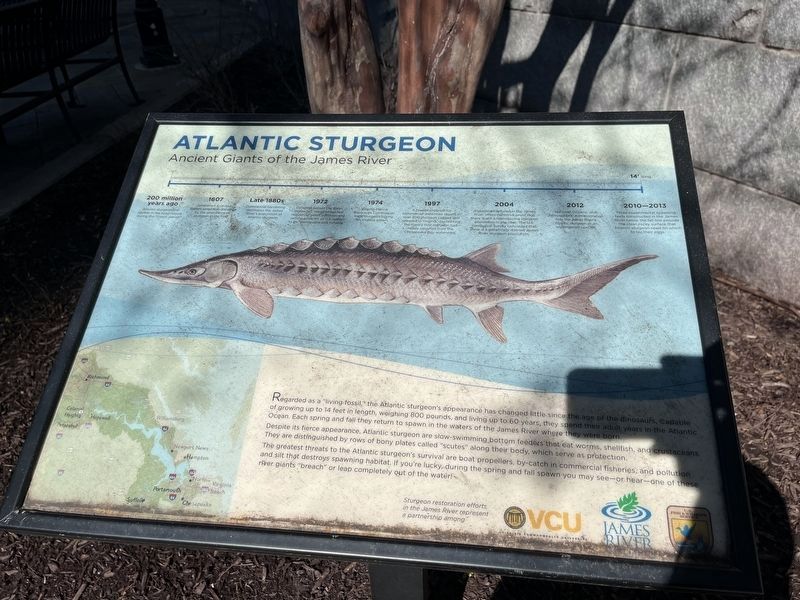
Regarded as a "living fossil," the Atlantic Sturgeon's appearance has changed little since the age of the dinosaurs. Capable of growing up to 14 feet in length, weighing 800 pounds, and living up to 60 years, they spend their adult years in the Atlantic Ocean. Each spring and fall they return to spawn in the waters of the James River where they were born.
Despite its fierce appearance, Atlantic sturgeon are slow-swimming bottom feeders that eat worms, shellfish, and crustaceans. They are distinguished by rows of bony plates called "scutes" along their body, which serve as protection.
The greatest threats to the Atlantic sturgeon's survival are boat propellers, by-catch in commercial fisheries, and pollution and silt that destroys spawning habitat. If you're lucky, during the spring and fall spawn you may see—or hear—one of these river giants "breach" or leap completely out of the water!
200 million years ago
Atlantic sturgeon first appear in the fossil record during the Triassic period.
1607
Jamestown founded. Settlers saved from starvation by the abundance of sturgeon in the river.
Late 1880s
Commercialharvesting decimates the James River's population of Atlantic sturgeon.
Click or scan to see
this page online
1972
Congress passes the Clean Water Act, the principal law regulating water pollution and setting goals for all U.S. waters to be "swimmable and fishable."
1974
Virginia Marine Resources Commission bans sturgeon fishing in Virginia waters.
1997
A reward program for commercial watermen results in over 300 sturgeon tagged and released in Virginia, discrediting the theory that sturgeon had nearly vanished from the Chesapeake Bay watershed.
2004
A yearling captured in the James River offers definitive proof that there is still a reproducing sturgeon population in the river. The U.S. Geological Survey concluded that there is a genetically distinct James River sturgeon population.
2012
National Oceanic and Atmospheric Administration lists the James River's Atlantic sturgeon as an endangered species.
2010-2013
Three experimental spawning reefs constructed in the James River below the fall line provide the clean rocky surface that Atlantic sturgeon need on which to lay their eggs.
Erected by Virginia Commonwealth University Rice Rivers Center;
Topics. This historical marker is listed in these topic lists: Animals • Colonial Era • Environment • Government & Politics • Waterways & Vessels. A significant historical year for this entry is 1607.
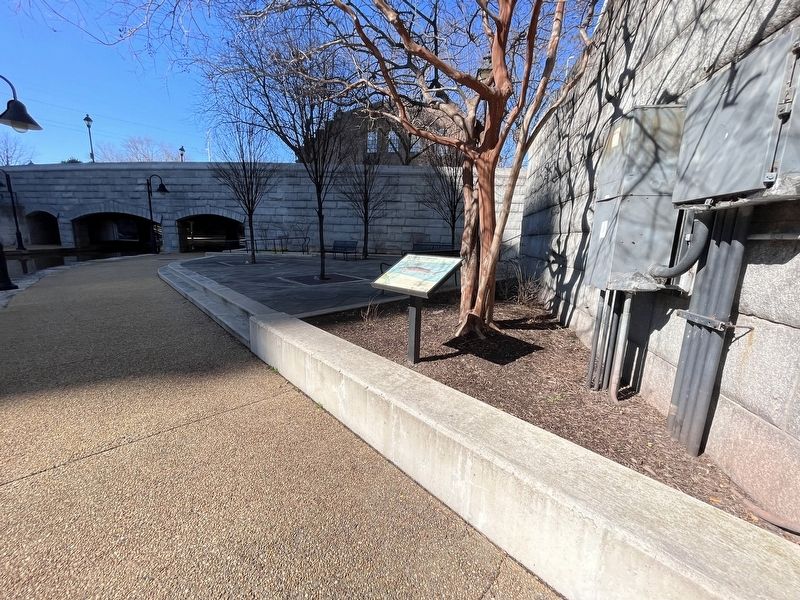
Location. 37° 32.001′ N, 77° 25.999′ W. Marker is in Richmond, Virginia. It is in Shockoe Slip. It is on Canal Walk east of Virginia Street, on the right when traveling west. Touch for map. Marker is at or near this postal address: 200 S 14th St, Richmond VA 23219, United States of America. Touch for directions.

Regionally, this marker is in Central Virginia. It is also in the American South and specifically in the Upper South. Globally, it is in North America, the Western Hemisphere, the Western World, and the Anglosphere. Historically, it finds itself in what was once the territory of the Mississippian Culture, one of the original Thirteen Colonies, one of the Confederate States of America, and the Antebellum South.
Other nearby markers. At least 8 other markers are within walking distance of this marker: James River & Kanawha Canal (a few steps from this marker); New Turning Basin (within shouting distance of this marker); Canal Walk / Historic Canals (within shouting distance of this marker); Use of Arms (within shouting distance of this marker); Burnt District (within shouting distance of this marker); George Washington’s Vision (within shouting distance of this marker); James River Bateaumen (within shouting distance of this marker); Tobacco District (within shouting distance of this marker). Touch for a list and map of all markers in Richmond.
Another marker is no longer nearby. Use of Arms (was within shouting distance of this marker but has been replaced with another marker now near it).
Credits. This page was last revised on February 19, 2023. It was originally submitted on February 19, 2023, by Devry Becker Jones of Washington, District of Columbia. This page has been viewed 306 times since then and 29 times this year. Photos: 1, 2. submitted on February 19, 2023, by Devry Becker Jones of Washington, District of Columbia.
