North Side in Richmond, Virginia — The American South (Mid-Atlantic)
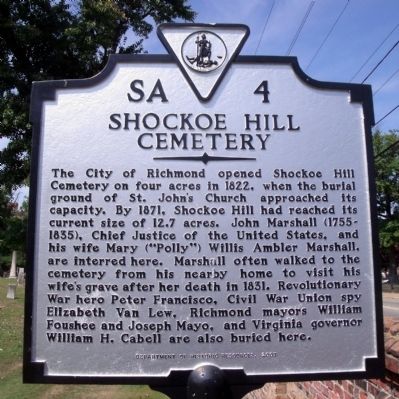
Shockoe Hill Cemetery
Photographed by Bernard Fisher, September 20, 2009
1. Shockoe Hill Cemetery Marker
Erected 2007 by Department of Historic Resources. (Marker Number SA-4.)
Topics and series. This historical marker is listed in these topic lists: Cemeteries & Burial Sites • War, US Civil • War, US Revolutionary • Women. In addition, it is included in the Virginia Department of Historic Resources (DHR) series list. A significant historical year for this entry is 1822.
Location. 37° 33.143′ N, 77° 25.855′ W. Marker is in Richmond, Virginia. It is in the North Side.
this page online

Regionally, this marker is in Central Virginia. It is also in the American South and specifically in the Upper South. Globally, it is in North America, the Western Hemisphere, the Western World, and the Anglosphere. Historically, it finds itself in what was once the territory of the Mississippian Culture, one of the original Thirteen Colonies, one of the Confederate States of America, and the Antebellum South.
Other nearby markers. At least 8 other markers are within walking distance of this marker: A different marker also named Shockoe Hill Cemetery (a few steps from this marker); Union POW Memorial (within shouting distance of this marker); a different marker also named Shockoe Hill Cemetery (within shouting distance of this marker); "The Great Chief Justice" (within shouting distance of this marker); Brown's Island Disaster (about 300 feet away, measured in a direct line); Hebrew Cemetery (about 300 feet away); Shockoe Hill African Burying Ground
Photographed by Bernard Fisher, September 20, 2009
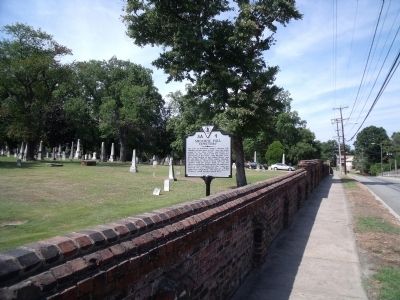
2. Shockoe Hill Cemetery Marker on Hospital Street
Also see . . .
1. Friends of Shockoe Hill Cemetery. (Submitted on September 21, 2009.)
2. General Hospital #1. Civil War Richmond (Submitted on September 21, 2009.)
Photographed by Bernard Fisher, September 20, 2009
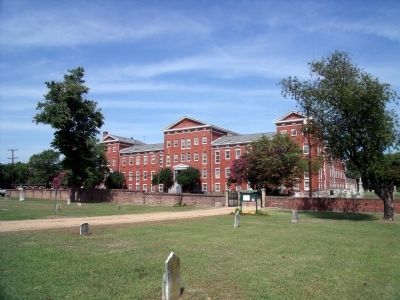
3. General Hospital Number 1.
The General Hospital, City Home Hospital, Alms House Hospital. Built shortly before the outbreak of the Civil War by the City of Richmond as a poor house. Rented by the City Council to the Confederate authorities in June 1861 as a military hospital. Continued in use as such until December 1864 when it was reclaimed by the City for rental to the Virginia Military Institute as their temporary location. Suffered heavy exterior damage when the nearby powder magazine was exploded on evacuation night. Taken over by Federal authorities and again used by them as a poor house. Returned to the City in December 1865. It was used for many years as the City Alms House. Still in use and owned by the City of Richmond. Earliest use by the Confederacy was for wounded Union prisoners. Soon became the first of the large General Hospitals. Capacity about 500 patients. Dr. Charles Bell Gibson, surgeon-in-charge. [Confederate Military Hospitals in Richmond by Robert W. Wait, Jr., Official Publication #22 Richmond Civil War Centennial Committee, Richmond, Virginia 1964.]
Photographed by Bernard Fisher, September 20, 2009
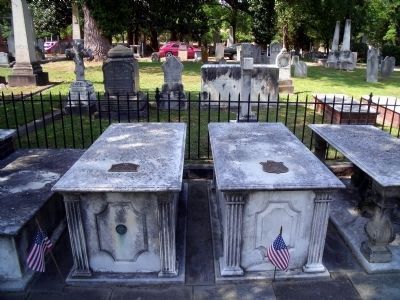
4. John and Mary Willis Ambler Marshall
John Marshall. Son of Thomas and Mary Marshall was born the 24th of September 1755. Intermarried with Mary Willis Ambler the 3rd of January 1783. Departed this life the 6th day of July 1835.
Photographed by Bernard Fisher, September 20, 2009
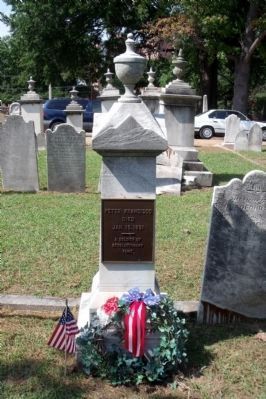
5. Peter Francisco
Died Jan. 16, 1831. A soldier of Revolutionary fame.
Photographed by Bernard Fisher, September 20, 2009
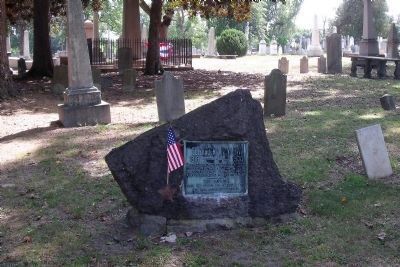
6. Elizabeth L. Van Lew
1818–1900. She risked everything that is dear to man–friends-fortune-comfort-health-life itself-all for the one absorbing desire of her heart-that slavery might be abolished and the Union preserved. This boulder from the capitol hill in Boston is a tribute from Massachusetts friends.
Photographed by Bernard Fisher, September 20, 2009
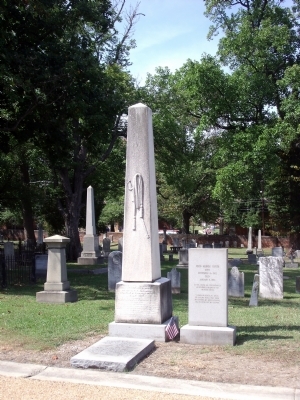
7. John Minor Botts
Born September 16, 1802. Died January 9, 1869. He was under all circumstances an inflexible friend of the American Union. “I know no North, no South, No East, no West; I only know my country, my whole country and nothing but my country.”
Photographed by Bernard Fisher, September 20, 2009
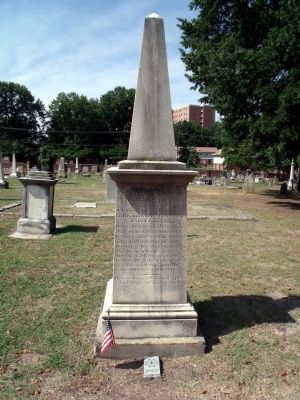
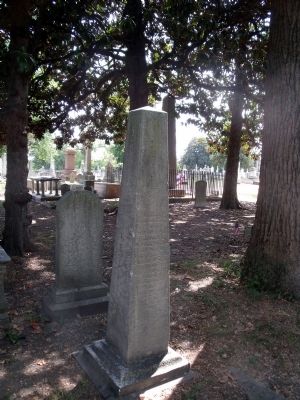
8. Dr William Foushee, 1st mayor of Richmond (1782).
To the memory of Dr William Foushee. A Virginian by birth. A patriot in his principles. In his manners the accomplished gentleman. He was a distinguished physician and graduated at Edinburgh. So great was the confidence reposed in his skill and so bright and cheering was his countenance, even after the age of three score years and ten, that his very presence at the bed side of the suffering seemed to operate as a balmy medicine upon the heart of the sick.
He was born 26th October, 1749 and died 21st August, 1824.
Photographed by Bernard Fisher, September 20, 2009
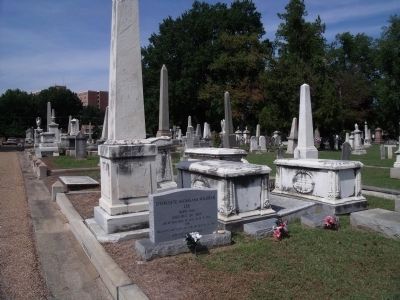
9. Sally Harrison Pickett
Sacred to the memory of Sally Harrison. Daughter of Dr. John Minge. And wife of Capt. George E. Pickett, U.S.A. Born August 9th 1829. Died at Fort Gates, Texas, November 13th, 1851.
Photographed by Bernard Fisher, September 20, 2009
10. Charlotte Georgiana Wickham Lee
Born 1841. Died Dec. 26, 1863. Cherished wife of Gen. W. H. F. Lee. And beloved daughter-in-law of Gen. R. E. Lee. “How sweet her memory”
Photographed by Bernard Fisher, September 20, 2009
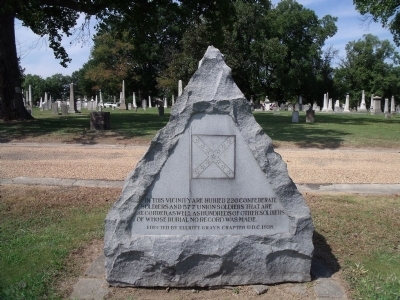
11. UDC Monument
In this vicinity are buried 220 Confederate soldiers and 577 Union soldiers that are recorded, as well as hundreds of other soldiers of whose burial no record was made. Erected by Elliott Grays Chapter U.D.C. 1938.
Note: The Union POWs were actually buried next to the City Hospital building east of 4th Street.
Photographed by Bernard Fisher, September 20, 2009
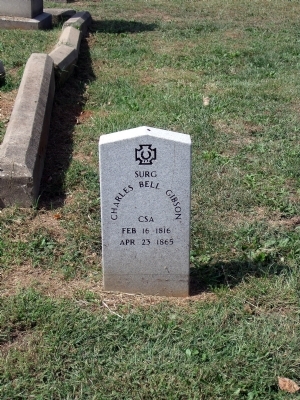
12. Surg Charles Bell Gibson CSA. Feb 16, 1816 - Apr 23, 1865.
Photographed by Bernard Fisher, September 20, 2009
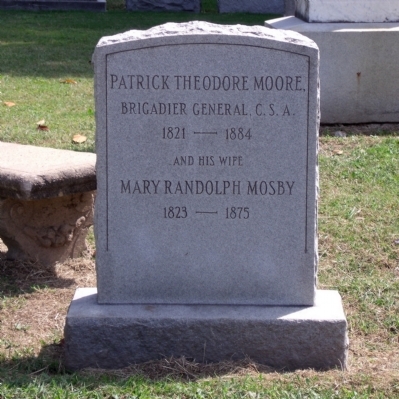
13. Patrick Theodore Moore
Brigadier General, C.S.A. 1821-1884 and his wife Mary Randolph Mosby 1823-1875.
After recovering from a head wound inflicted at Bull Run, Moore served on the staffs of Generals Longstreet and Pickett. From September 1864 to the end of the war, he commanded the local defenses of Richmond.
After recovering from a head wound inflicted at Bull Run, Moore served on the staffs of Generals Longstreet and Pickett. From September 1864 to the end of the war, he commanded the local defenses of Richmond.
Photographed by Bernard Fisher, September 20, 2009
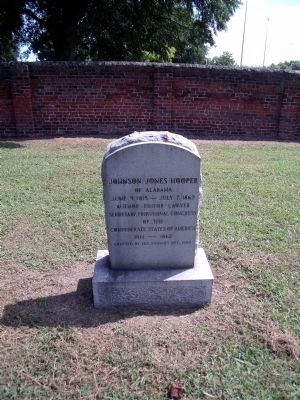
14. Johnson Jones Hooper
of Alabama. June 9, 1815-July 7, 1862. Author-Editor-Lawyer. Secretary, Provisional Congress of the Confederate States of America 1861-1862. Erected by his friends Dec. 1950
Photographed by Bernard Fisher, September 20, 2009
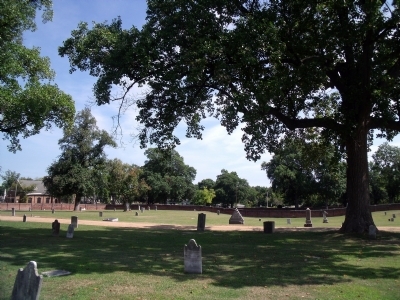
15. Confederate Burial Ground
Many marked & unmarked Confederate graves are in this relatively open section. Hundreds of Union POWs were buried across 4th street in the distance (City Hospital site).
Photographed by Alexander Gardner, April, 186
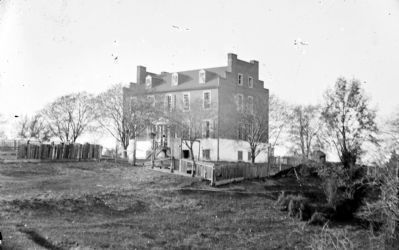
16. Richmond City Hospital
Library of Congress [LC-B815- 898] Many Union POWs were buried here east of Shockoe Hill Cemetery. The soldiers were later moved to Richmond National Cemetery on Williamsburg Road.
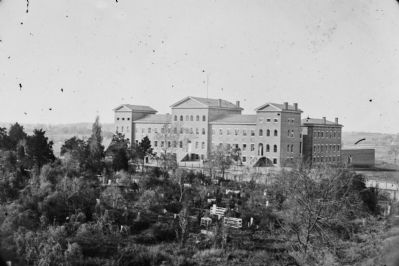
Photographed by Alexander Gardner, April 10, 1865
17. Almshouse, Richmond, Va.
Library of Congress [LC-B815- 860]. Used as CSA General Hospital #1. Charles Bell Gibson was the surgeon-in-charge. Shockoe Hill Cemetery is in the foreground.
Credits. This page was last revised on February 1, 2023. It was originally submitted on September 21, 2009, by Bernard Fisher of Richmond, Virginia. This page has been viewed 3,731 times since then and 108 times this year. Photos: 1, 2, 3, 4, 5, 6, 7, 8, 9, 10, 11, 12, 13, 14, 15, 16, 17. submitted on September 21, 2009, by Bernard Fisher of Richmond, Virginia.
