Gambles Hill in Richmond, Virginia — The American South (Mid-Atlantic)
Belle Isle
Captain John Smith’s Adventures on the James
| — | www.johnsmithtrail.org | — |
Photographed by Bernard Fisher, October 25, 2009
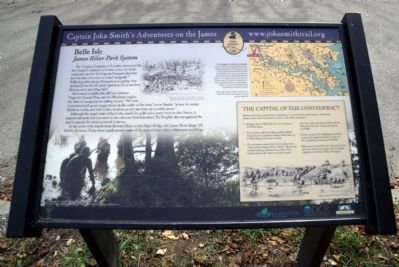
1. Belle Isle Marker
The Virginia Company of London instructed the first English colonists to choose a river for their settlement and to “let Captain Newport discover how far that river may be found navigable.” Following this charge, Newport and a group that included John Smith sailed upriver as far as modern Richmond in late May, 1607.
Richmond straddles the fall line between Virginia’s Coastal Plain and the Piedmont region, the limit of navigation for sailing vessels. “We were intercepted with great craggy stones in the midst of the river,” wrote Smith, “where the water falleth so rudely, and with such a violence, as not any boat can possibly passe.”
Although the rough water delayed the search for gold and a water route to the Orient, it exposed minerals like iron used in the colonists’ first industries. The English also recognized the river’s capacity for water-powered industry.
In the seven-mile stretch from Bosher’s Dam to the Mayo Bridge, the James River drops 105 feet in elevation. Today those rapids power some of the nation’s best urban whitewater paddling.
Capt. John Smith’s Trail
John
this page online
(sidebar)
The Capital of the Confederacy
> Richmond was the capital of the Confederacy. It combined the special features of industry, finance, trade, and transportation which are visible all around you.
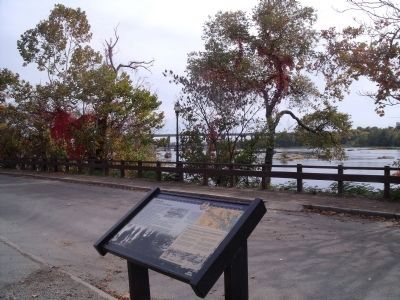
> Straight ahead is Belle Isle: site of an infamous Civil War prison.
> To your left are Brown’s Island and the Haxall Canal: site of a munitions factory, which blew up in 1863, killing 30 women workers.
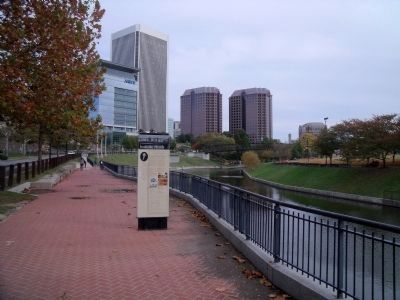
> On the horizon stands the steel and glass tower of the modern Federal Reserve Bank. Richmond was the banking and insurance center of the South based on the tobacco and slave trade.
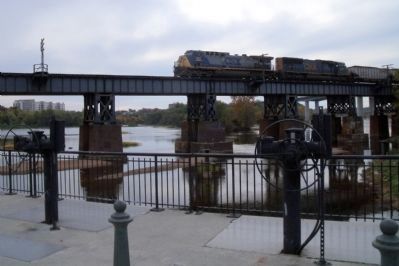
> Over the road is the current CSX railroad. Richmond had five railroads
Photographed by Bernard Fisher, October 25, 2009
2. Belle Isle Marker on the north bank of the James River.
> Further to your left is Tredegar Ironworks, perhaps the largest munitions factory for the Confederacy during the Civil War.
> Behind you up the hill is the Kanawha Canal, the route around the rapids, and the freight highway to the Great Valley of Virginia.
Erected by Captain John Smith’s Trail, James River Association, Virginia Department of Conservation and Recreation, Chesapeake Bay Gateways Network.
Topics. This historical marker is listed in these topic lists: Exploration • Indigenous Peoples and Communities • War, US Civil • Waterways & Vessels. A significant historical year for this entry is 1607.
Location. 37° 32.063′ N, 77° 26.903′ W. Marker is in Richmond, Virginia. It is in Gambles Hill. It is on Tredegar Street 0.3 miles west of South 5th Street, on the right when traveling west. Touch for map. Marker is in this post office area: Richmond VA 23219, United States of America. Touch for directions.

Regionally, this marker is in Central Virginia. It is also in the American South and specifically in the Upper South. Globally, it is in North America, the Western Hemisphere,
Photographed by Bernard Fisher, October 25, 2009
3. Federal Reserve Bank above the Haxall Canal.
Other nearby markers. At least 7 other markers are within walking distance of this marker: Welcome to Richmond’s Historic Riverfront (a few steps from this marker); Water Power (within shouting distance of this marker); Tredegar in the Twentieth Century / Then and Now (about 500 feet away, measured in a direct line); Horseshoe Shops (about 500 feet away); Robert E. Lee Bridge (about 500 feet away); What’s That? (about 600 feet away); Hurricane Agnes (about 800 feet away). Touch for a list and map of all markers in Richmond.
Other markers no longer nearby. Making Machines at Tredegar (was about 500 feet away but has been permanently removed); Tredegar Rolling Mills (was about 600 feet away but has been permanently removed); Industrial Recycling (was about 600 feet away but has been permanently removed); Belle Isle Prison (was about 600 feet away but has been permanently removed); Neighborhoods at Tredegar
Photographed by Bernard Fisher, October 25, 2009
4. CSX Railroad along the north bank of the James River.
Regarding Belle Isle. On the upper center is a sketch of Native Americans “Digging for silver.” Drawing by Marc Castelli for the John Smith Four Hundred Project © 2006.
On the upper right is a map of Captain John Smith's Trail.
On the lower left is a depiction of English colonists coming ashore along the banks of the James River. The photo carries the caption “The New World” © MMV, New Line Productions, Inc. All rights reserved. Photo by Merie Wallace. Photo appears courtesy of New Line Productions, Inc.
The sidebar shows a sketch of a military encampment along the river. Image Courtesy of the Library of Virginia.
Also see . . .
1. Belle Isle Prison. Civil War Richmond (Submitted on October 28, 2009.)
2. Friends of the James River Park.
Photographed by Bernard Fisher, October 25, 2009
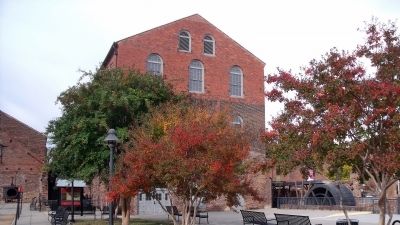
5. NPS Civil War Visitor Center at Tredegar Iron Works.
3. The American Civil War Museum. (Submitted on October 27, 2009.)
4. James River and Kanawha Canal Historic District. National Register of Historic Places (Submitted on October 27, 2009.)
Photographed by Bernard Fisher, October 25, 2009
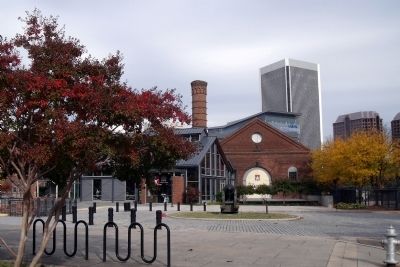
6. American Civil War Center at Historic Tredegar.
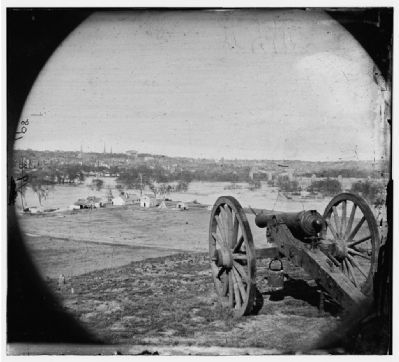
1865
7. View of city from Belle Isle; gun in foreground.
Photographed by Bernard Fisher, November 3, 2009
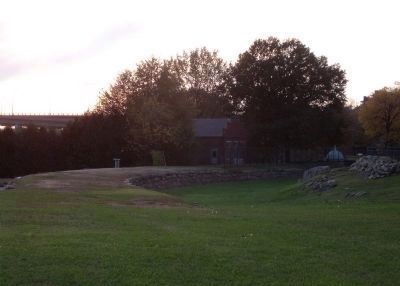
8. Kanawha Canal behind Tredegar Iron Works
Photographed by Bernard Fisher
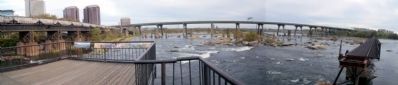
9. View from the James River overlook on Brown's Island.
Credits. This page was last revised on February 1, 2023. It was originally submitted on October 27, 2009, by Bernard Fisher of Richmond, Virginia. This page has been viewed 1,935 times since then and 58 times this year. Photos: 1, 2, 3, 4, 5, 6. submitted on October 27, 2009, by Bernard Fisher of Richmond, Virginia. 7. submitted on November 1, 2009, by Bernard Fisher of Richmond, Virginia. 8. submitted on November 4, 2009, by Bernard Fisher of Richmond, Virginia. 9. submitted on October 27, 2009, by Bernard Fisher of Richmond, Virginia.
