
Fredericksburg in Gillespie County, Texas — The American South (West South Central)
Pinta Trail

Photographed by James Hulse, June 9, 2024
1. Pinta Trail Marker
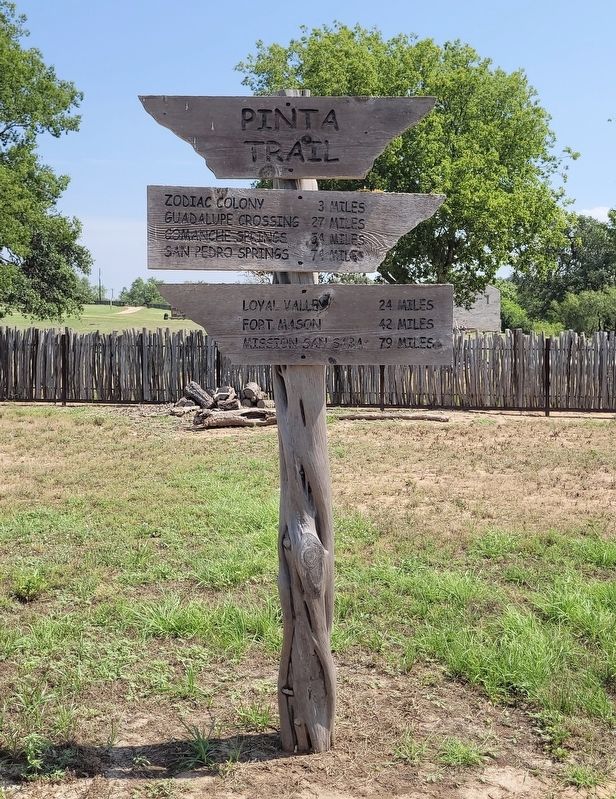
Native Americans, explorers, and settlers used the Pinta Trail for travel from San Antonio to points west. The trail was the primary route to the Presidio San Luis de las Amarillas, now better known as Presidio of San Sabá, which was founded in April 1757 near present day Menard, Texas. The Spanish continued to use this trail to reach Santa Fe into the 19th century. After German immigrants established New Braunfels in 1845, they forged onward to found Fredericksburg using a trail that looped south from New Braunfels and connected with the Pinta Trail above San Antonio, converting the trail to a road for European settlers. In January 1847 Ferdinand von Roemer rode the Pinta Trail traveling with John Meusebach to the six-month-old village of Fredericksburg and onward to the Presidio San Sabá. The Pinta Trail entered Gillespie from the south along the Grape Creek drainage, continuing northwest, it crossed the Pedernales at the first inverted horseshoe-bend east of Baron's Creek, north of today's U.S. Highway 290 near the site of the Mormon colony of Zodiac. It appears that the trail originally passed Fredericksburg a short distance to the east, but the town's founders built roads through their settlement one of which connected to the Pinta Trail at Fort Martin Scott. The Pinta Trail became known as the Upper Emigrant Trail used by the Forty-Niners on their way to the California gold fields and Fort Martin Scott was their guardian.
Topics. This historical marker is listed in these topic lists: Exploration • Immigration • Indigenous Peoples and Communities • Roads & Vehicles. A significant historical month for this entry is January 1847.
Location. 30° 14.894′ N, 98° 50.729′ W. Marker is in Fredericksburg, Texas, in Gillespie County. It is on East Main Street (U.S. 290) south of Industrial Loop. The marker
this page online

Regionally, this marker is in the Hill Country. Globally, it is in North America, a Gulf of Mexico state, the Western Hemisphere, the Western World, and the Anglosphere. Historically, it finds itself in what was once New Spain, the Republic of Texas, and one of the Confederate States of America.
Other nearby markers. At least 8 other markers are within walking distance of this marker: The Zodiac Community (a few steps from this marker); Fort Martin Scott: Frontier Army Post (within shouting distance of this marker); The Natural Setting (within shouting distance of this marker); Blacksmith Shop (within shouting distance of this marker); Peace with the Indians (within shouting distance of this marker); The Braeutigam Family (within shouting distance of this marker); Dragoons (within shouting distance of this marker); The Guardhouse (about 300 feet away, measured in a direct line). Touch for a list and map of all markers in Fredericksburg.
More about this marker.

Photographed by James Hulse, June 9, 2024
2. The view of the Pinta Trail Marker along the trail
Also see . . . From a Former Army Base to Texas Historical Site. Fort Martin Scott Organization
Between 1870 and 1959, the Braeutigam folks bought the former army installation. Johabb Wolfgang Braeutigam had moved from the Kaltenlengsfeld district of Germany, with his folks, and advanced toward Indianola in 1845. He and his significant other chose to settle in Fredericksburg with their 9 youngsters. In 1870, the Braeutigam moved into the former army base, after soldiers deserted it and utilized it as a farm. On 3rd September 1884, Johann Braeutigam was murdered in a theft involving 4 individuals who were after Biergarten’s cash box. The Braeutigam family later sold the property to Fredericksburg City.(Submitted on July 20, 2024, by James Hulse of Medina, Texas.)
Some of the remarkable highlights of the former army base include: the quarters for the post commander which previously acted as the Braeutigamgarden, 6 structures of troops’ houses, sutler’s warehouse and store, pastry kitchen with a stove, laundry, emergency military clinic, 3 sets of battalions for enlisted troops, quartermaster’s warehouse, a blacksmith store, and shed-fused stable. The watch house is presently the station’s only surviving structure after it was restored to mirror its underlying design of cut limestone, during the beginning of the 1900s.Photographed by James Hulse, June 9, 20243. Pinta Trail Sign
Credits. This page was last revised on August 13, 2025. It was originally submitted on July 20, 2024, by James Hulse of Medina, Texas. This page has been viewed 316 times since then and 19 times this year. Photos: 1, 2, 3. submitted on July 20, 2024, by James Hulse of Medina, Texas.
