Camden in Kershaw County, South Carolina — The American South (South Atlantic)
The First People
Photographed by Mark Parker, April 7, 2024
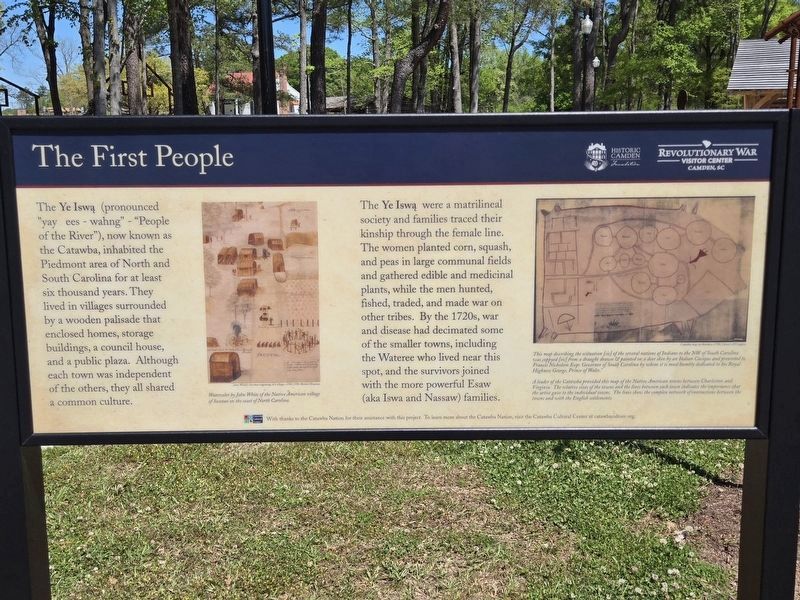
1. The First People Marker (side 1)
The Ye Iswa (pronounced "yay ees-wahng" - "People of the River"), now known as the Catawba, inhabited the Piedmont area of North and South Carolina for at least six thousand years. They lived in villages surrounded by a wooden palisade that enclosed homes, storage buildings, a council house, and a public plaza. Although each town was independent of the others, they all shared a common culture.
The Ye Iswa were a matrilineal society and families traced their kinship through the female line. The women planted corn, squash, and peas in large communal fields and gathered edible and medicinal plants, while the men hunted, fished, traded, and made war on other tribes. By the 1720s, war and disease had decimated some of the smaller towns, including the Wateree who lived near this spot, and the survivors joined with the more powerful Esaw (aka Iswa and Nassaw) families.
(side 2)
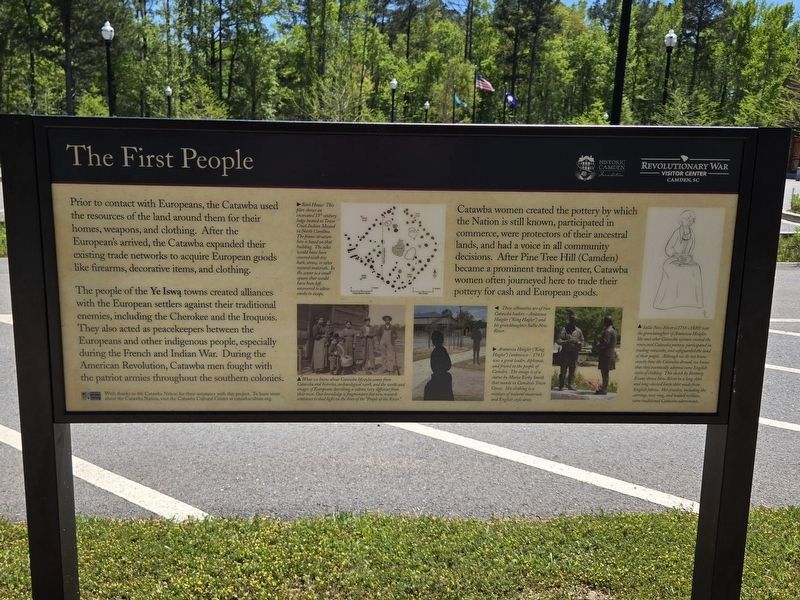
Prior to contact with Europeans, the Catawba used the resources of the land around them for their homes, weapons, and clothing. After the European's arrived, the Catawba expanded their existing trade networks to acquire European goods
this page online
The people of the Ye Iswa towns created alliances with the European settlers against their traditional enemies, including the Cherokee and the Iroquois. They also acted as peacekeepers between the Europeans and other indigenous people, especially during the French and Indian War. During the American Revolution, Catawba men fought with the patriot armies throughout the southern colonies.
Catawba women created the pottery by which the Nation is still known, participated in commerce, were protectors of their ancestral lands, and had a voice in all community decisions. After Pine Tree Hill (Camden) became a prominent trading center, Catawba women often journeyed here to trade their pottery for cash and European goods.
Erected by Historic Camden Foundation / Revolutionary War Visitor Center.
Topics. This historical marker is listed in these topic lists: Anthropology & Archaeology • Colonial Era • Indigenous Peoples and Communities • Settlements & Settlers • War, French and Indian • War, US Revolutionary.
Location. 34° 13.961′ N,
Photographed by Mark Parker, April 7, 2024
2. The First People Marker (side 2)

Regionally, this marker is in the Midlands and in the Olde English District. It is also in the American South and specifically in the Deep South. Globally, it is in North America, the Western Hemisphere, the Western World, and the Anglosphere. Historically, it finds itself in what was once the territory of the Mississippian Culture, one of the original Thirteen Colonies, one of the Confederate States of America, and the Antebellum South.
Other nearby markers. At least 8 other markers are within walking distance of this marker: Early Camden, 1830-32 (here, next to this marker); Wateree Street (a few steps from this marker); The Ye Iswa During the Revolution (a few steps from this marker); Corduroy Road

Photographed by Mark Parker, April 7, 2024
3. Closeup of Watercolor of Village of Secoton, center of side 1
Watercolor by Jobn White of the Native American village of Secotan on the coast of North Carolina.
Credit: John White's Secoton engraving of a village, c1585-1593, British Museum
Credit: John White's Secoton engraving of a village, c1585-1593, British Museum
Also see . . .
1. Revolutionary War Visitor Center at Camden. (Submitted on August 1, 2024.)
2. Historic Camden Foundation. (Submitted on August 1, 2024.)

Photographed by Mark Parker, April 7, 2024
4. Closeup Catawba Map on Deerskin, side one far right
This map describing the scituation [sic] of the several nations of Indians to the NW of South Carolina was coppyed [sic] from a draught drawn & painted on a deer skin by an Indian Cacique and presented to Francis Nicholson Esqr. Governor of South Carolina by whom it is most humbly dedicated to his Royal Highness George, Prince of Wales.
A leader of the Catawba provided this map of the Native American towns between Charleston and Virginia. The relative sizes of the towns and the lines between each town indicates the importance that the artist gave to the individual towns. The lines show the complex network of interactions between the towns and with the English settlements.
Credit: Catawba map on deerskin, c1729, Library of Congress
A leader of the Catawba provided this map of the Native American towns between Charleston and Virginia. The relative sizes of the towns and the lines between each town indicates the importance that the artist gave to the individual towns. The lines show the complex network of interactions between the towns and with the English settlements.
Credit: Catawba map on deerskin, c1729, Library of Congress

Photographed by Mark Parker, April 7, 2024
5. Close up photos and captions from side 2, center
Top left: Bark House: This plan shows an excavated 15's century lodge located at Town Creek Indian Mound in North Carolina. The frame structure here is based on that building. The sides would have been covered with tree bark, straw, or other natural materials. In the center is a small square that would bave been left uncovered to allow smoke to escape.
Bottom left: What we know about Catawba lifestyles comes from Catawba oral histories, archaeological work, and the words and images of Europeans describing a culture very different from their own. Our knowledge is fragmentary but new research continues to shed light on the lives of the "People of the River".
Bottom center:
These silhouettes are of two Catawba leaders - Arataswa Haigler ("King Hagler") and his granddaughter Sallie New River.
Bottom right:
Arataswa Haigler ("King Hagler") (unknown-1763) was a great leader, diplomat, and friend to the people of Camden. The image is of a statue by Maria Kirby Smith that stands in Camden's Town Green. His clothing is a mixture of natural materials and English style dress.
Bottom left: What we know about Catawba lifestyles comes from Catawba oral histories, archaeological work, and the words and images of Europeans describing a culture very different from their own. Our knowledge is fragmentary but new research continues to shed light on the lives of the "People of the River".
Bottom center:
These silhouettes are of two Catawba leaders - Arataswa Haigler ("King Hagler") and his granddaughter Sallie New River.
Bottom right:
Arataswa Haigler ("King Hagler") (unknown-1763) was a great leader, diplomat, and friend to the people of Camden. The image is of a statue by Maria Kirby Smith that stands in Camden's Town Green. His clothing is a mixture of natural materials and English style dress.

Photographed by Mark Parker, April 7, 2024
6. Closeup of Sallie New River Drawing, side two, bottom right
Sallie New River (c1755-c1820) was the granddaughter of Arataswa Haigler. She and other Catawba women created the renowned Catawba pottery, participated in trading networks, and safeguarded the land of their people. Although we do not know excactly how the Catawba dressed, we know that they eventually adopted some English styles of clotbing. This sketch by Brittney Evans shows New River in a long skirt and long-sleeved linen shirt made from English fabrics. Her jewelry, including the earrings, nose ring, and beaded necklace, were traditional Catawba adornments.
Credits. This page was last revised on August 1, 2024. It was originally submitted on July 31, 2024, by Mark Parker of Hickory, North Carolina. This page has been viewed 369 times since then and 66 times this year. Photos: 1, 2, 3, 4, 5, 6. submitted on July 31, 2024, by Mark Parker of Hickory, North Carolina. • Bernard Fisher was the editor who published this page.
