Near Core in Monongalia County, West Virginia — The American South (Appalachia)
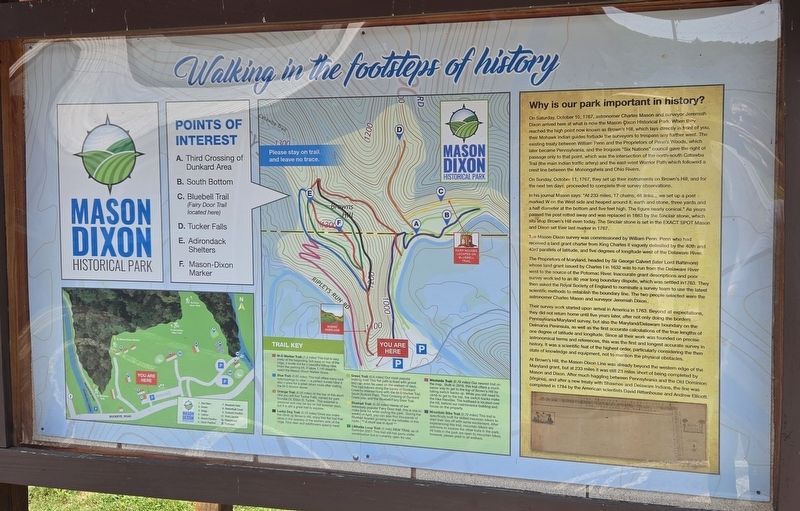
Walking in the Footsteps of History
Mason Dixon Historical Park
Photographed by Bradley Owen, August 23, 2024
1. Walking in the Footsteps of History Marker
Why is our park important in history?
On Saturday, October 10, 1767, astronomer Charles Mason and surveyor Jeremiah Dixon arrived here at what is now the Mason-Dixon Historical Park. When they reached the high point now known as Brown's Hill, which lays directly in front of you, their Mohawk Indian guides forbade the surveyors to trespass any further west. The existing treaty between William Penn and the Proprietors of Penn's Woods, which later became Pennsylvania, and the Iroquois "Six Nations" council gave the right of passage only to that point, which was the intersection of the north-south Catawba Trail (the main Indian traffic artery) and the east-west Warrior Path which followed a crest line between the Monongahela and Ohio Rivers.
On Sunday, October 11, 1767, they set up their instruments on Brown's Hill, and for the next ten days, proceeded to complete their survey observations.
In his journal Mason says: "At 233 miles, 17 chains, 48 links... we set up a post marked W on the West side and heaped around it, earth and stone, three yards and a half diameter at the bottom and five feet high. The figure nearly
this page online
The Mason-Dixon survey was commissioned by William Penn. Penn who had received a land grant charter from King Charles II vaguely delimited by the 40th and 43rd parallels of latitude, and five degrees of longitude west of the Delaware River.
The Proprietors of Maryland, headed by Sir George Calvert (later Lord Baltimore) whose land grant issued by Charles I in 1632 was to run from the Delaware River west to the source of the Potomac River. Inaccurate grant descriptions and poor survey work led to an 80 year long boundary dispute, which was settled in 1763. They then asked the Royal Society of England to nominate a survey team to use the latest scientific methods to establish the boundary line. The two people selected were the astronomer Charles Mason and surveyor Jeremiah Dixon.
Their survey work started upon arrival in America in 1763. Beyond all expectations, they did not return home until five years

Photographed by Bradley Owen, August 23, 2024
2. Walking in the Footsteps of History Marker
At Brown's Hill, the Mason-Dixon Line was already beyond the western edge of the Maryland grant, but at 233 miles it was still 23 miles short of being completed by Mason and Dixon. After much haggling between Pennsylvania and the Old Dominion (Virginia), and after a new treaty with Shawnee and Delaware Indians, the line was completed in 1784 by the American scientists David Rittenhouse and Andrew Ellicott.
POINTS OF INTEREST
A. Third Crossing of Dunkard Area
B. South Bottom
C. Bluebell Trail (Fairy Door Trail located here)
D. Tucker Falls
E. Adirondack Shelters
F. Mason-Dixon Marker
TRAIL KEY
M-D Marker Trail: (1.3 miles) This trail is very steep at the beginning, but once on top of the ridge, it levels out for a beautiful hilltop hike. From the parking lot, it takes 1,140 steps to reach the Mason-Dixon Marker Stone.
Blue Trail: (0.65 miles) This trail offers many rock outcroppings to view a perfect sunset hike! It also makes for a great return route after visiting the M-D Marker stone.
Orange Trail: (0.35 miles) At the top of this short hike you will find Tucker Falls, named for park founder Dr. Eldon B. Tucker. This waterfall is seasonal and may be dry on hot summer days, but it is still a great trail to explore.
Lucky Dog Trail: (0.75 miles) Once you make the climb up Brown's Hill, enjoy this flat trail that takes in the scenery of the eastern side of the ridge. Find deer and wildflowers aplenty here!
Green Trail: (0.6 miles) Our most popular walking trail! This flat path is lined with gravel and can even be used on the wettest of days. This trail follows along the banks of Dunkard Creek to intersections with the M-D Marker Trail, South Bottom Field, Third Crossing of Dunkard Creek site, and the Bluebell/Fairy Door Trail.
Bluebell Trail: (0.35 miles) Home of our extremely popular Fairy Door trail, this is one to make time for while visiting the park. During the weeks of April, you can also find thousands of Bluebell flowers growing on the hillsides of this route. ** A must see in April **
Lillibelle Loop Trail: (1 mile) NEW TRAIL as of Summer 2021! This trail still has parts under construction but is currently open for use.
Westside Trail: (0.79 miles) Our newest trail on the map. Built-in 2019, this trail offers a much easier way to get to the top of Brown's Hill by taking switch backs up. While you still need to climb to get to the top, the switch backs make the hike friendlier. The trailhead is located over the hill, behind our maintenance building and house on the property.
Mountain Bike Trail (0.70 miles) This trail is specifically built for skilled mountain bikers to start their day off with some excitement. After experiencing this trail, mountain bikers are welcome to explore the other trails in the park. All trails in the park are open to mountain bikes, however, please yield to all walkers.
Erected by Mason Dixon Historical Park.
Topics. This historical marker is listed in these topic lists: Colonial Era • Indigenous Peoples and Communities • Parks & Recreational Areas • Science & Medicine. A significant historical date for this entry is October 10, 1767.
Location. 39° 42.81′ N, 80° 6.869′ W. Marker is near Core, West Virginia, in Monongalia County. It is on Buckeye Road (County Route 39) east of Mason Dixon Highway (West Virginia Route 7), on the left when traveling east. Marker is located in Mason-Dixon Historical Park. Touch for map. Marker is at or near this postal address: 79 Buckeye Road, Maidsville WV 26541, United States of America. Touch for directions.

Regionally, this marker is in North Central West Virginia. It is also in the American South, specifically in the Upper South, in Appalachia, and specifically in Northern Appalachia. Globally, it is in North America, the Western Hemisphere, the Western World, and the Anglosphere. Historically, it finds itself in what was once the territory of the Mississippian Culture.
Other nearby markers. At least 8 other markers are within 3 miles of this marker, measured as the crow flies: History of the Mason-Dixon Survey and Historical Park (a few steps from this marker); Shanks Mill (within shouting distance of this marker); Aerial View - Dunkard Creek, Mason-Dixon Historical Park, and Monongahela Village Site (about 600 feet away); Border Heroine (approx. 0.2 miles away); a different marker also named Catawba War Path (approx. half a mile away); Price Memorial Cemetery (approx. 0.9 miles away); a different marker also named Statler's Fort (approx. 1.2 miles away); Veterans Memorial (approx. 2.2 miles away). Touch for a list and map of all markers in Core.
Other markers no longer nearby. Catawba War Path (was about 400 feet away, measured in a direct line but has been confirmed missing); Statler's Fort (was approx. 1.2 miles away but has been permanently removed).
Also see . . . Mason-Dixon Line. Mason-Dixon Line Wikipedia entry.
The Mason–Dixon line is a demarcation line separating four U.S. states: Pennsylvania, Maryland, Delaware and West Virginia. It was surveyed between 1763 and 1767 by Charles Mason and Jeremiah Dixon.(Submitted on August 27, 2024, by Bradley Owen of Morgantown, West Virginia.)
Credits. This page was last revised on August 27, 2024. It was originally submitted on August 27, 2024, by Bradley Owen of Morgantown, West Virginia. This page has been viewed 1,084 times since then and 84 times this year. Photos: 1, 2. submitted on August 27, 2024, by Bradley Owen of Morgantown, West Virginia.
