Anastasia in St. Augustine in St. Johns County, Florida — The American South (South Atlantic)
Juan Ponce de León - Adelantado and the Final Voyage to Florida
Photographed by Craig Doda, September 1, 2024
1. Juan Ponce de León - Adelantado and the Final Voyage to Florida Marker
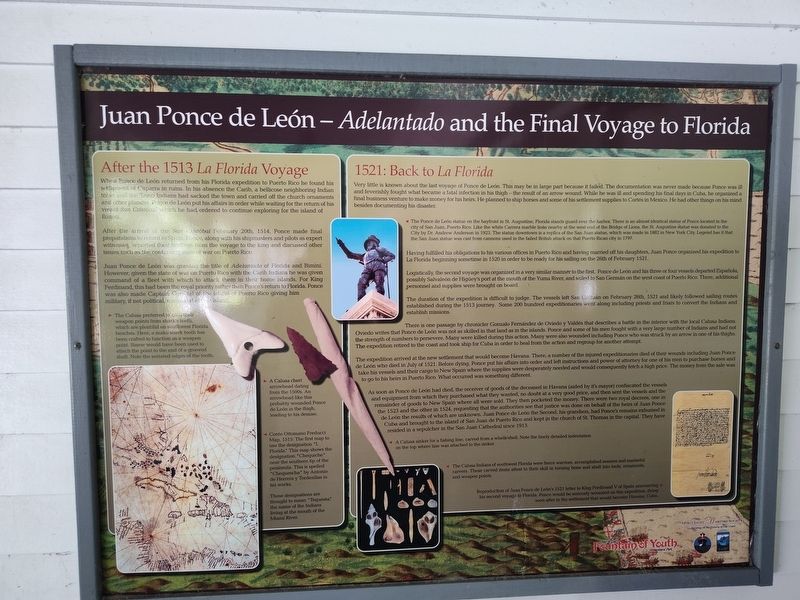
When Ponce de León returned from his Florida expedition to Puerto Rico he found his settlement of Caparra in ruins. In his absence the Carib, a bellicose neighboring Indian tribe, and the Taino Indians had sacked the town and carried off the church ornaments and other plunder. Ponce de León put his affairs in order while waiting for the return of his vessel San Cristóbal which he had ordered to continue exploring for the island of Bimini.
After the arrival of the San Cristóbal February 20th, 1514, Ponce made final preparations to return to Spain. Ponce, along with his shipmasters and pilots as expert witnesses, reported their findings from the voyage to the king and discussed other issues such as the continuing state of war on Puerto Rico.
Juan Ponce de León was granted the title of Adelantado of Florida and Bimini. However, given the state of war on Puerto Rico with the Carib Indians he was given command of a fleet with which to attack them in their home islands. For King Ferdinand, this had been the royal priority rather than Ponce's return to Florida. Ponce was also made Captain
this page online
1521: Back to La Florida
Very little is known about the last voyage of Ponce de León. This may be in large part because it failed. The documentation was never made because Ponce was il and feverishly fought what became a fatal infection in his thigh - the result of an arrow wound. While he was ill and spending his final days in Cuba, he organized a final business venture to make money for his heirs. He planned to ship horses and some of his settlement supplies to Cortés in Mexico. He had other things on his mind besides documenting his disaster.
Having fulfilled his obligations to his various offices in Puerto Rico and having married off his daughters, Juan Ponce organized his expedition to La Florida beginning sometime in 1520 in order to be ready for his sailing on the 26th of February 1521.
Logistically, the second voyage was organized in a very similar manner to the first. Ponce de León and his three or four vessels departed Española, possibly Salvaleón de Higüey's port at the mouth of the Yuma River, and sailed to San Germán
Photographed by Craig Doda, September 1, 2024
2. Juan Ponce de León - Adelantado and the Final Voyage to Florida Marker
The duration of the expedition is difficult to judge. The vessels left San Cemán on February 26th, 1521 and likely followed sailing routes established during the 1513 journey. Some 200 hundred expeditionaries went along including priests and friars to convert the Indians and establish missions.
There is one passage by chronicler Gonzalo Fernández de Oviedo y Valdés that describes a battle in the interior with the local Calusa Indians. Oviedo writes that Ponce de León was not as skilled in that land as in the islands. Ponce and some of his men fought with a very large number of Indians and had not the strength of numbers to persevere. Many were killed during this action. Many were also wounded including Ponce who was struck by an arrow in one of his thighs. The expedition retired to the coast and took ship for Cuba in order to heal from the action and regroup for another attempt.
The expedition arrived at the new settlement that would become Havana. There, a number of the injured expeditionaries died of their wounds including Juan Ponce de León who died in July of 1521. Before dying, Ponce put his affairs into order and left instructions and power of attorney for one of his men to purchase horses and take his vessels and their cargo to New Spain where the supplies were desperately needed and would consequently fetch a high price. The money from the sale was to go to his heirs in Puerto Rico. What occurred was something different.
As soon as Ponce de León had died, the receiver of goods of the deceased in Havana (aided by it's mayor) confiscated the vessels and equipment from which they purchased what they wanted, no doubt at a very good price, and then sent the vessels and the remainder of goods to New Spain where all were sold. They then pocketed the money. There were two royal decrees, one in the 1523 and the other in 1524, requesting that the authorities see that justice was done on behalf of the heirs of Juan Ponce de León the results of which are unknown. Juan Ponce de León the Second, his grandson, had Ponce's remains exhumed in Cuba and brought to the island of San Juan de Puerto Rico and kept in the church of St. Thomas in the capital. They have resided in a sepulcher in the San Juan Cathedral since 1913.
(Captions)
► The Calusa preferred to croitzear weapon points from shark's teeth, which are plentiful on southwest Florida beaches. Here, a mako shark tooth has been crafted to function as a weapon point. Sinew would have been used to attach the point to the end of a grooved shaft. Note the serrated edges of the tooth.
► A Calusa chert arrowhead dating from the 1500s. An arrowhead like this probably wounded Ponce de León in the thigh, leading to his demise.
► Conte Ottomano Freducci Map, 1515: The first map to use the designation "I. Florida." This map shows the designation "Chequiche" near the southern tip of the peninsula. This is spelled "Chequescha" by Antonio de Herrera y Tordesillas in his works.
These designations are thought to mean "Tequesta," the name of the Indians living at the mouth of the Miami River.
◄ The Ponce de León statue on the bayfront in St. Augustine, Florida stands guard over the harbor. There is an almost identical statue of Ponce located in the city of San Juan, Puerto Rico. Like the white Carrera marble lions nearby at the west end of the Bridge of Lions, the St. Augustine statue was donated to the City by Dr. Andrew Anderson in 1923. The statue downtown is a replica of the San Juan statue, which was made in 1882 in New York City. Legend has it that the San Juan statue was cast from cannons used in the failed British attack on that Puerto Rican city in 1797.
◄ A Calusa sinker for a fishing line, carved from a whelk shell. Note the finely detailed indentation on the top where line was attached to the sinker.
◄ The Calusa Indians of southwest Florida were fierce warriors, accomplished seamen and masterful carvers. These carved items attest to their skill in turning bone and shell into tools, ornaments, and weapon points.
► Reproduction of Juan Ponce de León's 1521 letter to King Ferdinand V of Spain announcing ▸ his second voyage to Florida. Ponce would be seriously wounded on this expedition, dying soon after in the settlement that would become Havana, Cuba .
Topics. This historical marker is listed in these topic lists: Anthropology & Archaeology • Colonial Era • Exploration • Indigenous Peoples and Communities • Waterways & Vessels. A significant historical date for this entry is February 20, 1514.
Location. 29° 53.103′ N, 81° 17.287′ W. Marker is in St. Augustine, Florida, in St. Johns County. It is in Anastasia. It can be reached from the intersection of Red Cox Drive and Ocean Vista Avenue, on the right when traveling south. Mounted on the back wall of the Visitors Center. Touch for map. Marker is at or near this postal address: 100 Red Cox Dr, Saint Augustine FL 32080, United States of America. Touch for directions.

Regionally, this marker is in First Coast and in Greater Jacksonville. It is also in the American South and on the Eastern Seaboard. Globally, it is in the North Atlantic Region, North America, a Gulf of Mexico state, the Western Hemisphere, the Western World, and the Anglosphere. Historically, it finds itself in what was once New Spain, the territory of the Mississippian Culture, one of the Confederate States of America, and the Antebellum South.
Other nearby markers. At least 8 other markers are within walking distance of this marker: Juan Ponce de León - The 1513 Voyage of Discovery (a few steps from this marker); Discover Four Authentic Experiences (a few steps from this marker); A Historical Comparison (a few steps from this marker); Historic Small Craft (a few steps from this marker); Maritime Hammock (a few steps from this marker); St. Augustine Dugout Canoe (a few steps from this marker); Discover... Four Authentic Experiences (a few steps from this marker); History of Dugout Canoes (a few steps from this marker). Touch for a list and map of all markers in St. Augustine.
Credits. This page was last revised on September 5, 2024. It was originally submitted on September 5, 2024, by Craig Doda of Napoleon, Ohio. This page has been viewed 376 times since then and 85 times this year. Photos: 1, 2. submitted on September 5, 2024, by Craig Doda of Napoleon, Ohio. • Bernard Fisher was the editor who published this page.
