Gambles Hill in Richmond, Virginia — The American South (Mid-Atlantic)
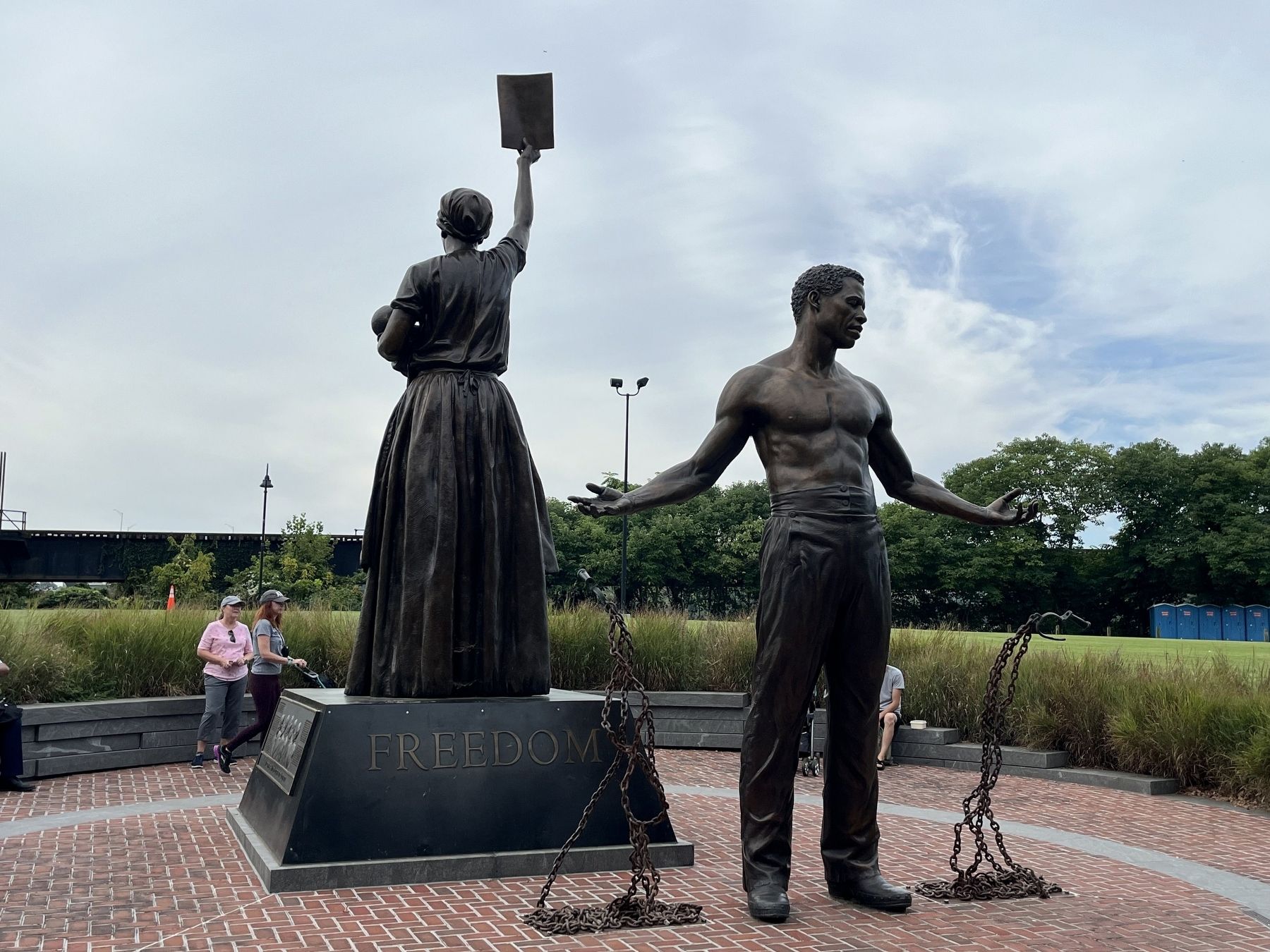
Freedom Monument
Photographed by Devry Becker Jones (CC0), September 7, 2024
1. Freedom Monument
Inscription.
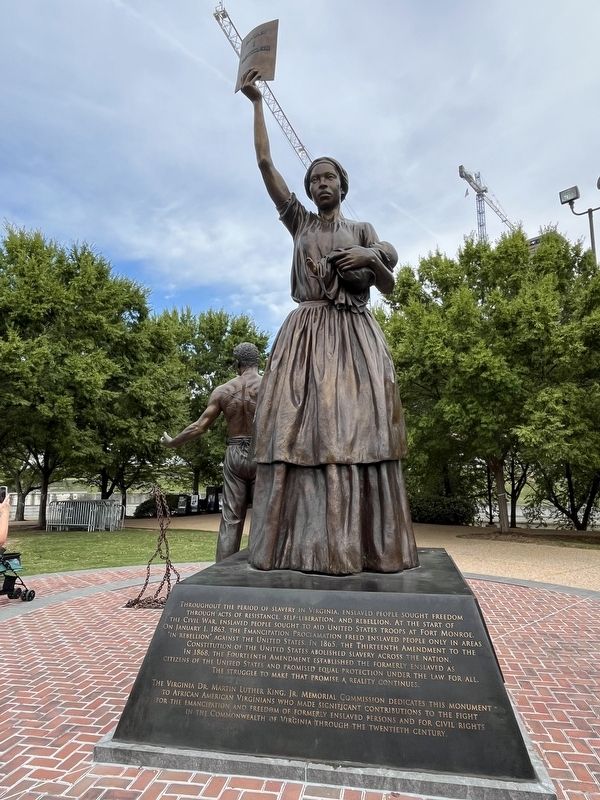
Throughout the period of slavery in Virginia, enslaved people sought freedom through acts of resistance, self-liberation, and rebellion. At the start of the Civil War, enslaved people sought to aid United States troops at Fort Monroe. On January 1, 1863, the Emancipation Proclamation freed enslaved people only in areas "in rebellion" against the United States. In 1865, the Thirteenth Amendment to the Constitution of the United States abolished slavery across the nation. In 1868, the Fourteenth Amendment established the formerly enslaved as citizens of the United States and promised equal protection under the law for all. The struggle to make that promise a reality continues.
The Virginia Dr. Martin Luther King, Jr. Memorial Commission dedicates this monument to African American Virginians who made significant contributions to the fight for the emancipation and freedom of formerly enslaved persons and for civil rights in the Commonwealth of Virginia through the twentieth century.
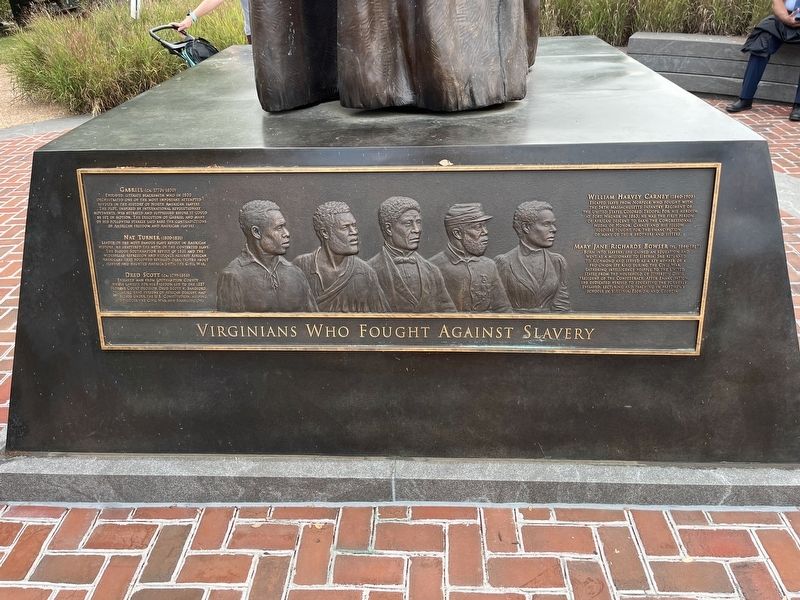
Virginians Who Fought Against Slavery
Gabriel (ca. 1770s-1800)
Enslaved, literate blacksmith who in 1800 orchestrated one of the most
Click or scan to see this page online
important attempted revolts in the history of North American slavery. The plot, inspired by international revolutionary movements, was betrayed and suppressed before it could be set in motion. The execution of Gabriel and many of his followers starkly laid bare the contradictions of American freedom and American slavery.
Nat Turner (1800 - 1831)
Leader of the most famous slave revolt in American history, he shattered the myth of the contented slave. The bloody Southampton Revolt of 1831 and the widespread repression and violence against African Americans that followed revealed dark truths about slavery and haunted America until the Civil War.
Dred Scott (ca. 1799 - 1858)
Enslaved man from Southampton County whose lawsuit for his freedom led to the 1857 Supreme Court decision Dred Scott v. Sanford, declaring that persons of African descent had no rights under the U.S. Constitution, helping to trigger the Civil War and Emancipation.
William Harvey Carney (1840 - 1908)
Escaped slave from Norfolk who fought with the 54th Massachusetts Infantry Regiment of the United States Colored Troops. For his heroism at Fort Wagner in 1863,
Photographed by Devry Becker Jones (CC0), September 7, 2024
2. Freedom Monument
he was the first person of African descent to earn the Congressional Medal of Honor. Carney and his fellow soldiers fought for the emancipation of many of their brothers and sisters.
Mary Jane Richards (Fl. 1846 - 1867)
Born into slavery, she gained an education and went as a missionary to Liberia. She returned to Richmond and served as a key member of a pro-Union spy ring during the Civil War, gathering intelligence helpful to the United States from the household of Jefferson Davis, president of the Confederacy. After Emancipation, she dedicated herself to educating the formerly enslaved, lecturing and teaching in freedmen's schools in Virginia, Florida, and Georgia.
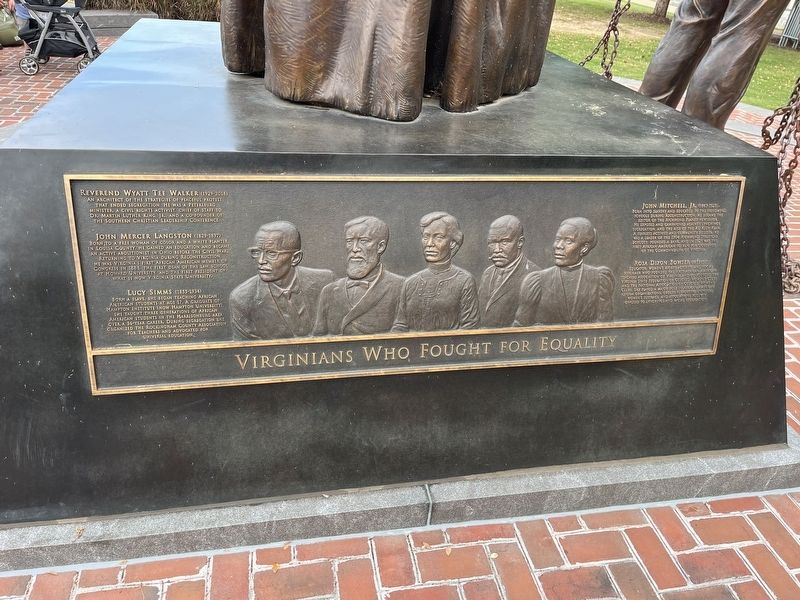
Virginians Who Fought For Equality
Reverend Wyatt Tee Walker (1929 - 2018)
An architect of the strategies of peaceful protest that ended segregation. He was a Petersburg minister, a civil rights activist, chief of staff to Dr. Martin Luther King, Jr., and a co-founder of the Southern Christian Leadership Conference.
John Mercer Langston (1829 - 1897)
Born to a free woman of color and a white planter in Louisa County, he gained an education and became an
Photographed by Devry Becker Jones (CC0), September 7, 2024
3. Freedom Monument
active abolitionist in Ohio before the Civil War. Returning to Virginia during Reconstruction, he was Virginia's first African American member of Congress in 1888, the first dean of the law school at Howard University, and the first president of what is now Virginia State University.
Lucy Simms (1855 - 1954)
Born a slave, she began teaching African American students at age 17. A graduate of Hampton Institute (now Hampton University), she taught three generations of African American students in the Harrisonburg area over a 56-year career. During segregation she organized the Rockingham County Association for Teachers and advocated for universal education.
John Mitchell, Jr. (1863 - 1929)
Born into slavery and educated in the freedmen's schools during Reconstruction, he became the editor of the Richmond Planet newspaper. He exposed and campaigned against lynchings, segregation, and the rise of the Ku Klux Klan. A fearless activist and community builder, he was a leader of the 1904 Richmond Streetcar Boycott, founded a bank, and in 1921 was the first African American to run for Governor of the Commonwealth of Virginia.
Rosa Dixon Bowser
Photographed by Devry Becker Jones (CC0), September 7, 2024
4. Freedom Monument
(1855 - 1931)
Educator, women's rights activist, and social reformer who founded the first African American teachers association of Virginia and co-founded the Virginia State Federation of Colored Women's Clubs and the National Association of Colored Women's Clubs. She played a major role in African American reform organizations, groups supporting universal women's suffrage, and associations publicly opposed to lynchings and racial segregation.
Erected 2021 by The Virginia Dr. Martin Luther King, Jr. Memorial Commission.
Location. 37° 32.077′ N, 77° 26.594′ W. Marker is in Richmond, Virginia. It is in Gambles Hill. It can be reached from the intersection of Canal Walk and 5th Street Footbridge, on the left when traveling west. Touch for map. Marker is at or near this postal address: 1 A Browns Island, Richmond VA 23219, United States of America. Touch for directions.
Regionally, this marker and monument is in Central Virginia. It is also in the American South and specifically in the Upper South. Globally, it is in North America, the Western Hemisphere, the Western World, and the Anglosphere. Historically, it finds itself in what was once the territory of the Mississippian Culture, one of the original Thirteen Colonies, one of the Confederate States of America, and the Antebellum South.
Credits. This page was last revised on September 8, 2024. It was originally submitted on September 8, 2024, by Devry Becker Jones of Washington, District of Columbia. This page has been viewed 307 times since then and 66 times this year. Photos:1, 2, 3, 4. submitted on September 8, 2024, by Devry Becker Jones of Washington, District of Columbia.