Near Core in Monongalia County, West Virginia — The American South (Appalachia)
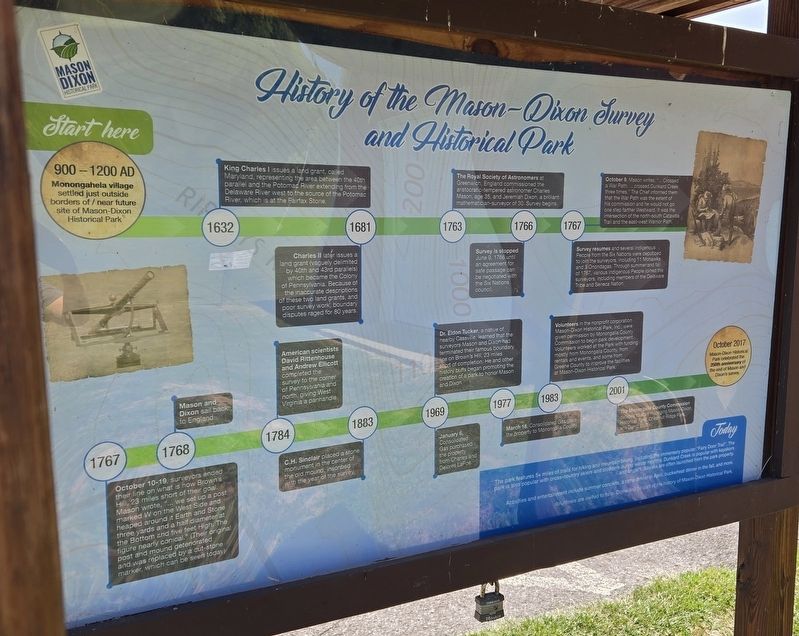
History of the Mason-Dixon Survey and Historical Park
Photographed by Bradley Owen, August 23, 2024
1. History of the Mason-Dixon Survey and Historical Park Marker
Start here
900 - 1200 AD
Monongahela village settled just outside borders of / near future site of Mason-Dixon Historical Park
1632
King Charles I issues a land grant, called Maryland, representing the area between the 40th parallel and the Potomac River extending from the Delaware River west to the source of the Potomac River, which is at the Fairfax Stone.
1681
Charles II later issues a land grant (vaguely delimited by 40th and 43rd parallels) which became the Colony of Pennsylvania. Because of the inaccurate descriptions of these two land grants, and poor survey work, boundary disputes raged for 80 years.
1763
The Royal Society of Astronomers at Greenwich, England commissioned the aristocratic-tempered astronomer Charles Mason, age 35, and Jeremiah Dixon, a brilliant mathematician-surveyor of 30. Survey begins.
1766
Survey is stopped June 9, 1766 until an agreement for safe passage can be negotiated with the Six Nations council.
1767
Survey resumes and several Indigenous People from the Six Nations were deputized to join the surveyors, including 11 Mohawks and 3 Onondagas. Through summer and
this page online
October 9, Mason writes, "... Crossed a War Path.... crossed Dunkard Creek three times." The Chief informed them that the War Path was the extent of his commission and he would not go one step farther Westward. It was the intersection of the north-south Catawba Trail and the east-west Warrior Path.
October 10-19, surveyors ended their line on what is now Brown's Hill, 23 miles short of their goal. Mason wrote, "... we set up a post marked W on the West Side and heaped around it Earth and Stone three yards and a half diameter at the Bottom and five feet High. The figure nearly conical." (Their original post and mound deteriorated and was replaced by a cut-stone marker, which can be seen today)
1768
Mason and Dixon sail back to England.
1784
American scientists David Rittenhouse and Andrew Ellicott completed the survey to the corner of Pennsylvania and north, giving West Virginia a panhandle.
1883
C.H. Sinclair placed a stone monument in the center of the old mound, inscribed with the year of the
Photographed by Bradley Owen, August 23, 2024
2. History of the Mason-Dixon Survey and Historical Park Marker
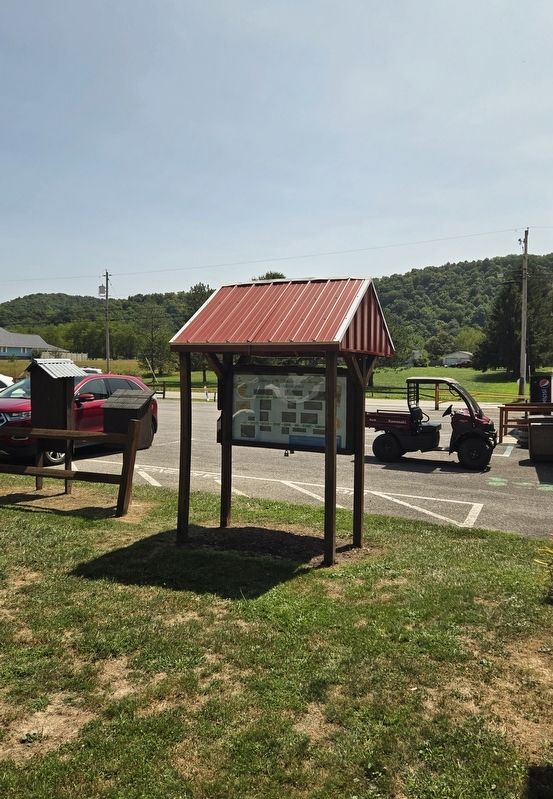
1969
January 6, Consolidated Gas purchased the property from Charles and Delores LaPoe.
Dr. Eldon Tucker, a native of nearby Cassville, learned that the surveyors Mason and Dixon had terminated their famous boundary line on Brown's Hill, 23 miles short of completion. He and other history buffs began promoting the creation of a park to honor Mason and Dixon.
1977
March 18, Consolidated Gas gave the property to Monongalia County.
1983
Volunteers in the nonprofit corporation Mason-Dixon Historical Park, Inc., were given permission by Monongalia County Commission to begin park development. Volunteers worked at the Park with funding mostly from Monongalia County, from rentals and events, and some from Greene County to improve the facilities at Mason-Dixon Historical Park.
2001
The Monongalia County Commission decided to start managing Mason-Dixon Historical Park, Chestnut Ridge Park, and Camp Muffly.
October 2017
Mason-Dixon Historical Park celebrated the 250th anniversary of the end of Mason and Dixon's survey.
Today
The park features 5+ miles of trails for hiking and mountain biking, including the immensely popular "Fairy Door Trail". The park is also popular with cross-country skiers and sledders during winter months. Dunkard Creek is popular with kayakers and anglers. Kayaks are often launched from the park property.
Activities and entertainment include summer concerts, a ramp dinner in April, buckwheat dinner in the fall, and more.
Volunteers are invited to help. Come and be part of the history of Mason-Dixon Historical Park.
Erected by Mason Dixon Historical Park.
Topics. This historical marker is listed in these topic lists: Colonial Era • Indigenous Peoples and Communities • Parks & Recreational Areas • Science & Medicine. A significant historical date for this entry is June 9, 1766.
Location. 39° 42.819′ N, 80° 6.87′ W. Marker is near Core, West Virginia, in Monongalia County. It is on Buckeye Road (County Route 39) east of Mason Dixon Highway (West Virginia Route 7), on the left when traveling east. Marker is located in Mason-Dixon Historical Park. Touch for map. Marker is at or near this postal address: 79 Buckeye Road, Maidsville WV 26541, United States of America. Touch for directions.

Regionally, this marker is in North Central West Virginia. It is also in the American South, specifically in the Upper South, in Appalachia, and specifically in Northern Appalachia. Globally, it is in North America, the Western Hemisphere, the Western World, and the Anglosphere. Historically, it finds itself in what was once the territory of the Mississippian Culture.
Other nearby markers. At least 8 other markers are within 3 miles of this marker, measured as the crow flies: Walking in the Footsteps of History (a few steps from this marker); Shanks Mill (within shouting distance of this marker); Aerial View - Dunkard Creek, Mason-Dixon Historical Park, and Monongahela Village Site (about 500 feet away); Border Heroine (approx. 0.2 miles away); a different marker also named Catawba War Path (approx. half a mile away); Price Memorial Cemetery (approx. 0.9 miles away); a different marker also named Statler's Fort (approx. 1.2 miles away); Veterans Memorial (approx. 2.2 miles away). Touch for a list and map of all markers in Core.
Other markers no longer nearby. Catawba War Path (was about 400 feet away, measured in a direct line but has been confirmed missing); Statler's Fort (was approx. 1.2 miles away but has been permanently removed).
Credits. This page was last revised on September 14, 2024. It was originally submitted on September 14, 2024, by Bradley Owen of Morgantown, West Virginia. This page has been viewed 760 times since then and 63 times this year. Photos: 1, 2. submitted on September 14, 2024, by Bradley Owen of Morgantown, West Virginia.
