Heart of Chicago in Cook County, Illinois — The American Midwest (Great Lakes)
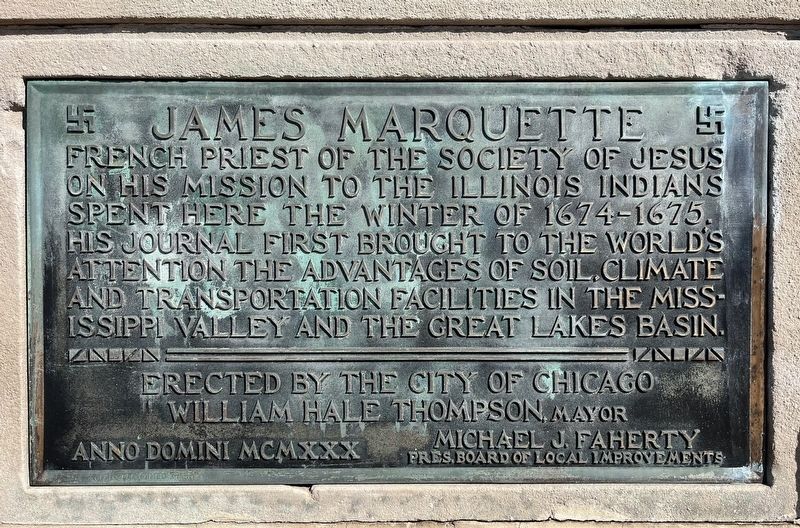
James Marquette
Photographed by Sean P. Flynn, October 20, 2024
1. James Marquette Marker
William Hale Thompson, Mayor
Michael J. Faherty, Pres. Board of Local Improvements
Erected 1930 by City of Chicago.
Topics. This historical marker is listed in these topic lists: Agriculture • Exploration • Indigenous Peoples and Communities • Religion & Religious Structures. A significant historical month for this entry is December 1674.
Location. 41° 50.639′ N, 87° 40.531′ W. Marker is in Chicago, Illinois, in Cook County. It is in Heart of Chicago. It is on Damen Avenue half a mile north of Stevenson Expressway (Interstate 55), on the right when traveling north. Touch for map. Marker is at or near this postal address: 2627 South Damen Avenue, Chicago IL 60608, United States of America. Touch for directions.

Regionally, this marker is on Chicago’s West Side. It is also in the American Midwest. Globally,
this page online
Other nearby markers. At least 8 other markers are within walking distance of this marker: Canal Origins Park (approx. half a mile away); Florian S. Jacolik Park (approx. ¾ mile away); Julian Carrillo (approx. 0.8 miles away); Alvaro Obregon (approx. 0.8 miles away); Venustiano Carranza (approx. 0.8 miles away); Francisco I Madero (approx. 0.8 miles away); The Ray Castro Plaza (approx. 0.8 miles away); Jose Maria Pino Suarez (approx. 0.8 miles away). Touch for a list and map of all markers in Chicago.
Another marker is no longer nearby. Marquette and Jolliet Memorial (was about 600 feet away, measured in a direct line but has been permanently removed).
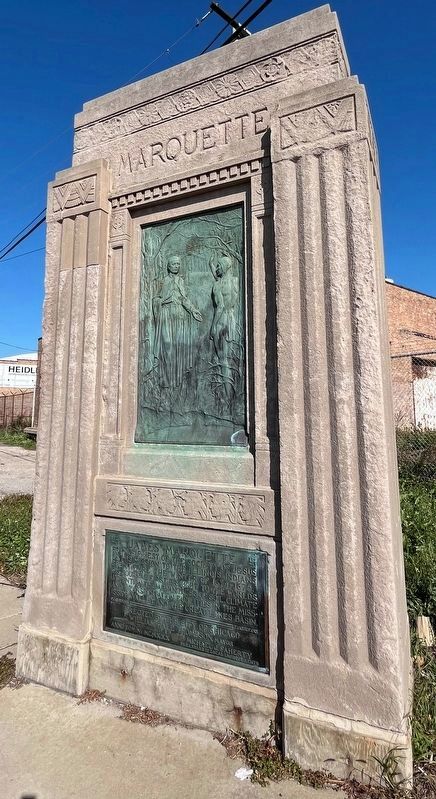
More about this marker. This memorial to Jesuit priest and 17th century explorer Father Jacques Marquette — for unknown reasons his name is anglicized on this memorial — was incorporated on the north
Photographed by Sean P. Flynn, October 20, 2024
2. The Marquette Memorial
The bronze plaque with the text is at the bottom of the roughly 15-foot-tall memorial; the top portion features a bronze relief that depicts Father Jacques Marquette meeting with a member of the Illinois tribe. The plaque includes swastikas in each of the upper corners; see link 3 below for an examination of the pre-Nazi use of swastikas as decorative features in Chicago architecture and public art.
Almost 5,000 people attended the unveiling of this memorial on October 12, 1930, according to the next day's Chicago Tribune. The ceremony included speeches by numerous Catholic dignitaries, including the president of St. Ignatius High School, a south-side Jesuit institution that was also the site of the founding of Loyola University of Chicago. Only three years earlier, Damen Avenue had been renamed after Father Arnold Damen, the founder of St. Ignatius; the road had originally been named after Chicago politician James Robey.
This area has been home to several now-gone memorials to Marquette and his exploration partner, fur trader Louis Jolliet, including several that were erected after 1900. In the early 1900s, a large wooden cross with a large historical plaque describing the site was dedicated to Marquette and Jolliet near where Damen Avenue (previously Robey Street) met the river. When that cross was removed by vandals, another cross was placed at the site around 1915; pictures from that era show that another smaller cross was located immediately next to this large one. The crosses would be removed

Photographed by Sean P. Flynn, October 20, 2024
3. James Marquette Marker
The marker is on the north side of the Damen Avenue bridge over the Chicago River, near the Banner Foods warehouse.
A few prominent names are etched into the bottom of the bronze relief. First is Ossian Guthrie, cited as "historian," who died at age 82 more than 20 years before this memorial was erected. Guthrie was the grandson of Dr. Samuel Guthrie, a scientist credited with discovering the anesthetic chloroform. Ossian Guthrie was a prominent Chicagoan in his own right, a geologist and a key figure in helping drain Chicago—and particularly this swampy area south of downtown—for development. He was also an amateur historian who, in addition to this memorial, played a role in the erection of the Marquette memorial still in existence in the suburb of Summit, about 15 miles west of here, honoring the spot where Marquette camped in March 1675 after leaving Chicago en route to connecting with the Illinois. Guthrie is also responsible for the "Guthrie Boulder," a giant rock dedicated to his grandfather

Photographed by Sean P. Flynn, October 20, 2024
4. Marquette Memorial
The monument's relief depicts Marquette and an Illinois Indian. Etched at the bottom are Ossian Guthrie, historian; E.P. Seidel, who molded the relief; and Thomas O'Shaugnessy, whose sketch was used in the design.
Next are the words, "Etched by E.P. Seidel." Emory P. Seidel was a prize-winning sculptor who lived in suburban Oak Park and was also responsible for sculptures on a different Damen Avenue bridge and over the North Branch of the Chicago River, as well as the 1931 Memorial Bridge and its accompanying sculptures in far west suburban Aurora.
Lastly, the etching says that Seidel's work was based on a sketch by Thomas A. O'Shaughnessy. O'Shaughnessy was an artist best known for the stained-glass windows inside Old St. Patrick's Church, on the west side of Chicago, installed between 1912 and 1922 and inspired by Ireland's Book of Kells.
The Chicago Monuments Project, a city-run program that looked at Chicago's public art through the context of issues like racism, recommended in its 2022 final report that the memorial be removed from Damen Avenue and placed in storage, largely, it said, because of its location. However, as of October 2024 this memorial remains in roughly the same spot it has held on Damen Avenue for the previous 94 years.
See the commentary below for a look at the sometimes-complicated legacy of memorials to Marquette and Jolliet.
Regarding James Marquette. "Père" Jacques Marquette, the Jesuit priest and explorer, made two visits to the Chicago area. The first, in 1673, came at the end of his famed voyage with fur trader Louis Jolliet, when they were the first white settlers to connect the Great Lakes basin and Mississippi River. Beginning at Marquette's mission at St. Ignace on the Upper Peninsula of Michigan, their seven-person team rode two birch-bark canoes along Lake Michigan's northern and western shore to what is now Green Bay, Wisconsin. They continued west, reaching the Wisconsin

Chicago Daily News Collection, Chicago History Museum, 1915
5. 1915 memorial to Marquette and Jolliet
This cross in honor of Fr. Jacques Marqeutte and fur trader Louis Jolliet, who came to this spot in 1673, was one of several that have been erected in honor of the two explorers over the past 100+ years. It replaced a 1907 memorial whose cross had been removed by vandals.
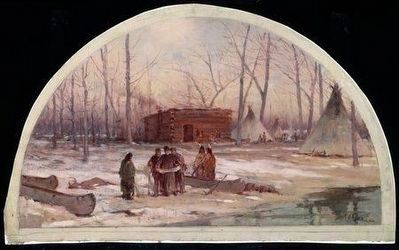
About a year and a half later, in late 1674, Father Marquette returned to the Chicago area during another trip to establish a mission among a Native American tribe called the Kaskaskia. After being slowed by poor weather while traveling south from Green Bay, Marquette and his entourage reached the Chicago River and then decided to spend
Painting by Lawrence C. Earle; Courtesy of Chicago History Museum (ICHi-062501), circa 1900
6. "The Winter Quarters of Father Marquette, 1674"
A 1900 painting by Lawrence C. Earle depicts Marquette's 1674-75 winter camp, which was located roughly where the modern Damen Avenue meets the Chicago River.
A few weeks later, Marquette and his party connected with the Kaskaskia and established the mission with them; Father Marquette preached an Easter mass at their settlement, close to where Starved Rock State Park is located today. However, by that point Marquette had fallen very ill, likely due to dysentery he had picked up during his journey with Jolliet two years earlier. Marquette was sent back to his mission and died en route, near present-day Ludington, Michigan, whose river would later bear Marquette's name.
Related markers. Click here for a list of markers that are related to this marker. Chicagoland memorials to Fr. Jacques Marquette
Also see . . .
1. WTTW-TV Chicago (Channel 11): Marquette Cross. From WTTW-TV (Channel 11), a look at the predecessor memorials to Fr. Jacques Marquette and his fellow explorer Louis Jolliet, who visited this area between 1673 and 1675. (Submitted on October 21, 2024, by Sean P. Flynn of Oak Park, Illinois.)
2. ABC 7 Chicago: Swastikas on public buildings, homes in Chicago. A look at the history and use of swastikas on architecture and public art in Chicago. (Submitted on October 21, 2024, by Sean P. Flynn of Oak Park, Illinois.)
3. Marquette Memorials. Starting on page 291, the April 1931 edition of the Mid-America journal, a publication by the Illinois Catholic Historical Society, offers an extensive history of Marquette memorials in the Midwest, including this memorial on Damen Avenue in Chicago.
Excerpt from page 298: "In October, 1930, an imposing monument of granite and stone was dedicated to commemorate Father Marquette's historic wintering on the site of Chicago. The monument marks one of the most sacred acres of the earth, where a frail missionary in fulfilling a pledge given to the Indians, labored to conquer a wilderness and by his writings, to build a nation. The memorial stands on the northern approach of the magnificent new bridge spanning the west fork of the south branch of the Chicago river at Damen Avenue."(Submitted on February 3, 2025, by Sean P. Flynn of Oak Park, Illinois.)
4. Marquette and Jolliet's Excellent Adventure.
Excerpt: "In 1673, a Jesuit missionary, a fur trader, and a small group of canoe men traveled 2000 miles from what is now upper Michigan down to Arkansas and back."(Submitted on October 21, 2024, by Sean P. Flynn of Oak Park, Illinois.)
Additional commentary.
1. The Complicated Legacy of Memorials to Fr. Jacques Marquette
Fr. Jacques Marquette and his exploration partner, the fur trader Louis Jolliet, have been honored with many plaques, statues and memorials (not to mention the city of Joliet, southwest of Chicago) since they visited the area more than 350 years ago. Many were erected in the late 1800s and early 1900s, during a period when Chicago grew into one of America’s largest cities for many of the same reasons that are why Marquette and Jolliet ended up here in the first place — the central location and access to waterways being two in particular.
However, the legacy of these memorials — much like that of other memorials linked to the Native Americans who inhabited this area prior to white settlement — is in some ways as complicated as that of the explorers themselves. And it is reflected in how Marquette and Jolliet memorials have been received and perceived in recent years. Some have been called out for simply ignoring the fact that Marquette and Jolliet were far from the first humans to live in this area; others have been targeted for removal for racist depictions of Native Americans.
For example, the Marquette Building in Chicago's Loop, listed on the National Register of Historic Places, features four bas reliefs over its main entrance depicting Fr. Marquette’s second visit to Chicago and his death; the building's lobby features an ornate mosaic depicting the Marquette-Jolliet voyage of 1673. As a counterbalance to this heroic depiction of these white explorers, the building has erected a permanent exhibit with a thorough history of Native Americans in Chicago — just steps from the lobby, near the building's Chicago Landmark.
Meanwhile, the Chicago Monuments Project, a city-run examination of Chicago's public art with an eye towards issues such as racism, flagged four different memorials related to Fr. Marquette in its final report, released in 2022. Three of those four — including this one on Damen Avenue — were recommended for removal and placement into storage. One is a a massive 1926 sculpture of Marquette and Jolliet with a Native American accompanying them, located about a mile due west of Damen Avenue in Marshall Square. The sculpture, called out for its depiction of the submissive Native American, is still standing as of March 2025. The second memorial is affixed to the DuSable (Michigan Avenue) Bridge over the Chicago River. There, a plaque in honor of Jolliet and Marquette, describing them as the "first white men to pass through the Chicago River," was recommended for removal for its white supremacy theme, but it is also still on display.
The third is this marker on Damen Avenue. While the report did not directly criticize its depiction of Native Americans (nor, for that matter, its use of swastikas), it did recommend that it be removed from Damen Avenue and placed in storage. The group wrote that "[s]ignificant changes to the site have affected the integrity of the monument showing an encounter between Pere Marquette and an American Indian. The artwork has been separated from the bridge structure it was once incorporated into and now stands adrift on an industrial stretch of South Damen Avenue." However, as of October 2024 this memorial remains in roughly the same spot it has held on Damen Avenue for the previous 94 years.
— Submitted March 26, 2025, by Sean P. Flynn of Oak Park, Illinois.
Credits. This page was last revised on October 14, 2026. It was originally submitted on October 21, 2024, by Sean P. Flynn of Oak Park, Illinois. This page has been viewed 3,190 times since then and 405 times this year. It was the Marker of the Week March 30, 2025. Photos: 1, 2, 3, 4, 5. submitted on October 21, 2024, by Sean P. Flynn of Oak Park, Illinois. 6. submitted on October 17, 2024, by Sean P. Flynn of Oak Park, Illinois.
