Poncha Springs in Chaffee County, Colorado — The American Mountains (Southwest)
The Roof of the Rockies
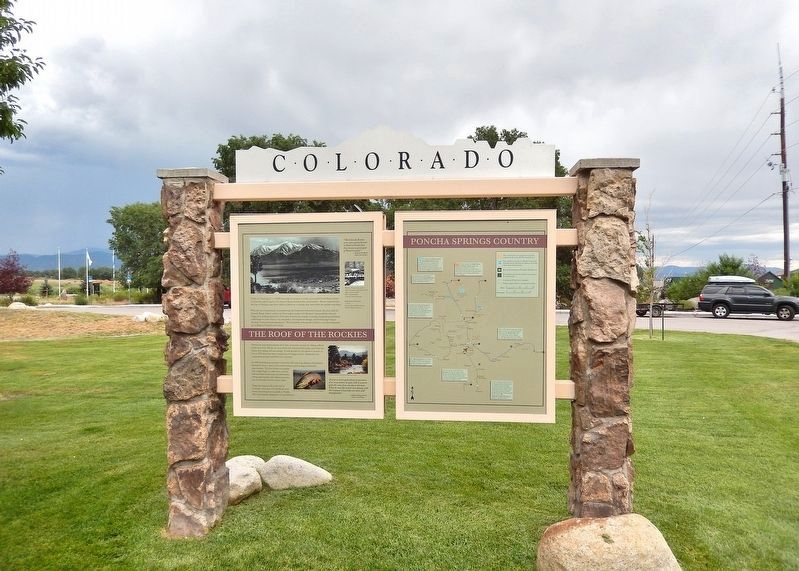
Photographed by Cosmos Mariner, July 22, 2025
1. The Roof of the Rockies Marker
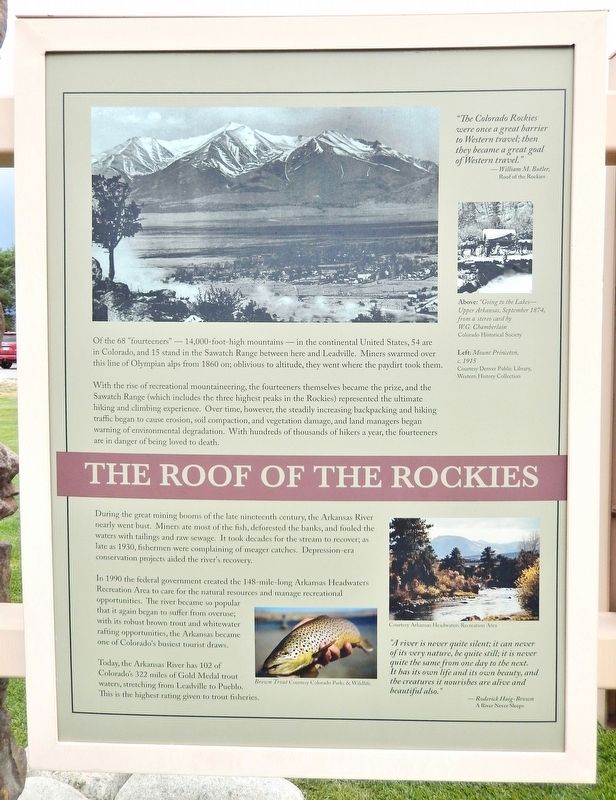
“The Colorado Rockies were once a great barrier to Western travel; then they became a great goal of Western travel.”
— William M. Butler,
Roof of the Rockies
Of the 68 "fourteeners" — 14,000-foot-high mountains — in the continental United States, 54 are in Colorado, and 15 stand in the Sawatch Range between here and Leadville. Miners swarmed over this line of Olympian alps from 1860 on; oblivious to altitude, they went where the paydirt took them.
With the rise of recreational mountaineering, the fourteeners themselves became the prize, and the Sawatch Range (which includes the three highest peaks in the Rockies) represented the ultimate hiking and climbing experience. Over time, however, the steadily increasing backpacking and hiking traffic began to cause erosion, soil compaction, and vegetation damage, and land managers began warning of environmental degradation. With hundreds of thousands of hikers a year, the fourteeners are in danger of being loved to death.
During the great mining booms of the late nineteenth century, the Arkansas River nearly went bust. Miners ate most of the fish, deforested the banks, and fouled
this page online
In 1990 the federal government created the 148-mile-long Arkansas Headwaters Recreation Area to care for the natural resources and manage recreational opportunities. The river became so popular that it again began to suffer from overuse; with its robust brown trout and whitewater rafting opportunities, the Arkansas became one of Colorado's busiest tourist draws.
Today, the Arkansas River has 102 of Colorado's 322 miles of Gold Medal trout waters, stretching from Leadville to Pueblo. This is the highest rating given to trout fisheries.
“A river is never quite silent; it can never of its very nature, be quite still; it is never quite the same from one day to the next. It has its own life and its own beauty, and the creatures it nourishes are alive and beautiful also.”
— Roderick Haig-Brown,
A River Never Sleeps
[photo caption] Brown Trout Courtesy Colorado Parks & Wildlife
• Arkansas Headwaters Recreation Area
Erected by The
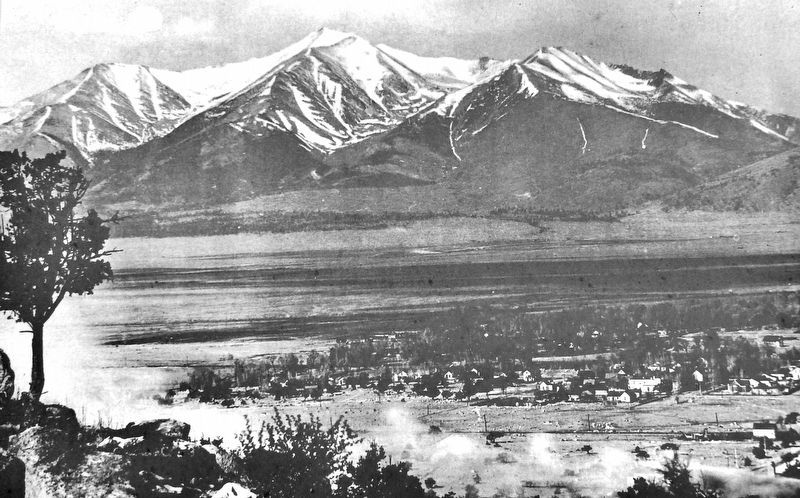
Denver Public Library, Western History Collection
2. Marker detail: Mount Princeton, c. 1915
Topics. This historical marker is listed in these topic lists: Environment • Natural Features • Parks & Recreational Areas • Waterways & Vessels.
Location. 38° 31.284′ N, 106° 4.853′ W. Marker is in Poncha Springs, Colorado, in Chaffee County. It can be reached from U.S. 285 just north of U.S. 50, on the right when traveling south. The marker is located at the Poncha Springs Crossroads Welcome Center. Touch for map. Marker is at or near this postal address: 7001 US Highway 285, Poncha Springs CO 81242, United States of America. Touch for directions.

Regionally, this marker is in the Arkansas River Valley, in the Colorado High Rockies and on the Continental Divide. It is also in the American Mountain West. Globally, it is in North America, the Rocky Mountains, the Western Hemisphere, the Western World, and the Anglosphere.
Other nearby markers. At least 8 other markers are within 4 miles of this marker, measured as the crow flies: Poncha Springs Country (here, next to this marker); Cities in the Wilderness (here, next to this marker);
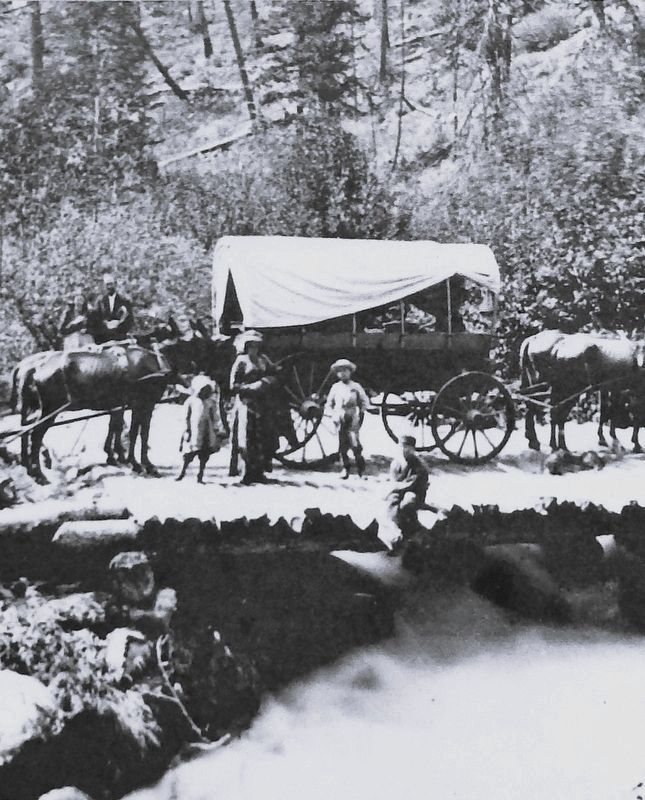
Colorado Historical Society
3. Marker detail: “Going to the Lakes — Upper Arkansas River”, September 1874
From a stereo card by W. Chamberlain.
Also see . . .
1. Mining in the West (Library of Congress).
Excerpt: Mineral rushes transformed the American West, stimulating large-scale migration, demands for transportation, and creating new economies and societies in the process. Once word spread back East of the discovery of gold in California, tens of thousands of men began streaming west. The first miners found gold nuggets in the rivers and simply washed the dirt through pans or boxes, leaving the gold in the bottom. Soon they exhausted all such easily obtainable gold and more difficult shaft mining began, requiring more labor, technical knowledge, and capital.(Submitted on August 9, 2025, by Cosmos Mariner of Cape Canaveral, Florida.)Many other rushes followed the California gold rush — in the 1850s in Nevada and Colorado, in the 1860s in Wyoming and Montana,
and in the Black Hills of South Dakota in the 1870s. The miners who swarmed to find riches demanded services. As a result, mining towns quickly sprouted, and often just as quickly disappeared once the mines played out. Some mining supply centers, notably Denver, Colorado, and Sacramento, California, managed to survive and grow into viable towns.Photographed by Cosmos Mariner, July 22, 20254. Poncha Springs Crossroads Interpretive KioskThis marker is the leftmost of 2 interpretive panels on the west side of the kiosk.
2. Arkansas Headwaters Recreation Area (Colorado Parks & Wildlife).
Excerpt: A 152-mile stretch of the Arkansas River makes up the Arkansas Headwaters Recreation Area (AHRA). The AHRA is recognized as one of the nation's most popular whitewater rafting and kayaking locations. AHRA visitors enjoy camping, hiking, picnicking, wildlife watching, mountain biking, rock climbing and even gold panning along the river’s shores, deep canyons, broad valleys and towering mountain peaks found within the upper Arkansas River Valley.(Submitted on August 9, 2025, by Cosmos Mariner of Cape Canaveral, Florida.)
Credits. This page was last revised on August 9, 2025. It was originally submitted on August 9, 2025, by Cosmos Mariner of Cape Canaveral, Florida. This page has been viewed 110 times since then and 33 times this year. Photos: 1, 2, 3, 4. submitted on August 9, 2025, by Cosmos Mariner of Cape Canaveral, Florida.
