Niagara-on-the-Lake in Niagara Region, Ontario — Central Canada (North America)
The Solomon Moseby Affair 1837
L'Affaire Solomon Moseby, 1837
Photographed by Kevin Westell, August 31, 2025
1. The Solomon Moseby Affair 1837 - Marker

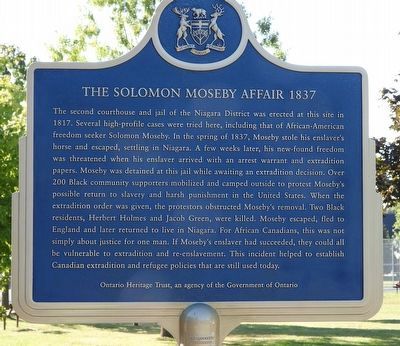
The Solomon Moseby Affair 1837
The second courthouse and jail of the Niagara District was erected at this site in 1817. Several high-profile cases were tried here, including that of African-American freedom seeker Solomon Moseby. In the spring of 1837, Moseby stole his enslaver's horse and escaped, settling in Niagara. A few weeks later, his new-found freedom was threatened when his enslaver arrived with an arrest warrant and extradition papers. Moseby was detained at this jail while awaiting an extradition decision. Over 200 Black community supporters mobilized and camped outside to protest Moseby's possible return to slavery and harsh punishment in the United States. When the extradition order was given, the protestors obstructed Moseby's removal. Two Black residents, Herbert Holmes and Jacob Green, were killed. Moseby escaped, fled to England and later returned to live in Niagara. For African Canadians, this was not simply about justice for one man. If Moseby's enslaver had succeeded, they could all be vulnerable to extradition and re-enslavement. This incident helped to establish Canadian extradition
this page online
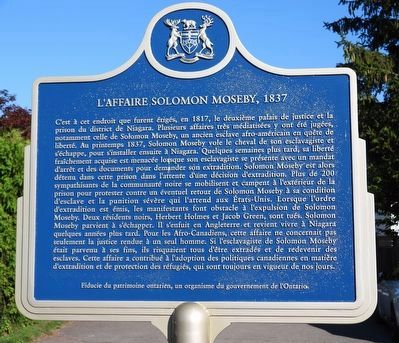
L'Affaire Solomon Moseby, 1837
C'est à cet endroit que furent érigés, en 1817, le deuxième palais de justice et la prison du district de Niagara. Plusieurs affaires très médiatisées y ont été jugées, notamment celle de Solomon Moseby, un ancien esclave afro-américain en quête de liberté. Au printemps 1837, Solomon Moseby vole le cheval de son esclavagiste et s'échappe, pour s'installer ensuite à Niagara. Quelques semaines plus tard, sa liberté fraîchement acquise est menacée lorsque son esclavagiste se présente avec un mandat d'arrêt et des documents pour demander son extradition. Solomon Moseby est alors détenu dans cette prison dans l'attente d'une décision d'extradition. Plus de 200 sympathisants de la communauté noire se mobilisent et campent à l'extérieur de la prison pour protester contre un éventuel retour de Solomon Moseby à sa condition d'esclave et la punition sévère qui l'attend aux États-Unis. Lorsque l'ordre d'extradition est émis, les manifestants font obstacle à l'expulsion de Solomon Moseby. Deux résidents noirs, Herbert Holmes et Jacob Green,
Photographed by Kevin Westell, August 31, 2025
2. The Solomon Moseby Affair 1837 - Marker reverse - French inscription
Erected 2023 by Ontario Heritage Trust.
Topics and series. This historical marker is listed in these topic lists: Abolition & Underground RR • African Americans • Civil Rights • Immigration. In addition, it is included in the Canada, Ontario Heritage Trust series list. A significant historical year for this entry is 1837.
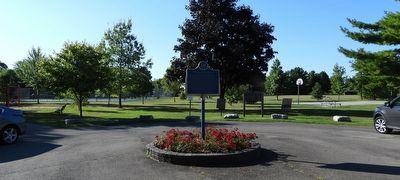
Location. 43° 14.586′ N, 79° 4.874′ W. Marker is in Niagara-on-the-Lake, Ontario, in Niagara Region. It can be reached from the intersection of Rye Street and Cottage Street, on the right when traveling north. The marker is at the centre of a round traffic island, within a dropoff
Photographed by Kevin Westell, August 31, 2025
3. The Solomon Moseby Affair 1837 - Marker in context
Photo faces south into Rye Heritage Park from the dropoff circle.

Regionally, this marker is on Ontario’s Golden Horseshoe and in Niagara Canada. It is also in Central Canada. Globally, it is in North America, on the Great Lakes, in the Western Hemisphere, in the Western World, and in the Anglosphere. Historically, it finds itself in what was once a British colony, the Viceroyalty of New France, the Haudenosaunee (Iroquois) Confederacy, and Rupert’s Land.
Other nearby markers. At least 8 other markers are within walking distance of this marker: Our Western Home - British Home Children (a few steps from this marker); The Cappon-Cash House 1840 (about 210 meters away, measured in a direct line); Upper Canada Heritage Trail (approx. 0.4 kilometers away); a different marker also named Upper Canada Heritage Trail (approx. 0.4 kilometers away); Our Carolinian Forest Zone (approx. 0.4 kilometers away); Rare and Interesting Animals in Niagara-on-the-Lake (approx. half a kilometer away); History of the Heritage Trail: Escarpment and Railroad (approx. 0.6 kilometers away); a different marker also named Upper Canada Heritage Trail (approx. 0.6 kilometers away). Touch for a list and map of all markers in Niagara-on-the-Lake.
More about this marker. This plaque replaced one at this identical location, it was titled "Court House and Gaol 1817 - 1866".
Credits. This page was last revised on September 8, 2025. It was originally submitted on September 1, 2025, by Kevin Westell of St. Catharines, Ontario. This page has been viewed 78 times since then and 35 times this year. Photos: 1, 2, 3. submitted on September 1, 2025, by Kevin Westell of St. Catharines, Ontario. • Andrew Ruppenstein was the editor who published this page.
