
Wessagussett in Weymouth in Norfolk County, Massachusetts — The American Northeast (New England)
The Massachusett Tribe
Wessagusset Historic Woodlot
Photographed by G.W.Bartlett
1. The Massachusett Tribe Marker
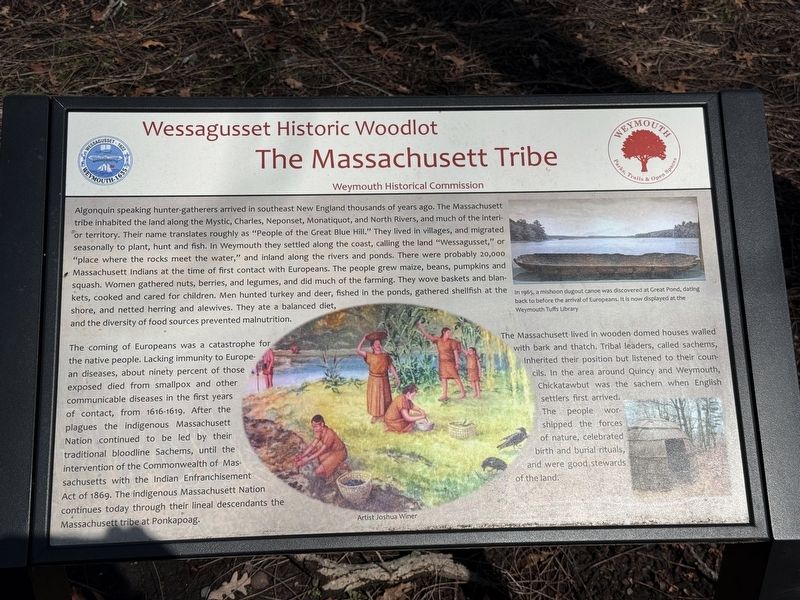
Algonquin speaking hunter-gatherers arrived in southeast New England thousands of years ago. The Massachusett tribe inhabited the land along the Mystic, Charles, Nesponset, Montiquot, and North Rivers, and much of the interior territory. Their name translates roughly as "People of the Great Blue Hill". They lived in villages, and migrated seasonally to plant, hunt and fish. In Weymouth, they settled along the coast, calling the land "Wessagusset", or "place where the rocks meet the water", and inland along the rivers and ponds. There were probably 20,000 Massachusett Indians at the time of first contact with Europeans. The people grew maize, beans, pumpkins and squash. Women gathered nuts, berries, and legumes, and did much of the farming. They wove baskets and blankets, cooked and cared for children. Men hunted turkey and deer, fished in the ponds, gathered shellfish at the shore, and netted herring and alewives. They ate a balanced diet, and the diversity of food sources prevented malnutrition.
The coming of Europeans was a catastrophe for the native people. Lacking immunity to European diseases, about ninety percent
this page online
The Massachusett lived in wooden domed houses walled with bark and thatch. Tribal leaders, called sachems, inherited their position but listened to their councils. In the area around Quincy and Weymouth, Chickatawbut was the sachem when English settlers first arrived. The people worshipped the forces of nature, celebrated birth and burial rituals, and were good stewards of the land.
[Caption:]
In 1965, a mishoon dugout canoe was discovered at Great Pond, dating back to before the arrival of Europeans. It is now displayed at the Weymouth Tufts Library.
Erected by Weymouth Historical Commission.
Topics. This historical marker is listed in these topic lists: Anthropology & Archaeology

Photographed by G.W.Bartlett, April 5, 2026
2. The Massachusett Tribe Marker (wide)
Location. 42° 14.789′ N, 70° 57.189′ W. Marker is in Weymouth, Massachusetts, in Norfolk County. It is in Wessagussett. It is at the intersection of Sea Street and Willow Avenue, on the left when traveling north on Sea Street. Touch for map. Marker is at or near this postal address: 228 Sea Street, North Weymouth MA 02191, United States of America. Touch for directions.

Regionally, this marker is in Greater Boston. It is also in the American Northeast, in New England, and on the Eastern Seaboard. Globally, it is in the North Atlantic Region, North America, the Western Hemisphere, the Western World, and the Anglosphere. Historically, it finds itself in what was once one of the original Thirteen Colonies.
Other nearby markers. At least 8 other markers are within walking distance of this marker: First English Settlement (a few steps from this marker); Puddingstone Memorials (a few steps from this marker); The Incorporation of Weymouth (a few steps from this marker); Settlement of Weymouth (approx.

Photographed by G.W.Bartlett, April 5, 2026
3. Historic Woodlot & Markers from Sea Street
Related markers. Click here for a list of markers that are related to this marker.
Also see . . . Wessagussett Wetland and Woodland - Historic Conservation Site.
The Wessagusset Wetland and Woodland is a small historic site with a grassy area and short woodland trails, located in a neighborhood setting in North Weymouth. Interpretive signage shares Native American and Colonial history.(Submitted on March 25, 2026, by G.W.Bartlett of Hingham, Massachusetts.)
Additional keywords. Joshua Winer

Photographed by G.W.Bartlett, April 5, 2026
4. Marker Group from Path
Credits. This page was last revised on April 9, 2026. It was originally submitted on March 25, 2026, by G.W.Bartlett of Hingham, Massachusetts. This page has been viewed 28 times since then. Photos: 1. submitted on March 25, 2026, by G.W.Bartlett of Hingham, Massachusetts. 2, 3, 4. submitted on April 5, 2026, by G.W.Bartlett of Hingham, Massachusetts. • Devry Becker Jones was the editor who published this page.
