Downtown in Columbus in Franklin County, Ohio — The American Midwest (Great Lakes)
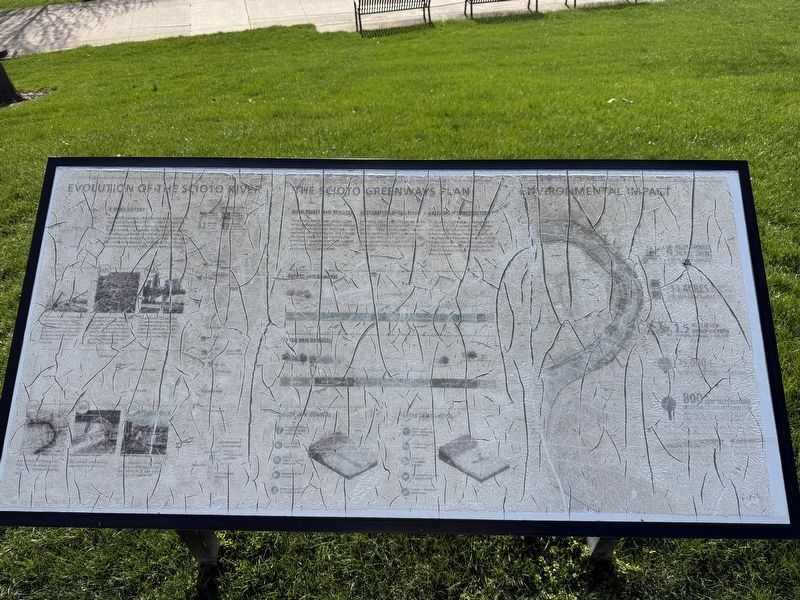
Evolution of the Scioto River
⎯⎯⎯
The Scioto Greenways Plan
⎯⎯⎯
Environmental Impact
Photographed by Devry Becker Jones (CC0), March 29, 2026
1. Evolution of the Scioto River / The Scioto Greenways Plan / Environmental Impact Marker
A Brief History:
At over 231 miles long, the Scioto River bisects half the longitude of the State of Ohio. The river has historically served as fertile hunting grounds for several Native American tribes, a navigational tool for European settlers staking their claim in the New World, a route to freedom for enslaved people escaping to the Northern States along the Underground Railroad; a feeder canal for traders using the Ohio Erie Canal; and today as a recreational amenity.
1913 The Great Flood - still considered the most catastrophic weather event experienced by the capitol city - sweeps through Downtown Columbus; devastating the city and surrounding communities and destroying the original wood dam.
1921 The City of Columbus responds by widening and deepening the river, constructing a 580 foot long low-head dam and retaining walls. The dam helped reshape the Downtown Scioto River basin and into a channel more than double its natural width.
1980 Due to its overly wide channel and sediment-laden water, the dam contributes to an unhealthy aquatic life. Efforts are made to dredge the
this page online
2010 As a solution, The Scioto Greenways idea is developed as a part of the 2010 Downtown Strategic Plan.
2013 The Scioto Greenways plan is underway by the fall of 2013.
2015 The Scioto Greenways, consisting of the main street dam removal, river restoration, and greenspace construction, is completed.
Main Street Dam Removal
Clean and accessible water, green and vast lawns, inviting and connective pathways are all reasons why the Scioto Greenways project was a city-changing endeavor. Not only does the Scioto Greenways improve the public realm, but it creates an enhanced ecosystem within the river now that its natural form and function has been restored.
Restoration of the River
A healthier river is inviting to a greater variety of insect, bird and mammal species that are now found along the naturalized river banks. Without the dam and with water moving more freely through the Downtown corridor, an aquatic environment exists that can support more diverse fish and invertebrate populations.
Greenspace Construction
33 new acres of greenspace
Photographed by Devry Becker Jones (CC0), March 29, 2026
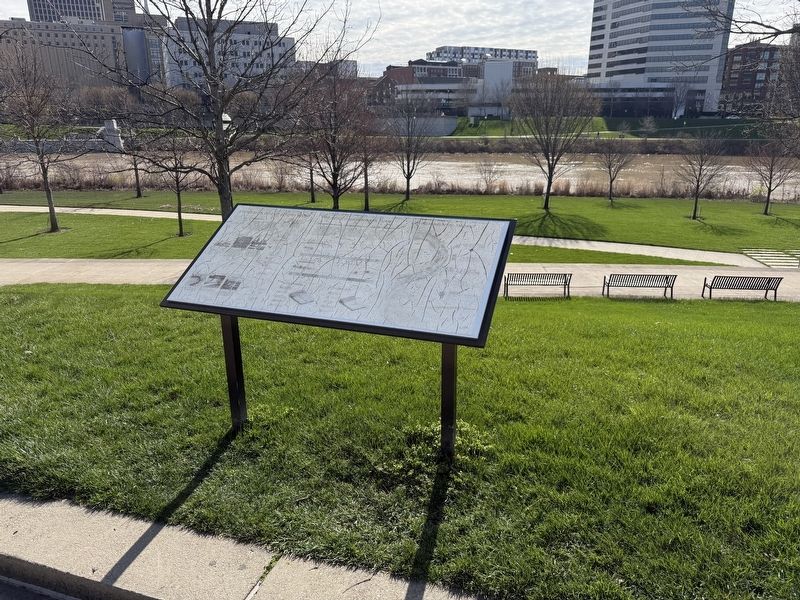
2. Evolution of the Scioto River / The Scioto Greenways Plan / Environmental Impact Marker
• 4 access points to the water. 1 dock and 4 landings.
• 33 acres [unreadable] of new greenspace created.
• 1.5 miles of new shared-use paths connecting to regional & state trails
• 75,000+ supporting [unreadable] native vegetation plantings.
• 800 new treesp lanted absorbing 3.9 tons of CO2 per year. [Unreadable]
Topics. This historical marker is listed in these topic lists: Environment • Natural Features • Parks & Recreational Areas • Waterways & Vessels. A significant historical year for this entry is 1913.
Location. 39° 57.532′ N, 83° 0.326′ W. Marker has been reported damaged. Marker is in Columbus, Ohio, in Franklin County. It is in Downtown. It is on Lower Scioto Greenway north of Washington Boulevard, on the right when traveling south. Touch for map. Marker is at or near this postal address: 120 Washington Blvd, Columbus OH 43215, United States of America. Touch for directions.

Regionally, this marker is in Ohio’s Scioto Valley. It is also in the American Midwest and in the Corn Belt. Globally, it is in North America, the Western Hemisphere, the Western World, and the Anglosphere. Historically, it finds itself in what was once the Haudenosaunee (Iroquois) Confederacy, the territory of the Mississippian Culture, and the Northwest Territory.
Other nearby markers. At least 8 other markers are within walking distance of this location: Town Street Bridge 1921 - 2009 (about 300 feet away, measured in a direct line); Town Street Bridge (about 400 feet away); Stegosaurus Stenops / Velociraptor Mongoliensis (about 500 feet away); Triceratops Horridus / Tyrannosaurus Rex (about 500 feet away); Science Spectrum (about 600 feet away); Roy L. Shafer 1951 - 2005 (about 600 feet away); Franklinton Historical Society Statue (about 700 feet away); Dorrian Green (approx. 0.2 miles away). Touch for a list and map of all markers in Columbus.
Credits. This page was last revised on March 30, 2026. It was originally submitted on March 30, 2026, by Devry Becker Jones of Washington, District of Columbia. This page has been viewed 19 times since then. Photos: 1, 2. submitted on March 30, 2026, by Devry Becker Jones of Washington, District of Columbia.
