Orange City in Volusia County, Florida — The American South (South Atlantic)
The History of Blue Spring

Photographed by Cosmos Mariner, October 25, 2021
1. The History of Blue Spring (center panel)
The Indians of Blue Spring
Early man left behind signs of his activity at Blue Spring. The Thursby house and grounds are on a huge Indian shell mound, a midden, consisting of millions of shells.
It had been thought the mounds were natural flood deposits. Jefferies Wyman, an archeologist from Harvard, thought differently. His work here in the late 1880’s showed that the mounds were built by man three to four thousand years ago.
The largest mound, which the house stands on, extended along the south bank of the spring run down to and around the point. A second mound was opposite the large mound on the north bank of the run, suggesting to Wyman that the two may have been one but were later separated by the spring outflow.
The materials unearthed were clay effigies, shell tools, pottery, projectile points, and bone fragments, both animal and human. Wyman writes that the human bones were punctured in similar ways to the bones of deer, opossum, turtle and alligator that he found. He attributed such “perforations” to the practice of cannibalism by the native residents of this area.
A Surprising Fountain
John Bartram was the first
this page online
A New Frontier
The Second Seminole War ended in 1842. The Indians were sent west to Oklahoma or forced into the Everglades. The interior of Florida was now open to the white man. The early pioneers advanced up the St. Johns River, settling near old war forts and on the fertile lands around Spring Garden and Blue Spring.
Blue Spring in the 20th Century
The decline of river traffic, combined with the freeze damage of 1895, resulted in a change of land use at Blue Spring. The John Thursby family and later private owners capitalized on the natural assets of the property by developing facilities for outdoor recreation.
The Florida Park Service, which acquired Blue Spring in 1972, continues to provide recreation while working to preserve the park’s natural and cultural

Photographed by Cosmos Mariner, October 25, 2021
2. The History of Blue Spring (left panel)
[captions]
• Indian cultural artifacts found at Blue Spring Shell Bluff near Thursby Mound, 1894
• Shell Bluff at Thursby Mound, early 1900’s
• Artist’s version of Bartram’s description of the boil area
• The Beginning of Orange City
• DeBary unloading at Blue Spring
• Family at the boil
• Garden at Blue Spring
• Undine at the boil
• Swimming docks on the Spring run
• Blue Spring Park in the 1950’s
• Spring Head
• Thursby House
• Scrub Jay
Topics and series. This historical marker is listed in these topic lists: Anthropology & Archaeology • Indigenous Peoples and Communities • Parks & Recreational Areas • Waterways & Vessels. In addition, it is included in the William Bartram Trails series list.
Location. 28° 56.673′ N, 81° 20.354′ W. Marker is in Orange City, Florida, in Volusia County. It can be reached from Magnolia Avenue (via Becker Boulevard) 0.8 miles south of West French Avenue. This interpretive kiosk is along the walkway near the Camp Store in Blue Spring State Park. Touch for map. Marker is at or near this postal address: 2100 West French Avenue, Orange

Photographed by Cosmos Mariner, October 25, 2021
3. The History of Blue Spring
(right panel)
(right panel)

Regionally, this marker is in Florida’s First Coast. It is also in the American South and on the Eastern Seaboard. Globally, it is in the North Atlantic Region, North America, a Gulf of Mexico state, the Western Hemisphere, the Western World, and the Anglosphere. Historically, it finds itself in what was once New Spain, the territory of the Mississippian Culture, one of the Confederate States of America, and the Antebellum South.
Other nearby markers. At least 8 other markers are within 3 miles of this marker, measured as the crow flies: Thursby House (about 600 feet away, measured in a direct line); Bartram at Blue Spring (approx. 0.2 miles away); A Fossil from the Steamboat Age (approx. ¼ mile away); Betsy Ross Airfield for Women (approx. 2.1 miles away); William Bartram Trail (approx. 2.4 miles away); Orange City Veterans Memorial (approx. 2½ miles away); Dickinson Memorial Library (approx. 2½ miles away); Rollins College (approx. 2½ miles away). Touch for a list and map of all markers in Orange City.
Also see . . .
1. Blue Spring State Park: A Historical Journey Through Time (ParksGuidance.com).
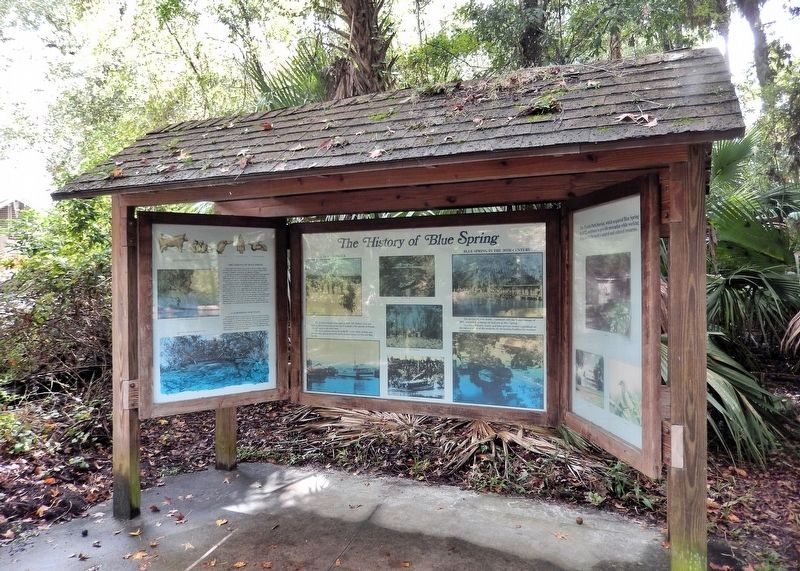
Photographed by Cosmos Mariner, October 25, 2021
4. The History of Blue Spring Interpretive Kiosk
Excerpt: Indigenous Roots: The Timucua Connection(Submitted on May 11, 2026, by Cosmos Mariner of Cape Canaveral, Florida.)
Long before the first European settlers arrived on the Florida peninsula, the Timucua people thrived in the region that is now home to Blue Spring State Park. The Timucua, native to the southeastern United States, left an indelible mark on the landscape, engaging in sustainable practices and cultivating a deep connection with the land. As you wander through the park’s trails, imagine the echoes of ancient footsteps and the stories told around the campfires of the Timucua people.
2. Blue Spring State Park (Wikipedia).
Excerpt: The spring was visited by botanist John Bartram in 1766. The spring and surrounding land were acquired by the Weismore family in the mid-19th century and a large plantation-style home built upon a shell mound on the property. The area seemed to be excellent for the cultivation of citrus fruit, and a small railway was built linking Orange City to the dock at Blue Spring. Ultimately, the Florida East Coast Railway was constructed not far from the present-day park. A killing freeze occurred in the 1890s, wiping out area citrus groves and driving the industry south. The Thursbys switched to the tourist trade, taking advantage of the spring along with fishing and hunting opportunities along the St. Johns River. The park was acquired by the Florida Department of Environmental Protection in 1972 to kick-start its manatee protection program.(Submitted on May 11, 2026, by Cosmos Mariner of Cape Canaveral, Florida.)
3. Blue Spring State Park: History and Nature (Florida State Parks).
Excerpt: When British “Colonial” botanist John Bartram paddled into Blue Spring in 1774, he appreciated the “admirable fountain” but objected to the water’s “most disagreeable taste.” Gold Rush prospector turned orange-grower Louis Thursby purchased a portion of Blue Spring in 1856. He built his house atop a large Indian midden in 1872. Before the railroad rolled through in the 1880s, Thursby’s Blue Spring Landing was a hotbed of steamboat activity, shipping tourists and goods to Jacksonville and beyond. Mrs. Thursby was Orange City’s first postmistress.(Submitted on May 11, 2026, by Cosmos Mariner of Cape Canaveral, Florida.)
Credits. This page was last revised on May 11, 2026. It was originally submitted on May 9, 2026, by Cosmos Mariner of Cape Canaveral, Florida. This page has been viewed 22 times since then. Photos: 1, 2, 3, 4. submitted on May 11, 2026, by Cosmos Mariner of Cape Canaveral, Florida.
