Fort Mason in San Francisco City and County, California — The American West (Pacific Coastal)
John Charles Frémont and “Manifest Destiny”
| — | Golden Gate National Recreation Area | — |

Photographed by Alice Mansell, June 29, 2026
1. John Charles Frémont and “Manifest Destiny” Marker
Conflicting Views on Human Worth
In 1842, US Army Captain John Charles Frémont led a westem expedition to explore and map the Oregon Trail. He would become known as "The Pathfinder,” the man who mapped the West. His wife, Jessie Frémont, compiled accounts of his adventures stirring the nation's fervor for a coast-to-coast empire that was the United States "Manifest Destiny.” This destiny would eradicate the cultures of indigenous peoples across the continent.
During his expeditions, Fremont was responsible for the brutal killing of native peoples including the slaughter of up to 1,000 Wintu in the Sacramento River area in 1846. Yet John Frémont, who was elected as US Senator from the new state of California, supported numerous bills against the extension of slavery. In 1856, he was selected (over Abraham Lincoln) as the first presidential candidate of the Republican Party running on an anti-slavery platform.
What are two seemingly contradictory views that you might hold?
(Captions:)
Jessie Fremont looks towards Alcatraz from the porch of the home that she shared here with John. The cottage, which stood on
this page online
John Charles Frémont (1813-1890) John Frémont gave the Golden Gate its name in 1846. That same year he assisted American settlers in a revolt against Mexican rule and declared California an independent republic after raising the Bear Flag. He was a Senator and presidential candidate before serving the Union as a general during the Civil War. But he is most remembered as an explorer of the West.
Jessie Benton Frémont (1824-1902) joined John in California in 1849 traveling with their young daughter by ship and crossing Panama. Jessie befriended Reverend Thomas Starr King, a Unitarian minister known for his powerful sermons and advocacy for the right of free Blacks. At her Black Point home, Jessie invited King to write his fiery abolitionist speeches in her study, and the two hosted literary and political salons with influential figures of the period, including Bret Harte and Herman Melville.
Topics. This historical marker is listed in these topic lists: Abolition & Underground RR • Indigenous Peoples and Communities

Photographed by Alice Mansell, June 29, 2026
2. John Charles Frémont and “Manifest Destiny” Marker
Vandalism damage
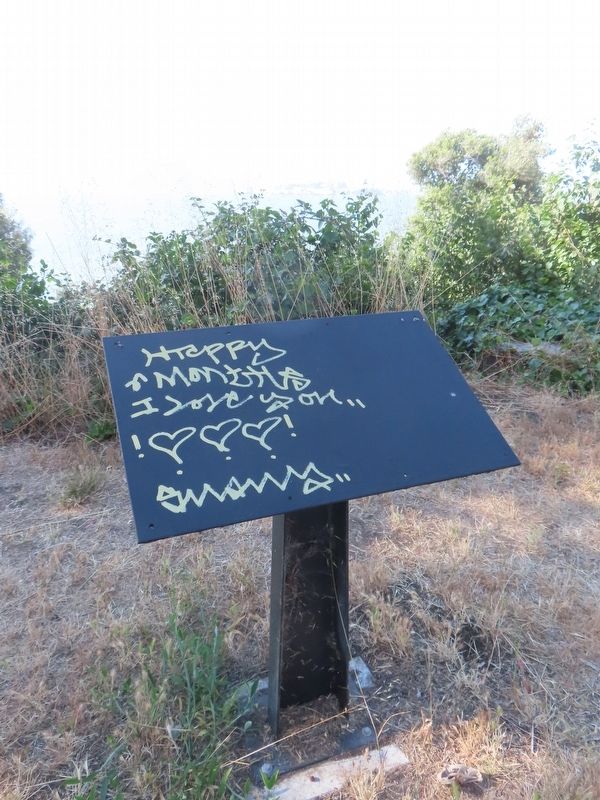
Location. 37° 48.449′ N, 122° 25.686′ W. Marker has been damaged. Marker is in San Francisco, California, in San Francisco City and County. It is in Fort Mason. It can be reached from Fort Mason 11. Marker can be reached by foot along concrete sidewalks beginning at the north end of Franklin Street in Fort Mason. A few feet away is another marker which has been removed and its stand vandalized with graffiti. Touch for map. Marker is in this post office area: San Francisco CA 94109, United States of America. Touch for directions.

Regionally, this marker is on the Coast Ranges. It is also on the American Pacific Coast. Globally, it is in North America, on the Ring of Fire, on the Pacific Rim, in the Western Hemisphere, in the Western World, and in the Anglosphere. Historically, it finds itself in what was once New Spain and also Mexico’s Alta California.
Other nearby markers. At least 8 other markers are within walking distance of this location: Black Point Fortifications (1797 - 1909) (within shouting distance of

Photographed by Alice Mansell, June 29, 2026
3. John Charles Frémont and “Manifest Destiny” Marker
Vandalised
Another marker is no longer nearby. Congressman Phillip Burton (was approx. 0.2 miles away but has been permanently removed).
More about this marker. Marker is below the remnants of Battery Burnham, which is noted on some online maps and as of 6/29/2026 has no marker, and above West Battery at Fort Mason National Park. This Frémont marker has been vandalized.
Regarding John Charles Frémont and “Manifest Destiny”. Jesse Frémont was the daughter of a U.S. Senator from Missouri who was an abolitionist. John Frémont was a founder of the Republican Party and ran for U.S. President on a platform of Abolition. A few

Photographed by Alice Mansell, June 29, 2026
4. John Charles Frémont and “Manifest Destiny” Marker
View towards Fort Mason piers from near this marker.
Photographed by Alice Mansell, June 29, 2026
5. Removed and vandalized companion marker to the Fremont marker
Credits. This page was last revised on July 8, 2026. It was originally submitted on July 8, 2026, by Alice Mansell of Los Altos, California. This page has been viewed 20 times since then. Photos: 1, 2, 3, 4, 5. submitted on July 8, 2026, by Alice Mansell of Los Altos, California. • Andrew Ruppenstein was the editor who published this page.
