Naperville in Will County, Illinois — The American Midwest (Great Lakes)
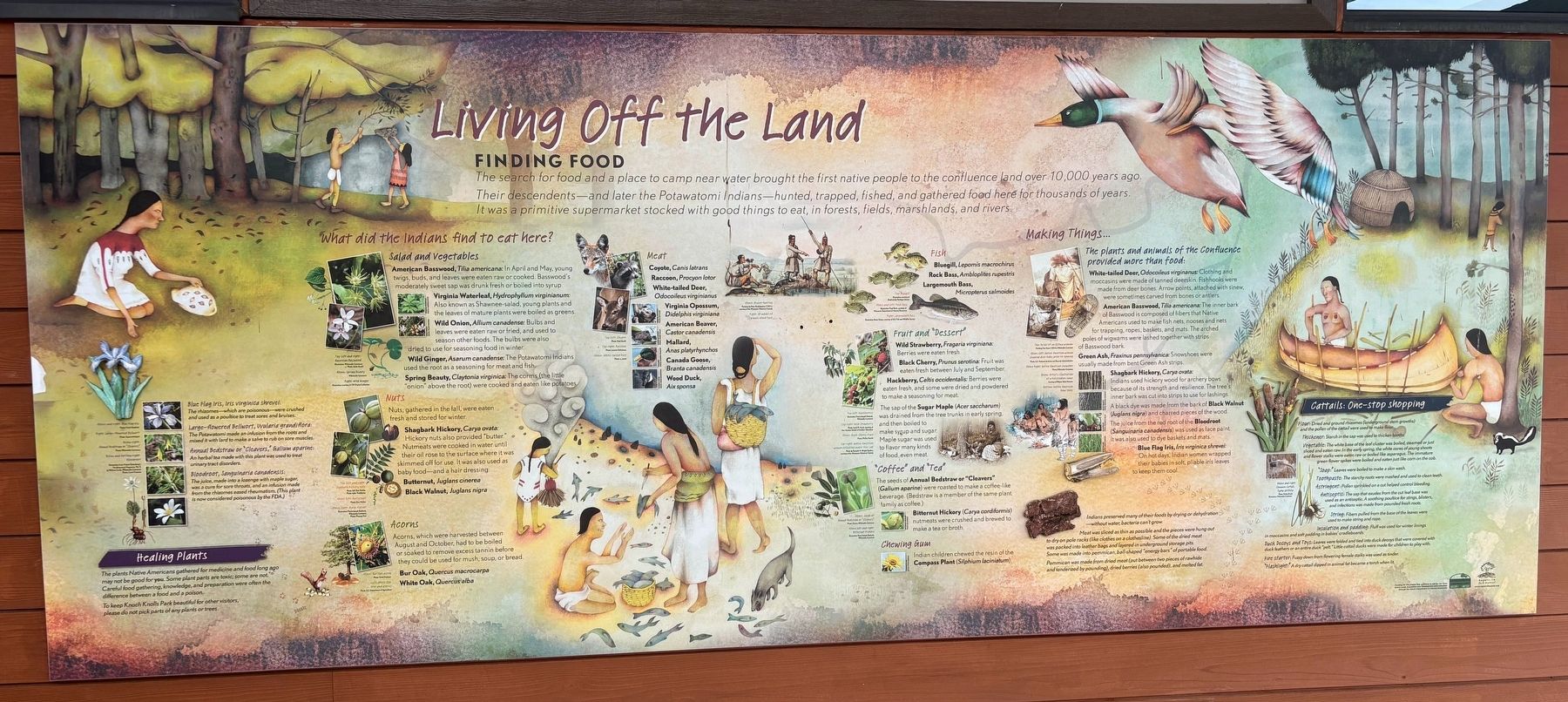
Living Off the Land
Finding Food
Photographed by Sean P. Flynn, August 18, 2026
1. Living Off the Land Marker
Healing Plants
The plants Native Americans gathered for medicine and food long ago may not be good for you. Some plant parts are toxic; some are not. Careful food gathering, knowledge, and preparation were often the difference between a food and a poison.
To keep Knoch Knolls Park beautiful for other visitors, please do not pick parts of any plants or trees.
Blue Flag Iris, Iris virginica shrevel:
The rhizomes which are poisonous were crushed and used as a poultice to treat sores and bruises.
Large-flowered Bellwort, Wularia grandiflora:
The Potawatomi made an infusion from the roots and mixed it with lard to make a salve to rub on sore muscles.
Annual Bedstraw or "Cleavers," Galium aparine:
An herbal tea made with this plant was used to treat urinary tract disorders.
Bloodroot, Sanguinaria canadensis:
The juice, made into a lozenge with maple sugar, was a cure for sore throats, and an infusion made from the rhizomes eased rheumatism. (This plant is now considered poisonous by the FDA.)
What did the Indians find to eat here?
Salad and Vegetables
American Basswood, Tilia americana: In April and May, young twigs, buds, and leaves were eaten raw or cooked. Basswood's moderately sweet
this page online
Virginia Waterleal, Hydrophyllum virginianum: Also known as Shawnee-salad, young plants and the leaves of mature plants were boiled as greens.
Wild Onion, Allium canadense: Bulbs and leaves were eaten raw or fried, and used to season other foods. The bulbs were also dried to use for seasoning food in winter.
Wild Ginger, Asarum canadense: The Potawatomi Indians used the root as a seasoning for meat and fish.
Spring Beauty, Claytonia virginica: The corms (the little "onion" above the root) were cooked and eaten like potatoes.
Nuts
Nuts, gathered in the fall, were eaten fresh and stored for winter.
Shagbark Hickory, Carya ovata: Hickory nuts also provided "butter." Nutmeats were cooked in water until their oil rose to the surface where it was skimmed off for use. It was also used as baby food and a hair dressing.
Butternut, Juglans cinerea
Black Walnut, Juglans nigra
Acorns
Acorns, which were harvested between August and October, had to be boiled or soaked to remove excess tannin before they could be used for mush, soup, or bread.
Bur Oak, Quercus macrocarpa
White Oak, Quercus alba
Meat
Coyote, Canis latrans
Raccoon, Procyon lotor
White-tailed Deer, Odocoileus virginianus
Virginia Opossum, Didelphis virginiana
American Beaver, Castor canadensis
Mallard, Anas platyrhynchos
Canada Goose, Branta canadensis
Wood Duck, Aix sponsa
Fish
Bluegill, Lepomis macrochirus
Rock Bass, Ambloplites rupestris
Largemouth Bass, Micropterus salmoides
Fruit and "Dessert"
Wild Strawberry, Fragaria virginiana: Berries

Photographed by Sean P. Flynn, August 18, 2026
2. Markers on the back deck of the Knoch Knolls Nature Center
Black Cherry, Prunus serotina: Fruit was eaten fresh between July and September.
Hackberry, Celtis occidentalis: Berries were eaten fresh, and some were dried and powdered to make a seasoning for meat.
The sap of the Sugar Maple (Acer saccharum) was drained from the tree trunks in early spring, and then boiled to make syrup and sugar. Maple sugar was used to flavor many kinds of food, even meat.
Coffee" and "Tea"
The seeds of Annual Bedstraw or "Cleavers" (Galium aparine) were roasted to make a coffee-like beverage. (Bedstraw is a member of the same plant family as coffee.)
Bitternut Hickory (Carya cordiformis) nutmeats were crushed and brewed to make a tea or broth.
Chewing Gum
Indian children chewed the resin of the Compass Plant (Silphium laciniatum).
Making Things...
The plants and animals of the Confluence provided more than food:
White-tailed Deer, Odocoileus virginanus: Clothing and moccasins were made of tanned deerskin. Fishhooks were made from deer bones. Arrow points, attached with sinew, were sometimes carved from bones or antlers.
American Basswood, Tilia americana: The inner bark of Basswood is composed of fibers that Native Americans used to make fish nets, nooses and nets for trapping, ropes, baskets, and mats. The arched poles of wigwams were lashed together with strips of Basswood bark.
Green Ash, Fraxinus pennsylvanica: Snowshoes were usually made from bent Green Ash strips.
Shagbark Hickory, Carya ovata: Indians used hickory wood for archery bows because of its strength and resilience. The tree's inner bark
Photographed by Sean P. Flynn, August 18, 2026
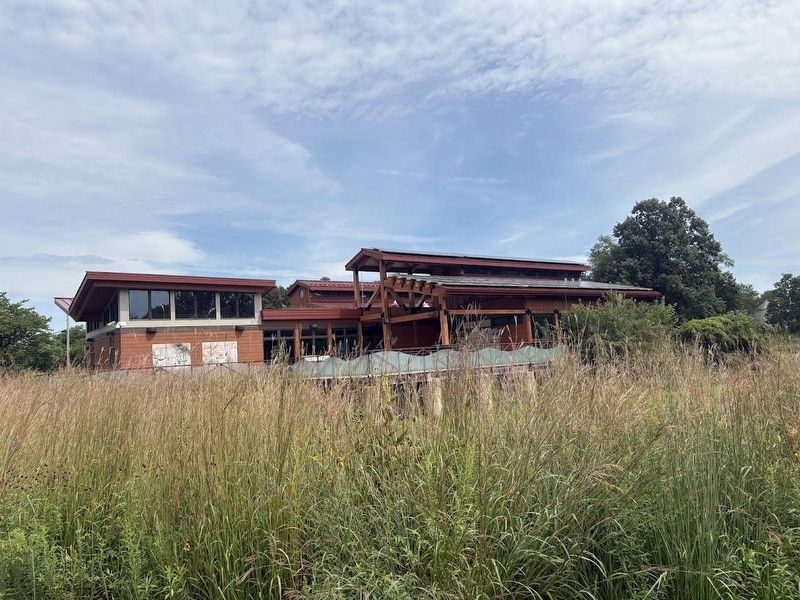
3. Knoch Knolls Nature Center
A black dye was made from the bark of Black Walnut (Juglans nigra) and charred pieces of the wood.
The juice from the red root of the Bloodroot (Sanguinaria canadensis) was used as face paint. It was also used to dye baskets and mats.
Blue Flag Iris, Iris virginica shrevei: On hot days, Indian women wrapped their babies in soft, pliable iris leaves to keep them cool.
Indians preserved many of their foods by drying or dehydration—without water, bacteria can't grow.
Meat was sliced as thin as possible and the pieces were hung out to dry on pole racks (like clothes on a clothesline). Some of the dried meat was packed into leather bags and layered in underground storage pits. Some was made into pemmican, ball-shaped "energy bars" of portable food.
Pemmican was made from dried meat (put between two pieces of rawhide and tenderized by pounding), dried berries (also pounded), and melted fat.
Cattails: One-stop shopping
Flour: Dried and ground rhizomes (underground stem growths) and the pollen of the cattail were used to make flour.
Thickener: Starch in the sap was used to thicken broths.
Vegetable: The white base of the leaf cluster was boiled, steamed or just sliced and eaten raw. In the early spring, the white cores of young shoots and flower stalks were eaten raw or boiled like asparagus. The immature green flower spikes were boiled and eaten just like corn on the cob.
"Soap:" Leaves were boiled to make a skin wash.
Toothpaste: The starchy roots were mashed and used to clean teeth.
Astringent: Pollen sprinkled on a cut helped control bleeding.
Antiseptic: The sap that exudes from the cut leaf base was used as an antiseptic. A soothing poultice for stings, blisters, and infections was made from pounded fresh roots.
String: Fibers pulled from the base of the leaves were used to make string and rope.
Insulation and padding: Fluff was used for winter linings in moccasins and soft padding in babies' cradleboards.
Duck Decoys and Toys: Leaves were folded and tied into duck decoys that were covered with duck feathers or an entire duck "pelt." Little cattail ducks were made for children to play with.
Fire starter: Fuzzy down from flowering female stalks was used as tinder.
"Flashlight:" A dry cattail dipped in animal fat became a torch when lit.
Erected by Naperville Park District.
Topics. This historical marker is listed in these topic lists: Agriculture • Environment • Indigenous Peoples and Communities • Waterways & Vessels.
Location. 41° 42.836′ N, 88° 8.47′ W. Marker is in Naperville, Illinois, in Will County. It is on Knoch Knolls Road 1.3 miles east of 95th Street, on the right when traveling east. The marker is affixed to the exterior of the Knoch Knolls Park Nature Center, on the rear part with a deck. Touch for map. Marker is at or near this postal address: 320 Knoch Knolls Road, Naperville IL 60565, United States of America. Touch for directions.

Regionally, this marker is in Greater Chicago. It is also in the American Midwest. Globally, it is in North America, on the Great Lakes, in the Western Hemisphere, in the Western World, and in the Anglosphere. Historically, it finds itself in what was once the territory of the Mississippian Culture and also the Northwest Territory.
Other nearby markers. At least 8 other markers are within walking distance of this marker: Green Builders Long Ago (a few steps from this marker); The Land Where the Rivers Meet (a few steps from this marker); Native Landscape Restoration at Knoch Knolls Park (a few steps from this marker); Taking Care of Our Watershed (a few steps from this marker); Where the Rivers Meet (a few steps from this marker); A Reminder of Times Past (within shouting distance of this marker); a different marker also named Where the Rivers Meet (within shouting distance of this marker); McDonald Creek (within shouting distance of this marker). Touch for a list and map of all markers in Naperville.
Also see . . . Knoch Knolls Nature Center. From the Naperville Park District website. (Submitted on August 21, 2026, by Sean P. Flynn of Oak Park, Illinois.)
Credits. This page was last revised on August 21, 2026. It was originally submitted on August 20, 2026, by Sean P. Flynn of Oak Park, Illinois. This page has been viewed 16 times since then. Photos: 1. submitted on August 20, 2026, by Sean P. Flynn of Oak Park, Illinois. 2. submitted on August 21, 2026, by Sean P. Flynn of Oak Park, Illinois. 3. submitted on August 20, 2026, by Sean P. Flynn of Oak Park, Illinois.
