Martinsville, Virginia — The American South (Mid-Atlantic)
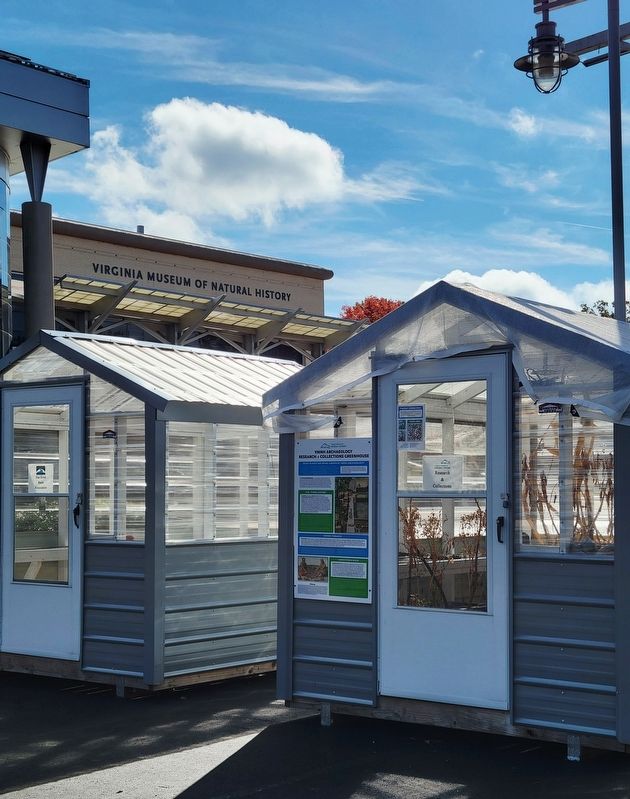
VMNH Archaeology Research Collections Greenhouse
Photographed by C. Ryan Dodson, November 4, 2026
1. VMNH Archaeology Research Collections Greenhouse Marker
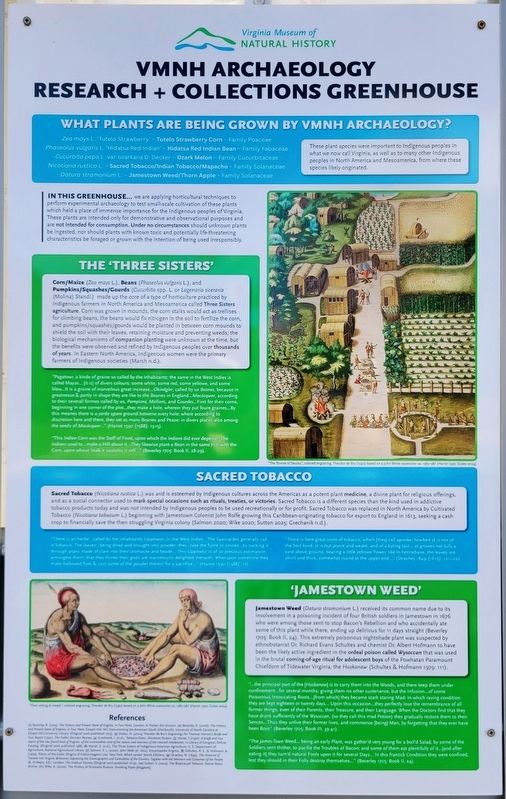
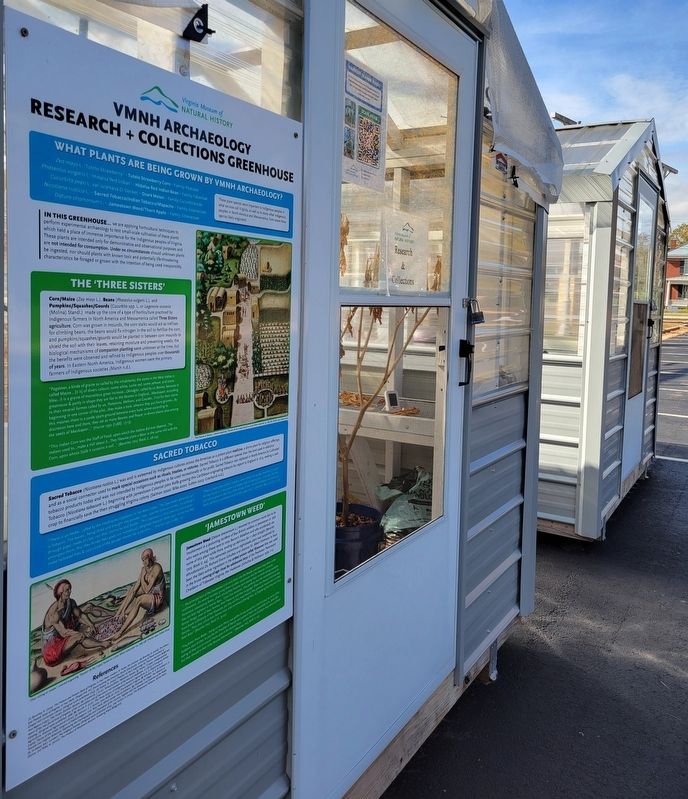
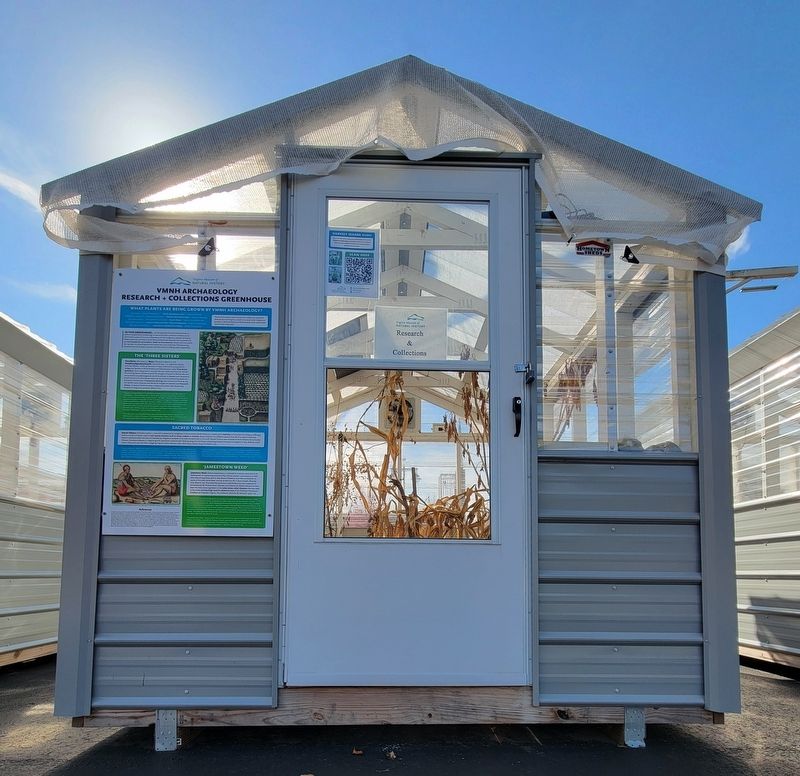
What plants are being grown by VMNH archaeology?
Zea mays L. 'Tutelo Strawberry' - Tutelo Strawberry Corn - Family Poaceae
Phaseolus vulgaris L. 'Hidatsa Red Indian' - Hidatsa Red Indian Bean - Family Fabaceae
Cucurbita pepo L. var. ozarkana D. Decker - Ozark Melon - Family Cucurbitaceae
Nicotiana rustica L- Sacred Tobacco/Indian Tobacco/Mapacho - Family Solanaceae
Datura stramonium L. - Jamestown Weed/Thorn Apple - Family Solanaceae
These plant species were important to Indigenous peoples in what we now call Virginia, as well as to many other Indigenous peoples in North America and Mesoamerica, from where these species likely originated.
In this greenhouse ... we are applying horicultural techniques to perform experimental archaeology to test small-scale cultivation of these plants which held a place of immense importance for the Indigenous peoples of Virginia. These plants are intended only for demonstrative and observational purposes and are not intended for consumption. Under no circumstances should unknown plants be ingested, nor should plants with known toxic and potentially life-threatening characteristics be foraged or grown with the intention of being used irresponsibly.
The 'Three Sisters'
Corn/Maize (Zea mays L.), Beans (Phaseolus vulgaris L.), and Pumpkins/Squashes/Gourds (Cucurbita spp. L or Lagenaria siceraria (Molina) Standl.) made up the core of a type of horticulture practiced by Indigenous farmers in North America and Mesoamerica called Three Sisters agriculture. Corn was grown in mounds, the corn stalks would act as trellises for climbing beans, the beans would fix nitrogen in the soil to fertilize the corn, and pumpkins/squashes/gourds would be planted in between corn mounds to shield the soil with their leaves, retaining moisture and preventing weeds;
this page online
"Pagatowr, a kinde of graine so called by the inhabitants; the same in the West Indies is called Mayze ... [it is] of divers colours; some white, some red, some yellowe, and some blew ... it is a graine of marveilous great increase ... Okindgier, called by us Beanes, because in greatnesse & partly in shape they are like to the Beanes in England. Mocócqwer, according to their several formes called by us, Pompions, Mellions, and Gourdes ... First for their corne, beginning in one corner of the plot they make a hole, wherein they put foure graines ... By this meanes there is a yarde spare ground betwene every hole: where according to discretion here and there, they set as many Beanes and Peaze; in divers places also among the seeds of Macóoquer" (Hariot 1590 (1588): 13 - 15)
"This Indian Corn was the staff of food, upon which the Indians did ever depend. The Indians
Photographed by C. Ryan Dodson, November 4, 2026
2. VMNH Archaeology Research Collections Greenhouse Marker
Sacred Tobacco
Sacred Tobacco (Nicotiana rustica L) was and is esteemed by Indigenous cultures across the Americas as a potent plant medicine, a divine plant for religious offerings, and as a social connector used to mark special occasions suvh as rituals, treaties, or victories. Sacred Tobacco is a different species than the kind used in addictive tobacco products today and was not intended by Indigenous peoples to be used recreationally or for profit. Sacred Tobacco was replaced in North America by Cultivated Tobacco (Nicotiana tabacum L.) beginning with Jamestown Colonist John Rolfe growing this Caribbean-originating tobacco for export to England in 1613, seeking a cash crop to financially save the then struggling Virginia colony (Salmon 2020; Wike 2020; Sutton 2025; Grechanik n.d.).
"There is an herbe ... called by the inhabitants Uppowoc. In the West indies ... The Spaniardes generally call a tobacco. The leaves ... being dried and brought into powder, they
Photographed by C. Ryan Dodson, November 4, 2026
3. VMNH Archaeology Research Collections Greenhouse Marker
"There is here great store of tobacco, which [they| call apooke; howbeit yt is not of the best kynd, yt is but poore and weake, and of a byting tast. Yt growes not fully a yard above ground, bearing a little yellowe flower, like to hennebane, the leaves are short and thick, somewhat round at the upper end." (Strachey 1849 (1619) 121-122)
'Jamestown Weed'
Jamestown Weed (Datura stramonium L.) received its common name due to its involvement in a poisoning incident of four British soldiers in Jamestown in 1676 who were among those sent to stop Bacon's Rebellion and who accidentally ate some of this plant while there, ending up delirious for 11 days straight (Beverley 1705: Book II, 24). This extremely poisonous nightshade plant was suspected by ethnobotanist Dr. Richard Evans Schultes
Photographed by C. Ryan Dodson, November 4, 2026
4. VMNH Archaeology Research Collections Greenhouse Marker
" ... the principal part of the [huskanaw] is to carry them into the Woods, and there keep them under confinement ... for several months; giving them no other sustanance, but the infusion ... of some Poisonous Intoxicating Roots ... [from which] they became stark staring Mad; In which raving condition they are kept eighteen or twenty days ... Upon this occasion ... they perfectly lose the remembrance of all former things, even of their Parents, their Treasure, and their Language. When the Doctors find that they have drank suffciently of the Wysoccan, (so they call this mad Potion) they gradually restore them to their sences ... Thus they unlive their former lives, and commence [being] Men, by forgetting that they ever have been Boys" Beverley 1705, Book III, 39 - 41).
The James-Town Weed being an early Plant, was gather'd very young for a boild Salad,
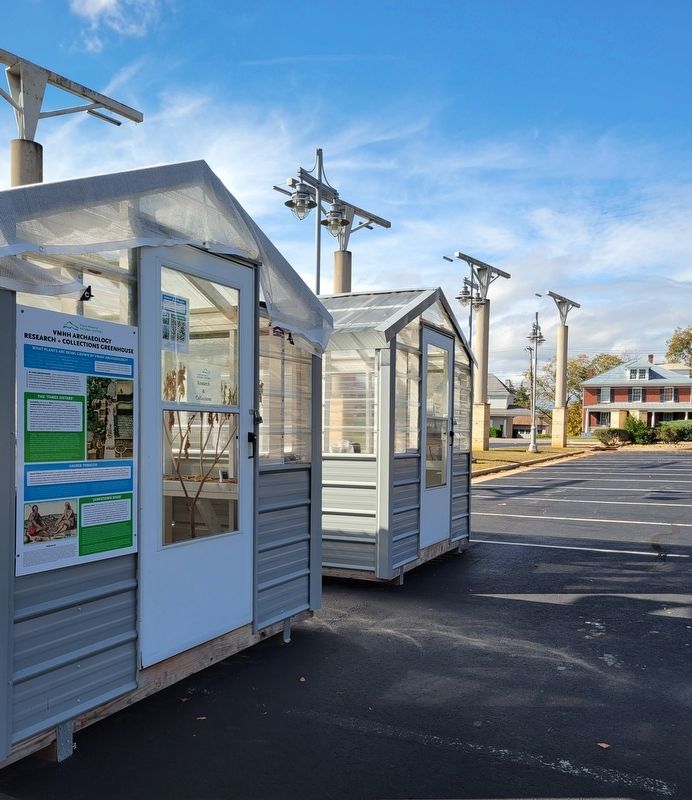
Photographed by C. Ryan Dodson, November 4, 2026
5. VMNH Archaeology Research Collections Greenhouse Marker
References (1)Beverley, R. (1705) The History and Prsent State of Virginia in four parts. London: R. Parker, the Unicorn. (2) Beverley, R. (2006) The History and Prsent State of Virginia in four parts. Chapel Hill, NC: Documenting the American South (DocSouth). University of North Carolina at Chapel Hill University Library (original work published 1705). (3) Dukes, H (2024) Theodor de Bry's Engraving's for Thomas Harriot's Briefe and true report (1590) The Public Domain review. (4) Grechanik, J (n.d.) Tobacco/Diets. Nicotiana Rustica. (5) Harriot, T. (1590) Briefe and true report of the new found land of Virginia of the commodities and of the nature and manners of the naturall inhabitants. In Library of Congress Online Catalog. (Original work published 1585). (6) Marsh, E. (n. d.) The Three Sisters of Indigenous American Agriculture. U. S. Department of Agriculture. National Agricultural Library. (7) Salmon, E. J. (2020) John Rolfe (d. 1622). Encyclopedia Virginia. (8) Schultes, R. E., & Hofmann, A. (1979) Plants of the gods: Origins of Hallucenogenic Use. New York: Alfred vander Marck Editions. (9) Strachey, W. (1849) The Histories of Travalls into Virginia Britainnia: Expressing the Cosmographic and Commodities of the country, together with the Manners and Customes of the people. (R. H. Major, Ed.) London. The Hakbryt Society (Original work published 1619). (10) Sutton, V. (2025) The Biopiracy of Tobacco. Native News Online. (11) Wike, A. (2020) The History of Nicotiana Rustica. Smoking Pipes [blogpost].
Erected 2026
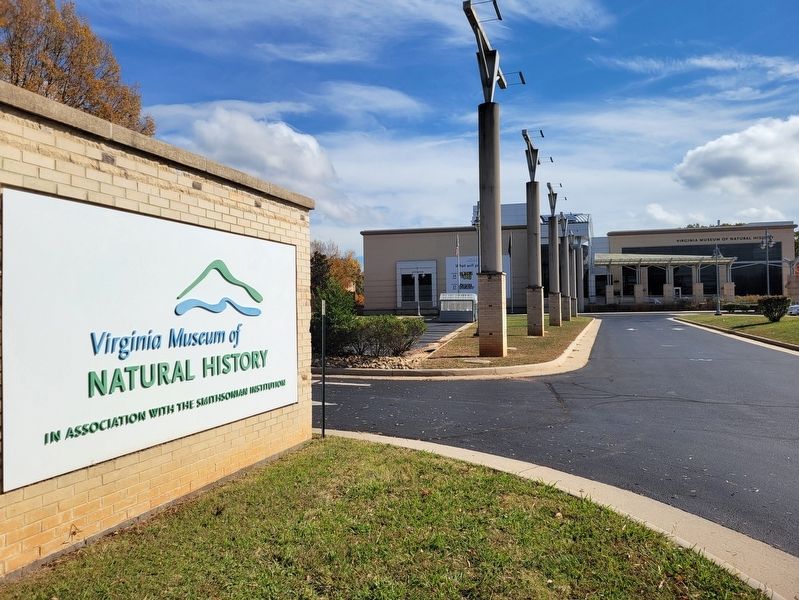
Photographed by C. Ryan Dodson, November 4, 2026
6. Virginia Museum of Natural History
The Marker is located on the grounds of the Virginia Museum of Natural History.
Topics. This historical marker is listed in these topic lists: Agriculture • Colonial Era • Indigenous Peoples and Communities • Science & Medicine.
Location. 36° 41.218′ N, 79° 51.833′ W. Marker is in Martinsville, Virginia. It is on Starling Avenue, on the right when traveling north. The Marker is located on the grounds of the Virginia Museum of Natural History. Touch for map. Marker is at or near this postal address: 21 Starling Avenue, Martinsville VA, United States of America. Touch for directions.

Regionally, this marker is in Southern Virginia. It is also in the American South and specifically in the Upper South. Globally, it is in North America, the Western Hemisphere, the Western World, and the Anglosphere. Historically, it finds itself in what was once the territory of the Mississippian Culture, one of the original Thirteen Colonies, one of the Confederate States of America, and the Antebellum South.
Other nearby markers. At least 8 other markers are within walking distance of this marker: The John Waddey Carter House (about 700 feet away, measured in a direct line); The Little Post Office (approx. 0.2 miles away); Christ Church Parish House (approx. 0.2 miles away); Changing With Industry (approx. 0.3 miles away); DeShazo's "Silo" (approx. 0.4 miles away); Furnishing a Nation (approx. half a mile away); The Early Years (approx. half a mile away); 1990s and beyond (approx. half a mile away). Touch for a list and map of all markers in Martinsville.
Credits. This page was last revised on November 5, 2026. It was originally submitted on November 5, 2026, by C. Ryan Dodson of Danville, Virginia. This page has been viewed 9 times since then. Photos: 1, 2, 3, 4, 5, 6. submitted on November 5, 2026, by C. Ryan Dodson of Danville, Virginia. • Andrew Ruppenstein was the editor who published this page.
