Rome in Oneida County, New York — The American Northeast (Mid-Atlantic)
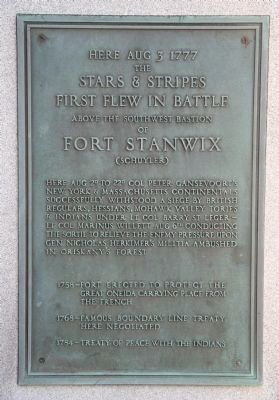
Stars & Stripes First Flew in Battle
Fort Stanwix
Photographed by Dale K. Benington, June 15, 2010
1. Stars & Stripes First Flew in Battle Marker
the
Stars & Stripes
First Flew In Battle
Above the Southwest Bastion
of
Fort Stanwix
(Schuyler)
Here Aug 2d to 22d Col. Peter Gansevoort's New York & Massachusetts Continentals successfully withstood a siege by British Regulars, Hessians, Mohawk Valley Tories & Indians under Lt. Col. Barry St. Leger - Lt. Col. Marinus Willett Aug. 6th conducting the sortie to relieve the enemy pressure upon Gen. Nicholas Herkimer's militia ambushed in Oriskany's Forest.
1758 - Fort erected to protect the Great Oneida Carrying Place from the French.
1768 - Famous Boundary Line Treaty here negotiated.
1784 - Treaty of Peace with the Indians.
Topics and series. This historical marker is listed in these topic lists: Colonial Era • Forts and Castles • Indigenous Peoples and Communities • Notable Events • War, French and Indian • War, US Revolutionary. In addition, it is included in the Battlefield Trails - Revolutionary War series list. A significant historical month for this entry is August 1902.
Location. 43° 12.655′ N, 75° 27.455′ W. Marker is in Rome, New York, in Oneida County. It is at the
this page online

Regionally, this marker is in Upstate New York and in the Mohawk Valley. It is also in the American Northeast and in the Mid-Atlantic. Globally, it is in North America, the Great North Woods, the Western Hemisphere, the Western World, and the Anglosphere. Historically, it finds itself in what was once the Haudenosaunee (Iroquois) Confederacy, New Netherland, and one of the original Thirteen Colonies.
Other nearby markers. At least 8 other markers are within walking distance of this marker: Christopher P. Destito (here, next to this marker); The Empire State Trail at Rome (here, next to this marker); Discover how courage, survival, and success against the odds shaped history...
Photographed by Dale K. Benington, June 15, 2010
2. Stars & Stripes First Flew in Battle Marker
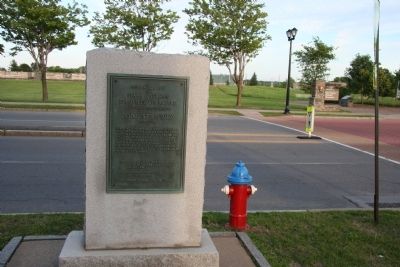
View, looking east, of the historical marker, with the sign for the entrance to the Fort Stanwix National Monument seen across the street on the right side of the historical marker and a portion of the reconstructed fort seen across the street on the left side of the historical marker.
Related markers. Click here for a list of markers that are related to this marker. To better understand the relationship, study each marker in the order shown.
Also see . . .
1. American Flag History. According to the information on this web site, "Probably the first display of the national flag at a military post was at Fort Schuyler, on the site of the present city of Rome, New York." (Submitted on June 29, 2010, by Dale K. Benington of Toledo, Ohio.)
2. Fort Stanwix, Rome, NY. This link provides access to a Site on a Revolutionary War Road Trip. (Submitted on June 29, 2010, by Dale K. Benington of Toledo, Ohio.)
3. Fort Stanwix. This link provides access to information regarding both Fort Stanwix and the first use
Photographed by Bill Coughlin, July 30, 2014
3. Stars & Stripes First Flew in Battle Marker
Photographed by Dale K. Benington, June 15, 2010
4. Stars & Stripes First Flew in Battle Marker
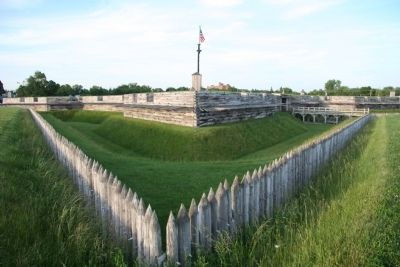
View of the reconstructed southwest bastion of Fort Stanwix, which is where the historical marker indicates that the Stars & Stripes first flew in battle.
Credits. This page was last revised on June 16, 2016. It was originally submitted on June 29, 2010, by Dale K. Benington of Toledo, Ohio. This page has been viewed 1,594 times since then and 38 times this year. Photos: 1, 2. submitted on June 29, 2010, by Dale K. Benington of Toledo, Ohio. 3. submitted on August 6, 2014, by Bill Coughlin of Woodland Park, New Jersey. 4. submitted on June 29, 2010, by Dale K. Benington of Toledo, Ohio. • Craig Swain was the editor who published this page.
