South Deerfield in Franklin County, Massachusetts — The American Northeast (New England)
Bloody Brook Monument
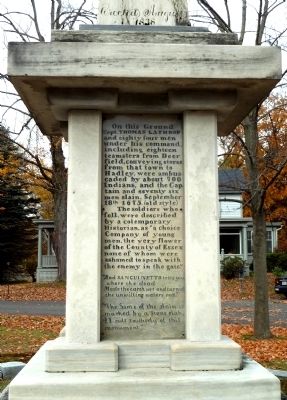
Photographed by Roger W. Sinnott, October 30, 2010
1. Bloody Brook Monument Marker
1838
—
On this Ground Capt. Thomas Lathrop and eighty four men under his command, including eighteen teamsters from Deer field, conveying stores from that town to Hadley, were ambuscaded by about 700 Indians, and the Captain and seventy six men slain, September 18th 1675. (old style)
The soldiers who fell, were described by a contemporary Historian, as “a choice Company of young men, the very flower of the County of Essex none of whom were ashamed to speak with the enemy in the gate.”
“And Sanguinetto tells you where the dead
Made the earth wet and turned the unwilling waters red.”
“The Same of the slain is marked by a Stone slab, 21 rods southerly of this monument.”
Erected 1838.
Topics and series. This historical marker and monument is listed in these topic lists: Colonial Era • Indigenous Peoples and Communities • Wars, US Indian • Waterways & Vessels. In addition, it is included in the King Philip's War 1675-1676 series list. A significant historical date for this entry is September 18, 1987.
Location. 42° 28.986′ N, 72° 36.221′ W.
this page online

Regionally, this marker and monument is in Massachusetts’ Pioneer Valley. It is also in the American Northeast and in New England. Globally, it is in North America, the Western Hemisphere, the Western World, and the Anglosphere. Historically, it finds itself in what was once one of the original Thirteen Colonies.
Other nearby markers. At least 8 other markers are within 4 miles of this marker, measured as the crow flies: Bloody Brook Stone Slab (about 400 feet away, measured in a direct line); SGT. Gregory Allen Belanger (approx. 3.1 miles away); Peter (approx. 4 miles away); Young Girl (approx. 4 miles away); Fortune (approx. 4 miles away); Rebecca (approx. 4.1 miles away); Pompey (approx. 4.1 miles away); House of Jonathan Wells (approx. 4.1 miles away).
More about this marker. The marker sits on a large grassy island on the east side of North Main Street just
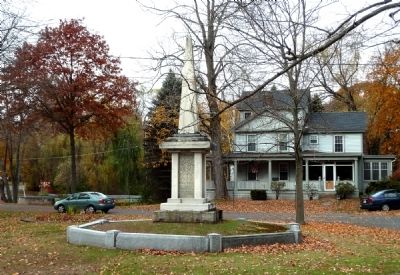
Photographed by Roger W. Sinnott, October 30, 2010
2. Wider View Looking North
Regarding Bloody Brook Monument. In their 1999 book King Philip’s War, Eric B. Schultz and Michael J. note: “Deerfield was a tempting target for the Indians because of its poor defenses and excellent fall harvest.” Accordingly, Massachusetts Bay leaders decided to evacuate Deerfield and sent troops under Capt. Lathrop to lead the teamsters out. Their wagons were carrying foodstuffs to be distributed throughout the Connecticut River valley during the coming winter. They got as far as present-day South Deerfield when the Nipmuc sachem Muttawmp and his warriors launched their attack.
[Note: The two lines of poetry (next-to-last paragraph of the inscription) are from Lord Byron’s Childe Harold’s Pilgrimage and refer to the Battle of Lake Trasimeno in 217 BC. It was one of the bloodiest battles of the Second Punic War, in which Hannibal’s Carthaginian troops “came down from the heights” to ambush and massacre a Roman army, turning a stream red.]
The cornerstone for this monument was laid in 1835, and it was completed three years later. But the stone slab referred
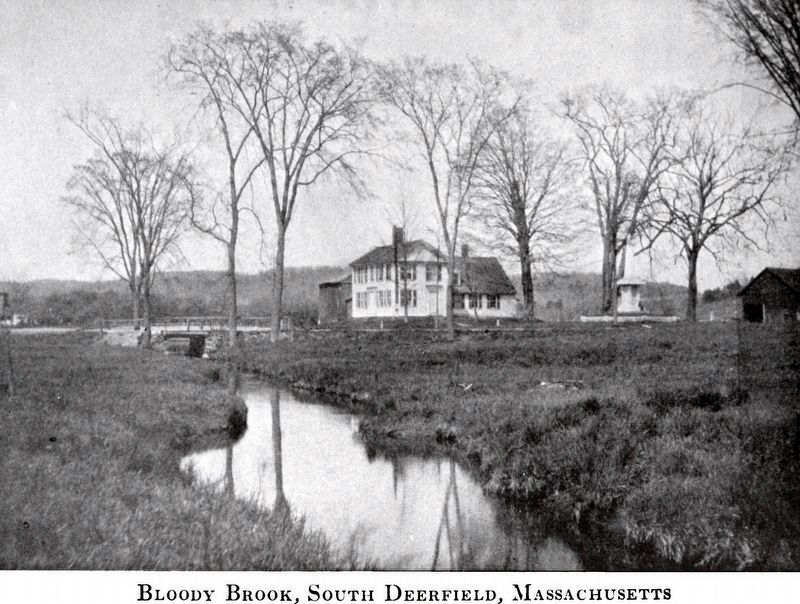
Internet Archive
3. Bloody Brook, South Deerfield, Massachusetts
The Monument can be seen in the distance to the right of the house in this 1906 photo.
Photo from King Philip's War by George William Ellis & John Emery Morris, 1906.
Photo from King Philip's War by George William Ellis & John Emery Morris, 1906.
Also see . . .
1. A Brief History. Short summary of King Philip’s War. (Submitted on November 4, 2010, by Roger W. Sinnott of Norwell, Massachusetts.)
2. Historian Stan Svec describes the 1675 Battle at Bloody Brook.
A large stone slab, with the inscription “Grave of Capt. Lathrop and Men Slain by the Indians,1675”, marks a mass grave where the bodies of the slain were interred, It has been moved multiple times and is currently located near the monument, in the front yard of 100 North Main Street.(Submitted on June 11, 2026, by G.W.Bartlett of Hingham, Massachusetts.)
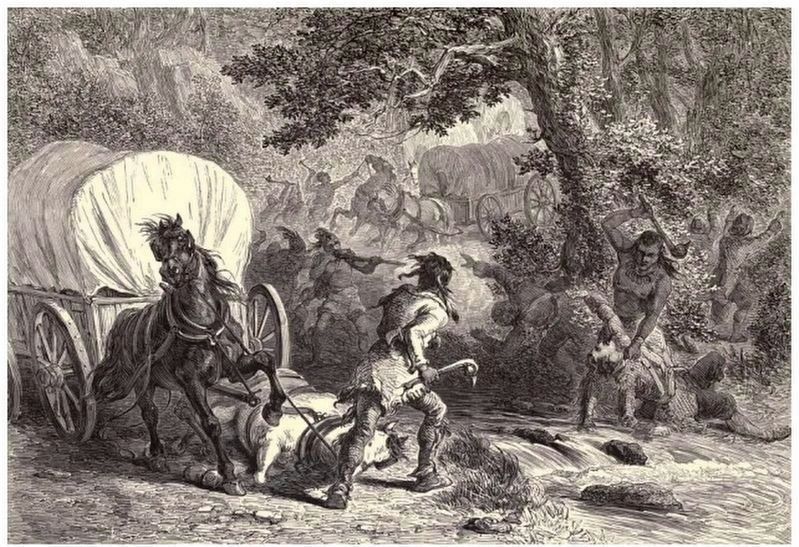
Photographed by G.W.Bartlett
4. Battle at Bloody Brook
The Battle of Bloody Brook was fought on September 18, 1675, between English colonial militia from the Massachusetts Bay Colony and a band of Indians led by the Nipmuc sachem Muttawmp. The Indians ambushed colonists escorting a train of wagons carrying the harvest from Deerfield to Hadley during King Philip’s War. They killed at least 40 militiamen and 17 teamsters out of a company that included 79 militiamen. Image from “Pioneers in the Settlement of America” by William A. Crafts
Credits. This page was last revised on July 14, 2026. It was originally submitted on November 4, 2010, by Roger W. Sinnott of Norwell, Massachusetts. This page has been viewed 4,635 times since then and 286 times this year. Photos: 1, 2. submitted on November 4, 2010, by Roger W. Sinnott of Norwell, Massachusetts. 3. submitted on November 11, 2020, by Allen C. Browne of Silver Spring, Maryland. 4. submitted on April 17, 2026, by G.W.Bartlett of Hingham, Massachusetts. • Bill Pfingsten was the editor who published this page.
