Johnson City in Washington County, Tennessee — The American South (East South Central)
Daniel Boone
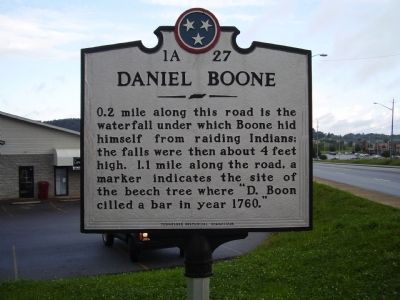
Photographed by Stanley and Terrie Howard, September 27, 2009
1. Daniel Boone Marker
Erected by Tennessee historical Commission. (Marker Number 1A 27.)
Topics and series. This historical marker is listed in this topic list: Exploration. In addition, it is included in the Tennessee Historical Commission series list. A significant historical year for this entry is 1760.
Location. Marker is missing. It was located near 36° 22.951′ N, 82° 24.546′ W. Marker was in Johnson City, Tennessee, in Washington County. It was at the intersection of North Roan Street (Tennessee Route 36) and Old Gray Station Road, on the left when traveling north on North Roan Street. Touch for map. Marker was at or near this postal address: 4411 N Roan St, Johnson City TN 37615, United States of America. Touch for directions.

Regionally, this marker was in East Tennessee and in the Tri-Cities Area. It was also in the American South, specifically in the Upper South, in
this page online
Other nearby markers. At least 8 other markers are within 3 miles of this location, measured as the crow flies: Boone's Creek Church (approx. half a mile away); William Bean's Cabin (approx. half a mile away); Jesse Duncan (approx. 1½ miles away); Isaac Hammer (approx. 1.7 miles away); History on Knob Creek (approx. 2.4 miles away); Henry Massengill (approx. 2.8 miles away); Robert E. Young Cabin (approx. 2.8 miles away); Knob Creek Church of the Brethren (approx. 2.9 miles away). Touch for a list and map of all markers in Johnson City.
Also see . . . State historic marker missing from Boones Creek - [WJHT- News 11]. Marker has been missing since at least June of 2016. The intersection was redesigned and a stoplight was added. This one and many more was
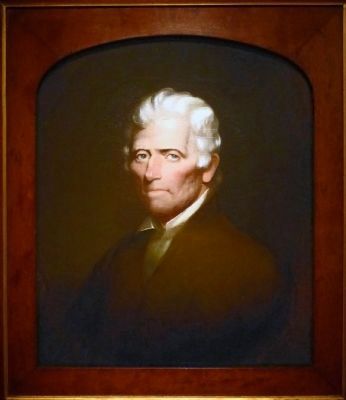
Photographed by Allen C. Browne, February 16, 2015
2. Daniel Boone
This 1820 portrait of Daniel Boone by Chester Harding hangs in the National Portrait Gallery in Washington DC.
“When historian Frederick Jackson Turner formulated his ‘Frontier Thesis” to explain American history and character, he began the progress of settlement with the ‘Lone Scout,’ a harbinger of the civilization to follow. For this concept, Turner likely had Daniel Boone in mind. Boone spent his life pushing westward, always dissatisfied with where he was and always moving on; he ended up in Kentucky, opening that area for white settlement. One reason Boone kept moving was that when the government caught up with him on the trail he had blazed, it usually voided his land claims and expelled him. Although the reality of Boone's career did not embody the romantic legends that others applied to it, the persistence of Boone as a symbol indicates how strongly the idea of the lone frontiersman has shaped American consciousness and history.” — National Portrait Gallery.
“When historian Frederick Jackson Turner formulated his ‘Frontier Thesis” to explain American history and character, he began the progress of settlement with the ‘Lone Scout,’ a harbinger of the civilization to follow. For this concept, Turner likely had Daniel Boone in mind. Boone spent his life pushing westward, always dissatisfied with where he was and always moving on; he ended up in Kentucky, opening that area for white settlement. One reason Boone kept moving was that when the government caught up with him on the trail he had blazed, it usually voided his land claims and expelled him. Although the reality of Boone's career did not embody the romantic legends that others applied to it, the persistence of Boone as a symbol indicates how strongly the idea of the lone frontiersman has shaped American consciousness and history.” — National Portrait Gallery.
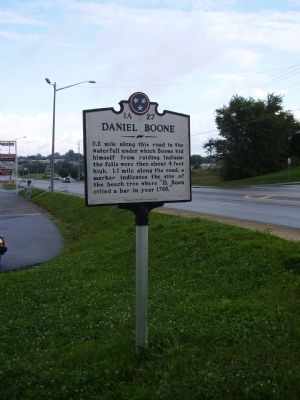
Photographed by Stanley and Terrie Howard, September 27, 2009
3. Daniel Boone Marker
Credits. This page was last revised on August 19, 2026. It was originally submitted on September 30, 2009, by Stanley and Terrie Howard of Greer, South Carolina. This page has been viewed 4,069 times since then and 211 times this year. Last updated on May 7, 2015, by J. Makali Bruton of Washington, District of Columbia. Photos: 1. submitted on September 30, 2009, by Stanley and Terrie Howard of Greer, South Carolina. 2. submitted on May 7, 2015, by Allen C. Browne of Silver Spring, Maryland. 3. submitted on September 30, 2009, by Stanley and Terrie Howard of Greer, South Carolina. • Andrew Ruppenstein was the editor who published this page.
