Franklin in Macon County, North Carolina — The American South (South Atlantic)
Nikwasi Mound
Cherokee Heritage Trails
Photographed by Don Morfe
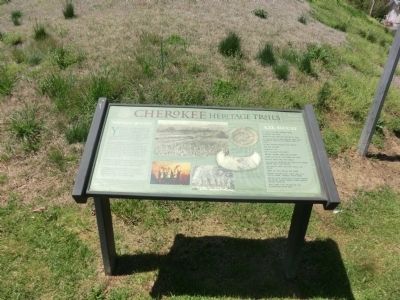
1. Nikwasi Mound-Cherokee Heritage Trails
The Cherokee dominated the southern Appalachians for thousands of years. When Alexander Cuming visited Nikwasi in 1730, the Cherokees had men and women leaders in autonomous towns that functioned democratically. Cuming called a council here that was attended by more than two thousand representatives from Cherokee towns. Cuming chose an Emperor, and took a Cherokee delegation to London. In 1761 the British, former allies of the Cherokee, destroyed Nikwasi. After the Cherokees rebuilt, the Americans destroyed it in 1776. The Cherokees rebuilt again and lived here until this area was taken by the Treaty of 1819.
A
this page online
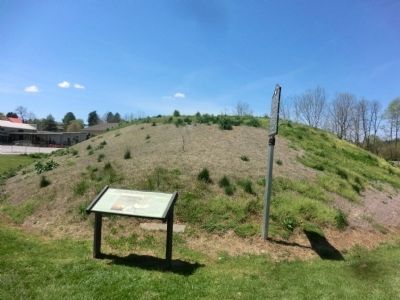
The Nikwasi mound is one of the largest surviving mounds in the original Cherokee territory of 140,000 square miles. In 1946, the schoolchildren of Macon County saved their pennies and bought the mound through the Macon County Historical Society to save it from development. It is now owned by the Town of Franklin.
Erected 2008 by Cherokee Heritage Trails.
Topics. This historical marker is listed in these topic lists: Anthropology & Archaeology • Colonial Era • Indigenous Peoples and Communities • Man-Made Features. A significant historical year for this entry is 1730.
Location. 35° 11.09′ N, 83° 22.401′ W. Marker is in Franklin, North Carolina, in Macon County. It is at the intersection of East Main Street (Business U.S. 441) and Nikwasi Lane, on the left when traveling east on East Main Street. Touch for map. Marker is in this post office area:
Photographed by Don Morfe
2. Nikwasi Marker with the mound in the background

Regionally, this marker is in andspecifically he Mountains in the Golden Corner. It is also in the American South, specifically in the Upper South, in Appalachia, and specifically in Southern Appalachia. Globally, it is in North America, the Western Hemisphere, the Western World, and the Anglosphere. Historically, it finds itself in what was once the original Cherokee Nation, the territory of the Mississippian Culture, one of the original Thirteen Colonies, one of the Confederate States of America, and the Antebellum South.
Other nearby markers. At least 8 other markers are within walking distance of this marker: Nikwasi (here, next to this marker); Na'ha or Rebecca Morris (about 300 feet away, measured in a direct line); Nokwisiyi (Star Place) (about 300 feet away); The Bartram Trail (approx. 0.4 miles away); Main Street Milliners (approx. 0.4 miles away); Built in 1907 (approx. 0.4 miles away); The Brave New World of Beauty Industry Offered Opportunities for Women (approx. 0.4 miles away); The North Carolina Bartram Trail (approx. half a mile away). Touch for a list and map of all markers in Franklin.
Credits. This page was last revised on June 16, 2016. It was originally submitted on July 20, 2014, by Don Morfe of Baltimore, Maryland. This page has been viewed 1,217 times since then and 56 times this year. Photos: 1, 2. submitted on July 19, 2014, by Don Morfe of Baltimore, Maryland. • Bernard Fisher was the editor who published this page.
