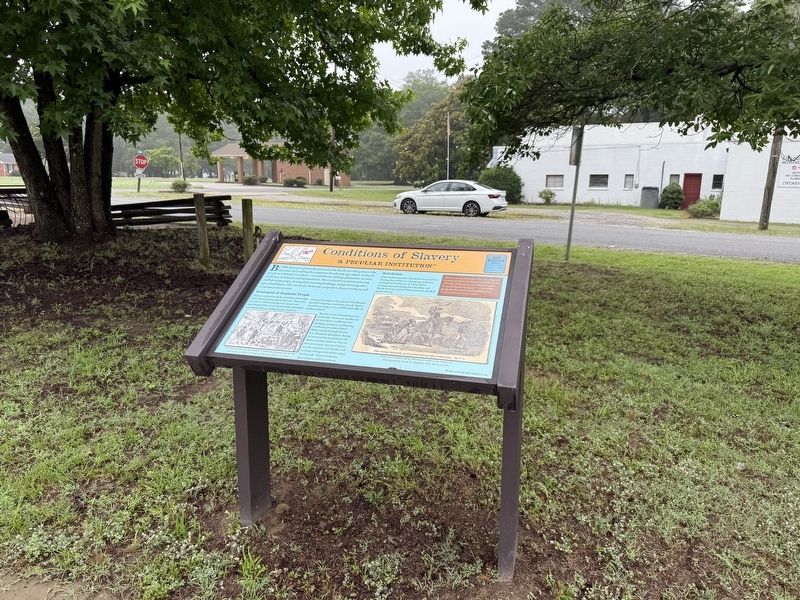
By 1800, slavery was primarily practiced in the South, providing most of the labor force and enabling the expansion of cash crop agriculture. Enslaved people were everywhere — on small farms and large plantations, in cities and towns, in industry . . . — — Map (db m276514) HM
After the clash with members of the Southampton Militia a few miles away at Parker's Field. Nat Turner was determined to continue to Jerusalem (today's Courtland), directing 20 or so of his men to follow lesser used roads. Turner believed that he . . . — — Map (db m276530) HM
Dred Scott was born with slave status in Southampton County around 1798. The peter Blow family acquired him shortly after that. The Blows moved to Alabama and later to St. Louis, Missouri, where they sold Dred to John Emerson, a physician serving . . . — — Map (db m276528) HM
In 1854, john Brown, a freedom seeker born in Southampton County, first known as "Fed," dictated his story to Louis Alexis Chamerovzow, secretary of The British and Foreign Anti-Slavery Society. The resulting book, Slave Life in Georgia: A . . . — — Map (db m276532) HM
Two newspapers reported that Deputy Sheriff Edward Butts executed Turner at either high noon or one o'clock p.m. on November 11, 1831. Most sources agree that a large crowd gathered on the day of the execution. Yet only a few were permitted to . . . — — Map (db m290878) HM
Near where you are standing today once stood the so-called "Hanging Tree," Southampton County's "usual place of execution" for criminals, both White and Black. Nat Turner was hanged here on November 11, 1831. The executioner was Edward Butts, . . . — — Map (db m290880) HM
You are here in Courtland, the county seat of Southampton County, Virginia, at the Rebecca Vaughan House's new site. This building was moved from its original location, five miles away from the end of a long lane off Barrow Road. the last . . . — — Map (db m276515) HM
This home is one of Courtland's most significant properties on the National Register of Historic Places. The Rochelle-Prince House, built in 1814, is an excellent example of a Southeastern Virginia residence with Federal influences. The house was . . . — — Map (db m276520) HM
The elegant residence you see here is known as Seven Gables. Josiah Vick constructed it around 1800. By the time of the 1831 Southampton Insurrection, attorney Thomas Ruffin Gray owned this home.
Gray's Time with Nat Turner
From a . . . — — Map (db m276519) HM
The 1831 Southampton Insurrection is considered the most consequential slave revolt in North American history. It was, however, preceded by many others. Slaveholders lived in fear of such uprisings as enslaved people of African descent often . . . — — Map (db m276512) HM
The first documented Africans to arrive in Virginia landed at Old Point Comfort in August 1619. From Angola, they were captured from a Portuguese slave ship near Veracruz, Mexico, by the Dutch privateers Treasurer and White Lion. . . . — — Map (db m276513) HM
Southampton County was established in 1749. Before the Europeans' arrival, the area south of the Blackwater River was inhabited by Native Americans primarily the Nottoway Indians. According to the 1830 census, Southampton County mostly contained . . . — — Map (db m276523) HM
The local militia mustered here on August 22, 1831, after the news of Nat Turner's uprising spread throughout Southampton County.
Governor John Floyd
Governor John Floyd, a War of 1812 veteran, held a militia commission as brigadier . . . — — Map (db m276518) HM
Nat Turner, an enslaved, self-taught preacher, believed that signs from Heaven guided him to initiate the slave revolt in which more White people were killed than in any other in American history. Born in Southampton County in October 1800, . . . — — Map (db m276516) HM
The legacy of Nat Turner's Rebellion is profound. The uprising of August 21-23, 1831 resulted in the deaths of 57 White men, women and children, spreading terror amongst enslavers. Vicious militia reprisals caused the deaths of approximately 40 . . . — — Map (db m290877) HM
You are at the site of the 1795 Federal-style Southampton County Courthouse. The trials of Nat Turner and many of his followers were held here after the defeat of their insurrection in 1831. The 1795 courthouse was replaced in 1834. The new . . . — — Map (db m276524) HM
In 1831, a simple wood structure stood here, next to the Southampton County Courthouse. Built as a jail, the small building held Nat Turner and many of his followers before trial and during the time between their sentencing and executions. . . . — — Map (db m276527) HM
Crowds gathered at Jerusalem's taverns, attracted by the trials of Nat Turner and his followers. Ideally located across the street from the Southampton County Courthouse, these taverns served as the hub of social and business activity during . . . — — Map (db m276541) HM