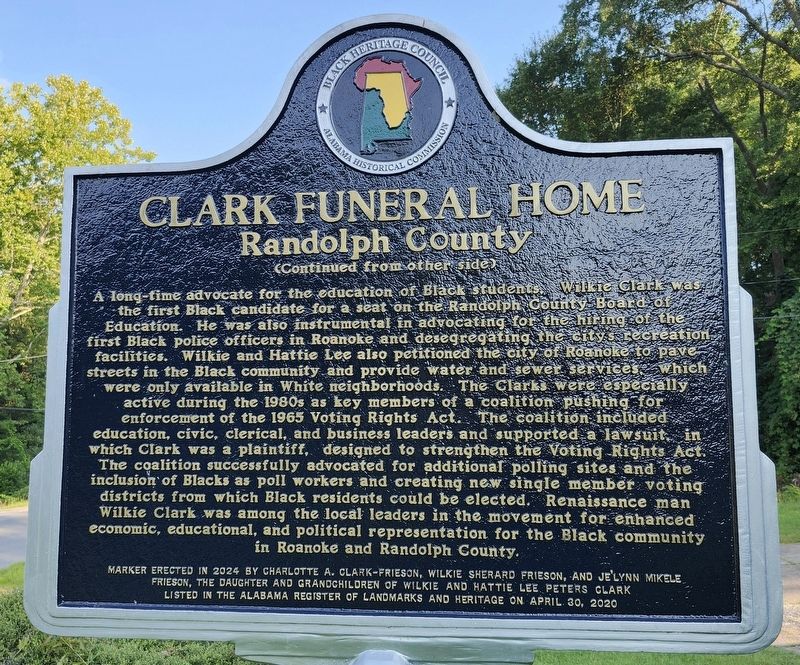
On Lafayette Highway (Local Route 252) 0.2 miles south of Main Street (Alabama Route 22), on the right when traveling south.
Clark Funeral Home was established on this site in 1969 by Wilkie Clark and his wife and business partner, Hattie Peters Clark, representing the life-long dream of the well-known civil rights activist and entrepreneur. The funeral home was . . . — — Map (db m282042) HM
On County Road 16 at Bacon Cove Road (County Road 75), on the right when traveling south on County Road 16.
Pottery-Making Families of Randolph County
During the 1830s, pottery-making families moved directly from the Carolinas and Georgia. Most came from the Edgefield District of western South Carolina, which boasted an important pottery-making . . . — — Map (db m118124) HM
On Lafayette Highway 0.1 miles north of West Point Street, on the right when traveling north.
Randolph County Training School (RCTS) was chartered on
September 15, 1919 as a public school for African Americans. It
opened in the fall of 1920 with 73 students. The original two-story
wood structure was built with contributions from black . . . — — Map (db m235575) HM
Near Court Square (Road 31) at 2nd Avenue North, on the right when traveling south.
Clay County
Established Dec. 7, 1866
Boundaries of eastern Talladega County and western Randolph County were redrawn in 1866 to create the 58th county of Alabama. The name honors U. S. Senator Henry Clay of Kentucky. Historical place . . . — — Map (db m95095) HM
On Pearl Street (U.S. 82) 0.2 miles south of Bentley Road (State Route 41), on the left when traveling south.
Five miles NE is the Battleground of Echowanochaway Creek, site of the last engagement between Randolph County settlers and hostile Creek Indians on July 27, 1836. Captain Thomas Stapleton was killed in a preliminary fight the day before near . . . — — Map (db m113675) HM
On East Greene Street (Georgia Route 16) at Blue Run Street, on the left when traveling east on East Greene Street.
Here lived Dr. David Addison Reese, born in Mecklenberg County, N. C., son of a Revolutionary soldier and grandson of a signer of the Mecklenberg Declaration of Independence. When a young man Dr. Reese moved to Monticello and married Mary Gaines . . . — — Map (db m207808) HM
On Pine Street at Court Street, on the right when traveling west on Pine Street.
Early Randolph County
The area that is now Randolph County lies within the vast territory in Georgia and Alabama once claimed by the Creeks. In the late 1700s and early 1800s several small Creek towns were scattered throughout the area, . . . — — Map (db m113738) HM
On Pace Ranch Road 0.5 miles south of County Highway 4622, on the left when traveling south.
David Allen Owen came to Texas with his first wife, Mary (Langsdon), who died enroute, and their 5 children. They traveled with family members and others from Randolph County, Alabama to Henderson County, Texas in 1851. Owen served as chief . . . — — Map (db m155485) HM
On U.S. 62/67 north of South Bettis Street, on the right when traveling north.
People have hunted and fished in the rich Black River Basin at least since the Paleo Indian Period (beginning around 10,000 B.C.). More recently, Native American built villages and mounds across the Mississippi River valley (3000 B.C.-A.D.1650). . . . — — Map (db m170367) HM
On Cheaha Road (Alabama Route 49) south of Nichols Street, on the right when traveling south.
Native Americans were the first to inhabit the area known as
Lineville. The Creek Indian War of 1812, however, resulted in their
removal. The first white settlers here were William and Thomas
Lundie. Their settlement became known as Lundie's . . . — — Map (db m175281) HM
On Pine Street at Court Street, on the right when traveling west on Pine Street.
Located within what had long been Creek territory and containing portions of well-used trails connecting the area with the Seminoles in Florida, Randolph County became an important scene of action during the Second Creek War (1836-38). The war came . . . — — Map (db m223533) HM
Thin black lines indicate changes in relevance. Between each pair of lines entries are ordered geographically but all have the same relevance.
* Inflectional forms of words are their plurals, singulars, and possessives as well as gramatical tenses and similar variations.