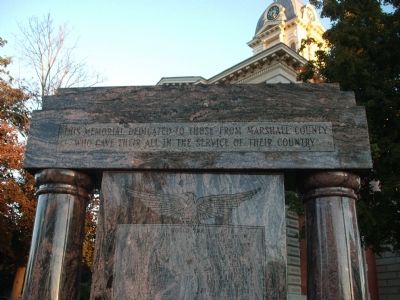
On West Jefferson Street at North Center Street, on the right when traveling west on West Jefferson Street.
( Front )
This Memorial dedicated to those from Marshall County who gave their all in the service of their Country
- - - 1917 - - - World War I - - - 1918 - - -
( Column One )
William E. Albert ● Earnest A. Anderson . . . — — Map (db m36771) WM
On E. Jefferson Street at Cleveland Street, on the right when traveling east on E. Jefferson Street.
(Side One)
Historic Crossroads of America
Marshall County has been called the Crossroads of America. The Lincoln Highway (the Lincoln’s second alignment constructed in the mid-1920s), the Michigan Road (Indiana’s first state . . . — — Map (db m75489) HM
On Indiana Route 10 at Queen Road, on the right when traveling east on Indiana Route 10. Reported permanently removed.
Pioneer Camp. Here, at twilight on July 26, 1836, after a two-week trip from southern Indiana, Marshall County’s first multi-family group of pioneer settlers made their camp, blowing a conch shell to announce their arrival to Vincent . . . — — Map (db m231887) HM
Near North Blackford Street north of Indianapolis Cultural Trail, on the right when traveling north.
A mixture of quaint country atmosphere and scholarly excellence is brought to life in Marshall County. The landscape is home to the second largest natural lake in Indiana, Lake Maxinkuckee. Blueberries are grown throughout the county. The . . . — — Map (db m238944) HM
On Michigan Road at Meadow Drive, on the right when traveling south on Michigan Road.
1836
Under the pine tree that grew near there this spot was held the first meeting for the organization of Marshall County.
First Commissioners
Charles Osterhaut
Robert Blair
Abraham Johnson — — Map (db m75755) HM
On Shelbyville Highway (Tennessee Route 64) 0.2 miles west of David Road, on the right when traveling west.
The Farmington engagement took place along this road during Confederate Gen. Joseph Wheeler's October 1-6, 1864, raid through the Sequatchie Valley to cut supply lines to Federal-occupied Chattanooga. Wheeler and his 4,000 cavalrymen captured or . . . — — Map (db m151054) HM
Thin black lines indicate changes in relevance. Between each pair of lines entries are ordered geographically but all have the same relevance.
* Inflectional forms of words are their plurals, singulars, and possessives as well as gramatical tenses and similar variations.