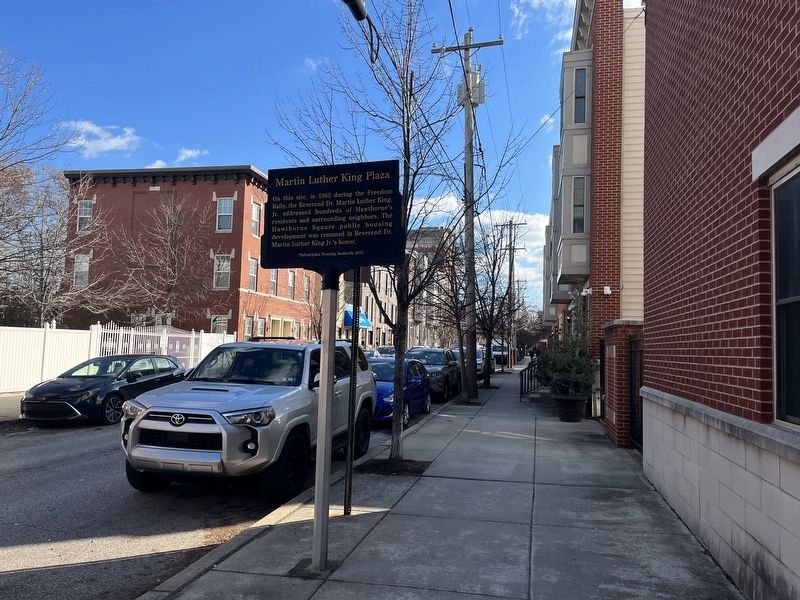
On Fitzwater Street at South 13th Street, on the right when traveling east on Fitzwater Street.
On this site, in 1965 during the Freedom Rally, the Reverend Dr. Martin Luther King, Jr. addressed hundreds of Hawthorne's residents and surrounding neighbors. The Hawthorne Square public housing development was renamed in Reverend Dr. Martin Luther . . . — — Map (db m191620) HM
Near Market Street (County Road 2004) east of South 6th Street (County Road 2005), on the left when traveling west.
Korean Children's Choir at the Liberty Bell
April 22, 1954
Independence National Historical Park
Dalai Lama's visit, Fall 1990
Independence National Historical Park
Dr. Martin Luther King Junior and
Dr. Emmanuel C. . . . — — Map (db m146646) HM
On South 6th Street (County Road 2005) south of Market Street (County Road 2004), on the left when traveling south.
The words "slave" and "slavery" are not in the U.S. Constitution as ratified, nor the word 'property' in connection with language alluding to slavery. At the Constitutional Convention, James Madison, a Virginian, said it would be "wrong to admit . . . — — Map (db m307039) HM
On Dr. Martin Luther King Drive (State Highway S-7-45), on the right when traveling south.
One of the first schools for blacks in the South, Penn School, was reorganized as Penn Normal, Industrial and Agricultural School in 1901. As a
result of this change, incorporating principals of education found at both Tuskegee and Hampton . . . — — Map (db m20294) HM
Native Charlestonian and daughter of a former lowcountry slave, Mrs. Septima Clark was a leader of the Civil Rights Movement. A graduate of Avery Normal Institute, Clark's first job was teaching African-American children on Johns Island. Her . . . — — Map (db m64797) HM
The spiritual mentor of
Martin Luther King, Jr.
Born here in 1894. Served
as president of Morehouse
College 1940-67 and as
presidential advisor.
Died in 1984. — — Map (db m11044) HM
On Harden Street near Greene Street, in the median. Reported missing.
Front
The honorary designation of Harden Street and installation of markers in the name of the Reverend Dr. Martin Luther King, Jr. Blvd. recognizes the achievements of a man who inspired the world to embrace equality and non-violence to . . . — — Map (db m223467) HM
On North Minnesota Avenue (Interstate 90BS) at West 7th Street, on the right when traveling north on North Minnesota Avenue.
Dr. Martin Luther King, Jr., the preeminent leader of the movement to end segregation and racial discrimination through civil disobedience and other nonviolent means, arrived in Sioux Falls on January 12, 1961, a guest of nearby St. John's Baptist . . . — — Map (db m208208) HM
On 17th Avenue North, on the right when traveling north.
Fisk Memorial Chapel, deigned by New York architect William Bigelow, was erected in 1892 in memory of General Clinton B. Fisk, a founder of the University. The religious and cultural center of the campus, the Chapel has welcomed foreign dignitaries, . . . — — Map (db m4268) HM
On Tracy Road (U.S. 41) at Justus Street, on the left when traveling north on Tracy Road.
In 1932, Myles Horton and Don West founded Highlander Folk School, located ½ mile north of this site. It quickly became one of the few schools in the South committed to the cause of organized labor, economic justice. and an end to racial . . . — — Map (db m150471) HM
On Mulberry Street near Butler Avenue, on the left when traveling north.
The National Civil Rights Museum is a place of pilgrimage, where the community of Memphis and citizens of the world gather to renew a commitment to nonviolence, civil rights, and human rights.
BlueCross Healthy Place at Founders Park is . . . — — Map (db m297012) HM
On Mulberry Street north of Butler Avenue, on the left when traveling north.
Coretta Scott King addresses the "Solidarity Day" rally during the Poor People's Campaign from the steps of the Lincoln Memorial, Washington, DC, June 19, 1968
Courtesy of Bettmann/Corbis/AP Images
Stokely Carmichael, national . . . — — Map (db m297011) HM
On Mulberry Street north of Butler Avenue, on the right when traveling north.
The vintage cars in the parking lot represent the vehicles parked at the Lorraine Motel when Dr. King was killed. The wreath on the balcony is a replica—the original was placed here on April 8, 1968, during a memorial service. The marble marker was . . . — — Map (db m297009) HM
On Mulberry Street north of Butler Avenue, on the right when traveling north.
Founding President
Southern Christian Leadership Conference
”They said one to another.
Behold, here cometh the dreamer...
Let us slay him...
And we shall see what will become of his dreams”
Genesis . . . — — Map (db m296992) HM
392 Beale Avenue
"There were two types of
culture, I guess you could
say, on Beale Street.
There were the sinners
and there were the saved.
You had your professional
people, your doctors and
business folk. Then you
had those who . . . — — Map (db m107601) HM
On Hernando Street just south of Dr. Martin Luther King, Jr. Avenue (U.S. 78), on the left when traveling south.
This building. designed by architects
Long & Kees with E. C. Jones supervising, was dedicated to the worship
of God on Jan. 1, 1893. It was the second home of Second Presbyterian
Church (organized Dec. 28, 1844)
until sold to the AME Church in . . . — — Map (db m148963) HM
Here, on April 4, 1968 …
Dr. Martin Luther King Jr. stood on the balcony in front of Room 306, discussing that evening's sanitation strike meeting with aides. King requested his favorite spiritual, “Precious Lord,” be played that night. . . . — — Map (db m183598) HM
On Mulberry Street at Hulling Avenue, on the left when traveling south on Mulberry Street.
Originally the Windsor Hotel (c. 1925) and later one of only a few hotels for blacks, it hosted such entertainers as Cab Calloway, Aretha Franklin, Count Basie, B.B. King, and Nat King Cole. Walter and Loree Bailey bought it in 1942, renaming it . . . — — Map (db m82865) HM
On E. Highway 80 (Martin Luther King Jr Boulevard) at N. Treadaway Boulevard, on the right when traveling east on E. Highway 80 (Martin Luther King Jr Boulevard).
Martin Luther King, Jr.
January 15, 1929 - April 4, 1968
”I Have a Dream”
Dr. Martin Luther King, Jr., was an American leader of nonviolence and a prophet of peace in a time of trouble. He dared valiantly to dream that . . . — — Map (db m79784) HM
On Patton Street east of South Union Street, on the right when traveling east.
In the spring of 1963 local African American ministers and other leaders organized the Danville Movement to combat widespread racial segregation and discrimination. On 10 June, two demonstrations occurred. Police clubbed and fire-hosed the marchers, . . . — — Map (db m66038) HM
On Courthouse Road south of Lundys Road, on the right when traveling south.
The Rev. Dr. Martin Luther King Jr. spoke at Mount Level Baptist Church on 28 March 1962 during a "People to People" tour of communities in southern Virginia. King and other official of the Southern Christian Leadership Conference made stops between . . . — — Map (db m310182) HM
Near East Market Street (Virginia Route 7) at Sycolin Road Southeast, on the right when traveling east.
• February was selected as Black History Month because it contained the birthdays of President Abraham Lincoln and Frederick Douglass
• Phillis Wheatley was only 12 when she became the first female African American author published in 1773
. . . — — Map (db m291578) HM
On East Market Street (Route 7) at Sycolin Road Southeast, on the right when traveling east on East Market Street.
He was an activist, humanitarian, Baptist minister and a leader in the African-American civil rights movement.
Sculptor: Jeffery L. Hall, 2023 — — Map (db m291549) HM
On Martin L. King Jr. Way at Jefferson Avenue on Martin L. King Jr. Way.
As part of Dr. King’s crusading efforts, he made appearances at historically black colleges throughout the country, including Hampton Institute, to spread his message. As a man of the cloth, his most frequent venue for reaching African Americans . . . — — Map (db m98321) HM
On Martin L. King Jr. Way at Jefferson Avenue on Martin L. King Jr. Way.
Groundbreaking for this memorial devoted to Dr. King took place September 10, 2010, as part of Southeast Community Day. The keynote speaker was his daughter and national president of the Southern Christian Leadership Conference, Dr. Bernice A. King. . . . — — Map (db m98324) HM
On Martin L. King Jr. Way at Jefferson Avenue on Martin L. King Jr. Way.
The report of Dr. King’s death by an assassin’s bullet on April 4, 1968, left the nation and the world stunned. The shock was especially pronounced because the minister had advocated nonviolence throughout his civil rights career. A victim of the . . . — — Map (db m98326) HM
On South Sycamore Street (U.S. 301) at Marshall Street, on the left when traveling south on South Sycamore Street. Reported permanently removed.
Petersburg's main public library, the William R. McKenney Library, is housed in a fine dwelling constructed in 1859 by John Dodson, a prominent lawyer and mayor of Petersburg. After the Civil War, the Confederate General and railroad magnate . . . — — Map (db m20609) HM
On South Sycamore Street just north of Marshall Street, on the right when traveling north.
Petersburg's main public library, the William R. McKenney Library, is housed in a dwelling constructed in 1859 by John Dodson, a prominent lawyer and a former mayor of Petersburg. After the Civil War, the Confederate general and railroad . . . — — Map (db m180105) HM
On Perry Street just north of Farmer Street, on the right when traveling north.
Wyatt Tee Walker, pastor of Gillfield Baptist Church from 1953 to 1960, served as the president of the Petersburg branch of the NAACP and as Virginia director of the Congress of Racial Equality. He worked closely with Dr. Martin Luther King Jr. and . . . — — Map (db m180107) HM
On South Main Street (U.S. 15) at 4th Street, on the right when traveling north on South Main Street. Reported permanently removed.
The First Baptist Church was organized in 1866 as an outgrowth of the predominantly white Farmville Baptist Church. In 1949, following the death of the Rev. C. H. Griffin, the Church voted unanimously to call his son, L. Francis Griffin, as . . . — — Map (db m31310) HM
On North Main Street (Business U.S. 15) just south of 4th Street, on the right when traveling north.
First Baptist Church in Farmville was organized in 1866 as an outgrowth of the predominantly white Farmville Baptist Church. In 1949, following the death of the Rev. C.H. Griffin, the church voted unanimously to call on his son, L. Francis . . . — — Map (db m181206) HM
Coburn Hall was constructed in 1899 and named for Maine governor Abner Coburn. It held Virginia Union’s original chapel and library collection. Many legendary pastors and scholars preached and lectured in Coburn Hall, including Dr. Martin Luther . . . — — Map (db m108984) HM
On Norfolk Avenue Southwest north of 1st Street Southwest, on the left when traveling east.
Facing the railroad tracks, west is to your left where you see the Dr. Martin Luther King Jr. Memorial Bridge. Originally called the Henry Street Bridge, it spans the tracks to connect historic Henry Street with First Street to the south. The bridge . . . — — Map (db m134595) HM
On Scotland Street just west of Prince George Street, on the right when traveling west.
This church, home to one of the oldest continuous congregations organized by African Americans, traces its origins to brush arbor meetings held by 1776 at a nearby plantation. The congregation moved to a Williamsburg carriage house and in 1856 . . . — — Map (db m167815) HM
Near Martin Luther King, Jr. Way S. south of S. Walker Street.
This park honoring Martin Luther King, Jr. was inspired by Dr. King’s last speech entitled “I’ve Been to the Mountaintop.” He delivered the speech in Memphis, Tennessee the night before he was assassinated. He was there in support of . . . — — Map (db m22557) HM
138 entries matched your criteria. Entries 101 through 138 are listed above. ⊲ Previous 100