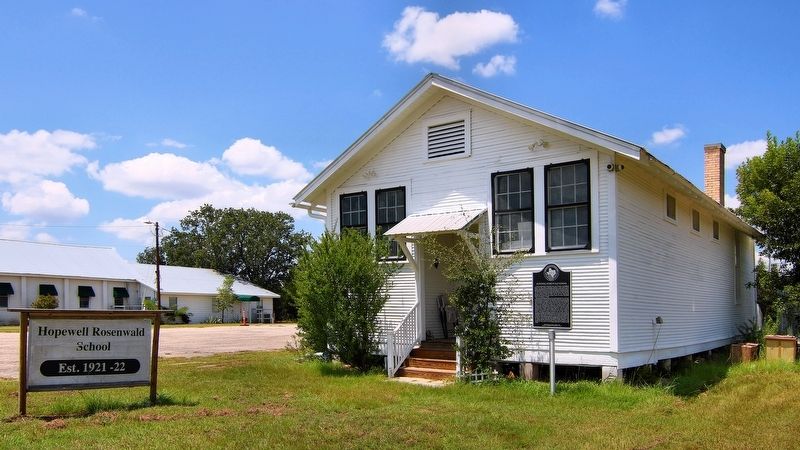
After Emancipation, education was a key pathway to economic prosperity for African Americans. However, funds were often scarce and advocates experienced significant disparities in public monies appropriated for black education. Booker T. Washington . . . — — Map (db m254149) HM
A grant from the Rosenwald Foundation of Chicago led to the establishment of a local school for African American students. The foundation represented a collaboration between Julius Rosenwald, President of Sears, Roebuck, and Company, and the . . . — — Map (db m83276) HM
Julius Rosenwald created the Rosenwald Fund in 1917 to endow new African American schools. Luling's Rosenwald school opened in 1925 to replace the Luling Colored School which began operation in 1874. The Rosenwald School employed four teachers for . . . — — Map (db m204666) HM
Before a school existed in Eagle Lake, African Americans were educated at home or in small churches, with some classes held in a local blacksmith shop. The first school for African-American children was located on Main Street in a room on the first . . . — — Map (db m192866) HM
A symbol of Black America's pride in education, plus crusade of Julius Rosenwald (1862-1932), a Chicagoan who in 1913 began to fund school buildings for Negroes. By 1920, when this one-teacher structure was built at Ratcliff (4 miles east), . . . — — Map (db m201868) HM
By 1883, Liberty County maintained 53 schools, including 19 African American schools. The average school term was three months for ages 8-14 but the only school for children in Dayton was located near the settlements of Stilson and Fouts.
In . . . — — Map (db m206767) HM
Through the joint efforts of Dr. Booker T. Washington, President of Tuskegee University, and Julius Rosenwald, a Jewish American philanthropist, more than 200 schools and related buildings were constructed in rural, Black communities in East . . . — — Map (db m243515) HM
In the 1920s, Black schoolchildren, mostly poor and rural, attended school in old dilapidated buildings with out-of-date textbooks. Julius Rosenwald, president of Sears, Roebuck and Company, in collaboration with African American educator Booker . . . — — Map (db m306975) HM