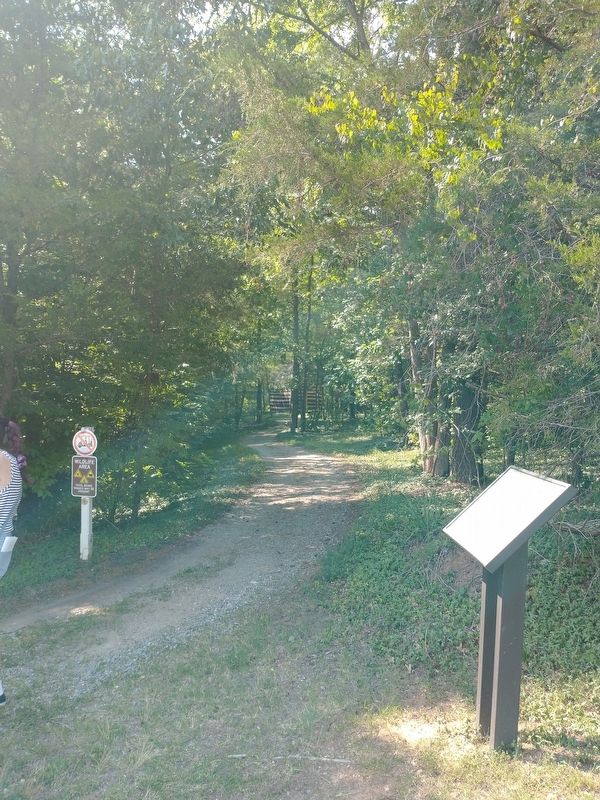
The Quarter Place is a one-mile, down-and-back trail where the enslaved and later free black population lived at Red Hill. Along the trail are an exhibit cabin, original cabin foundations, tobacco barn, ordering pit, and the Quarter Place Enslaved . . . — — Map (db m306985) HM
The reconstructed cabin is the starting point for the half-mile Quarter Place Trail. It is representative of the types of dwellings that were present along the Quarter Place that the enslaved and later free black population lived in throughout the . . . — — Map (db m306987) HM
These two cabin foundations are what remains of structures used as housing for the enslaved population and later sharecroppers after 1865. A photograph of these cabins from a 1945 edition of "The Iron Worker" served as the basis for the Quarter . . . — — Map (db m307012) HM
This turntable is the last known example of a Sellers turntable found in the United States. The turntable is one of the most iconic relics from the steam era of American railroading. It was the most efficient way to burn a steam locomotive . . . — — Map (db m304013) HM
Most ordering pits were built under barns and could be as deep as eight feet. Tobacco workers would access the pit through a trap door and ladder. The inside of this pit would have been unlined with beams forming crosses for tobacco to be hung from . . . — — Map (db m307014) HM
You are now standing before one of Virginia's largest plantation cemeteries for enslaved and freed African Americans. It is estimated that this site was used for burials between the 1790s and the 1930s.
This cemetery shows patterns of . . . — — Map (db m307015) HM