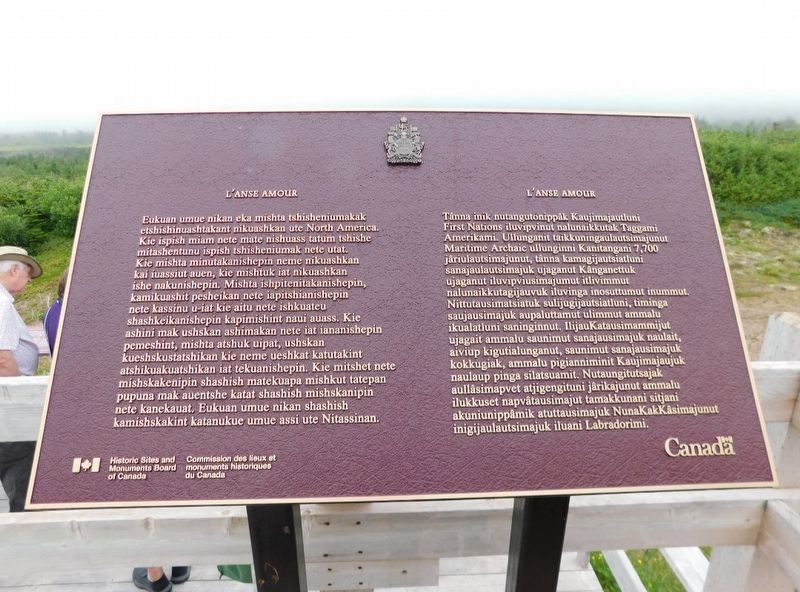
This is the site of the oldest known First
Nations funerary monument in North
America. Dating to the Maritime Archaic
period about 7,700 years ago, the carefully
built mound of rocks over a stone burial
box marked the grave of a young . . . — — Map (db m289807) HM
English:
This mound of rocks is the earliest known funeral monument in the new world and marks the burial place of an Indian child who died about 7500 years ago. The Maritime Archaic people, to whom the child belonged, occupied this area . . . — — Map (db m79551) HM
The concrete foundations near the beach are the remains of a huge diaphone - a fog signal which produces a blast of two distinct tones. When it was installed (in) 1906 the diaphone was the latest in technology. It was operated by compressed air and . . . — — Map (db m79554) HM
The concret ruins which you see here are the remains of the Marconi Wireless Telegraph Station that was built in 1904. Originally constructed for the benefit of trans-Atlantic shipping, the telegraph station became the first major communication link . . . — — Map (db m79552) HM
Tracey has been home to several generations of the Moores Family since the mid-1800s.
This monument marks the location of Ellis & Lillian Moores’s family house. — — Map (db m79543) HM
English:
In the 16th century, the Labrador side of the Strait of Belle Isle emerged as the world's largest producer of whale oil. At its peak, whaling on this coast attracted nearly 2000 Basques annually from Spain and France, and Red Bay . . . — — Map (db m79527) HM