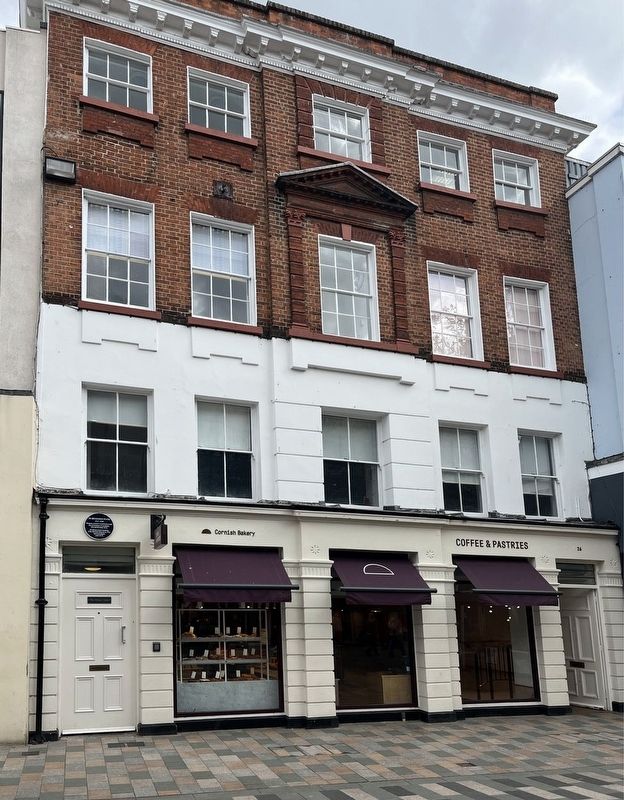
On High Street, on the right when traveling north.
Surgeon, pioneer in midwifery and the inoculation of smallpox, who saved many lives.
He designed this building (The Mansion House) in 1755 and lived there until 1773 — — Map (db m304633) HM
This green is named Frank Whitmore Green after the said Frank Whitmore, an influential architect in Essex in the late nineteenth century and early twentieth century, and former Mayor of Chelmsford (1892-3).
He is credited with laying out . . . — — Map (db m304629) HM
On Business Springs Road at Victoria Road South, on the left when traveling east on Business Springs Road.
Introduction
Frederic Chancellor (1825-1918) was a notable local Victorian architect archaeologist and surveyor. He began his career in 1846, working for James Beadel & Sons. By 1860, he had set up his own practice, and was joined by his son . . . — — Map (db m304631) HM
Saved a troop train from entering Chelmsford during an air raid in 1943 after the signal box he manned above this platform was bomb damaged and in danger of collapsing. — — Map (db m314375) HM
On High Street, on the right when traveling north.
Founded the Marconi Wireless Telegraph Company Ltd in 1900.
Stayed here at the Saracen's Head Hotel whilst visiting his New Street factory between 1912 and 1928.
On the 15th of June 1920 Dame Nellie Melba made the first professional . . . — — Map (db m304632) HM
Near New London Road, on the left when traveling south.
Introduction
James Fenton left his mark on Chelmsford in the mid-19th century, as an accomplished designer of chapels and fine classical buildings. Responsible for laying out New London Road and this very cemetery, as well as implementing the . . . — — Map (db m314367) HM
On Burgess Springs west of Victoria Road S, on the right when traveling west.
Renowned ceramic artist and potter with works featured in both Chelmsford and Victoria & Albert Museums
Taught here at the former Mid-Essex Technical College — — Map (db m314368) HM
On Tindal Street at High Street, on the right when traveling north on Tindal Street.
The Right Honorable
Sir Nicolas Conyngham Tindal, Knt., D.C.L
Lord Chief Justice of the Court of Common Pleas
Born at Chelmsford, A.D. 1776,
Died A.D. 1846,
Erected A.D. 1850.
To preserve for all time the image of a judge, whose . . . — — Map (db m314373) HM
The first gaol in Chelmsford was built on the south bank of the River Can during the 17th Century, probably in 1658. Known as the Moulsham Gaol, it was demolished and rebuilt in 1777. Chelmsford's elegant stone bridge was built ten years later. . . . — — Map (db m304669) HM
On Barrack Square at Moulsham Street, on the right when traveling east on Barrack Square.
The Stone Bridge you see today dates back to 1788, but to find the origins of a crossing here you have to go back to Roman times.
There is no evidence that the Romans bridged the River Can during their occupation of Britain between AD43 and . . . — — Map (db m304634) HM