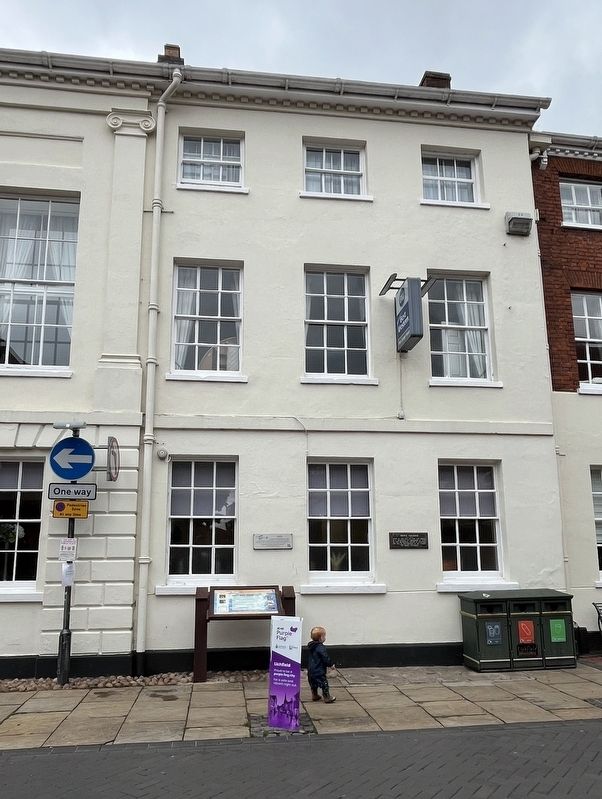
In a challenge to make the first flight between London and Manchester and win a £10,000 prize Louis Paulhan, a Frenchman, landed his Farman biplane in a field near Lichfield Trent Valley Station on 27 April. He stayed overnight at the George Hotel . . . — — Map (db m313260) HM
The Civil War developed from intense rivalry between Royalists who were loyal to the monarch, and Parliamentarians, who supported the rights gained by parliament. Lichfield became a key battle location during this period and at the start of the . . . — — Map (db m313267) HM
Captain Smith was the officer in command of RMS Titanic. He died on 15 April 1912 alongside more than 1,500 people when his ship sank after striking an iceberg on its maiden voyage from Southampton to New York.
The 7'8" (2.34 m) statue is made . . . — — Map (db m309195) HM
Edward Wightman
of Burton-on-Trent
was burnt at the stake
in this Market Place
for heresy
11th April 1612
being the last person
in England so to die. — — Map (db m22661) HM
The area around you was the site of a thriving monastery for over three centuries, from 1230 to 1538. Today, the largely hidden remains of the once impressive friary are protected as a Scheduled Monument.
Look out for the part of the friary . . . — — Map (db m313653) HM
Lived in the inn on this site whilst as a lieutenant of Grenadiers in 1705 he was recruiting troops in Lichfield. The inn he immortalised in his comedy "The Beaux Stratagem". — — Map (db m313264) HM
This Hospital or place of hospitality was founded just outside the walls of Lichfield in AD 1135 by Austin Canons for the accommodation of pilgrims who had come to reverence the relics of S. Chad. It was refounded by Bishop William Smyth in 1495, . . . — — Map (db m313656) HM
Saint Chad was the fifth bishop of Mercia and the first to make Lichfield the base for his missionary work. When he died in 672, public opinion gave him the title of "Saint".
In 700 the cathedral was built to house his relics, and quickly . . . — — Map (db m313654) HM
Brewing played a key role in Lichfield's past and by 1732 there were 80 innkeepers recorded in Lichfield. The coach trade supported this industry as travellers passed through the city stopping at coaching inns, such as The Swan and The George, which . . . — — Map (db m313263) HM
This small garden at the entrance to The Close is on the site of two former dwellings of Newton's College which were demolished in 1929.
The College was built in 1800-1802 to provide accommodation for widows and orphans of clergymen by a . . . — — Map (db m313265) HM
In the Victorian period, work and household chores were very time consuming
and leisure time was scarce. However, when there was down time people would
flock to parks and pleasure gardens.
The main parks in Lichfield developed along the line . . . — — Map (db m309194) HM
This sunken garden retains the ruins of the medieval walls that once surrounded the Cathedral and formed part of the south-east gate to the Cathedral Close.
The area which is now a rockery appears to be the footing of a turret which was . . . — — Map (db m313266) HM
Lichfield is a centre for arts and culture with a wide range of shows held on stage at the Lichfield Garrick Theatre - the building to your right - which replaced the Arts Centre and Civic Hall in 2003. Lichfield's Guildhall offers a programme of . . . — — Map (db m309196) HM
A history of the Garden of Remembrance
In the early 1300s, a crenellated wall surrounded Cathedral Close and formed part of the cathedral's fortifications. According to an 18th century map, the wall passed through the centre of what is now . . . — — Map (db m313657) HM