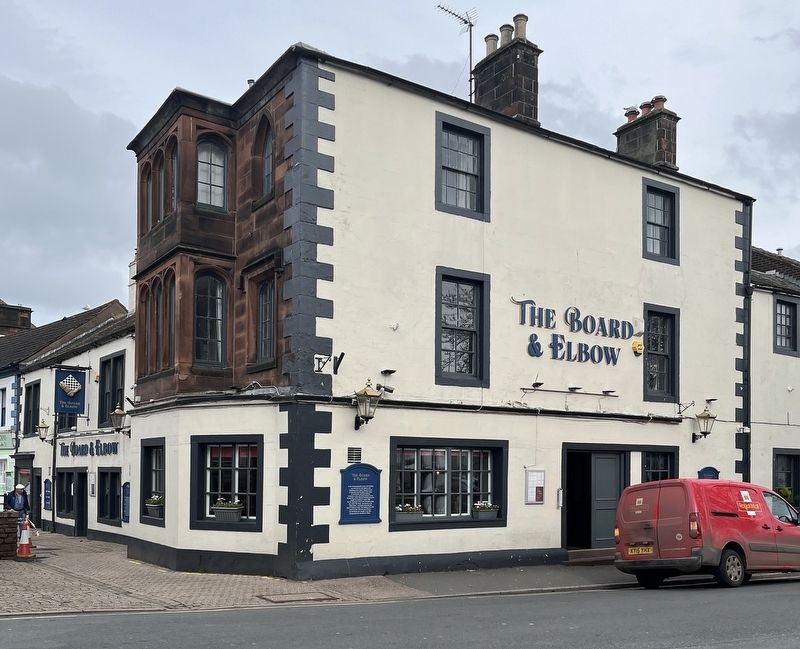
In the mid seventeenth century this building was referred to in the deeds as the 'Gambling Corner House' because a tailor of that name had his shop on this corner of Cornmarket and Great Dockray. It became a wine and spirits business run by George . . . — — Map (db m252204) HM
Penrith is famous for its historic market squares, narrow lanes and courtyards. Markets have been held here for almost 800 years.
Produce and animals were sold in different parts of town. The market cross stood in this square in the 18th . . . — — Map (db m252205) HM
Great Dockray is Penrith's largest open market and the location with Sandgate of the former Whitsunside and Martinmas hiring fairs, every Tuesday the street market held in earlier times bull-baiting took place here when it was an offence, punishable . . . — — Map (db m245889) HM
Following the death of Richard, 2nd earl of Salisbury in 1471, the castle was granted to Richard, duke of Gloucester (1452-1485), who later became King Richard III.
The future king resided at the castle for periods between 1471 and 1483, as he . . . — — Map (db m245699) HM
This is the Cornmarket, where grain was traditionally sold. Markets are still held here every Tuesday.
Different grains were sold outside the inns here. Coal butter, bacon, cattle and tea were also traded. The landlords included farmers, . . . — — Map (db m252383) HM
In 1396 Ralph Neville was given the Manor of Penrith and thereafter built this castle. Neville was an important figure in the safety of the western border with Scotland, but his castle here was more a place of comfort and luxury than strategic . . . — — Map (db m245701) HM
Penrith has always stood at an important junction of routes linking England and Scotland. The arrival of the railway in the 19th century boosted trade and tourism even further.
Penrith was now linked with the Lakes and London, and the town grew . . . — — Map (db m252386) HM
The streets and shops of Penrith have always changed with the times.
Middlegate was once known as the Long Front, one of Perth's main streets Imagine the noise and smell in the 17th century, when the street was inhabited by weavers, tanners and . . . — — Map (db m252266) HM
The Parish Church, rebuilt in 1720-1722, incorporates a medieval west tower and a galleried interior, and has been described as 'the stateliest church of its time in the county'. The architect is not known, but the church is in the style of Nicholas . . . — — Map (db m245886) HM
Penrith is unusual because it doesn't stand on the banks of a major river. More water had to be brought here 600 years ago to support the growing town and its industries.
Beside Thacka Beck
Look to your right to see Thacka Beck. In about . . . — — Map (db m252209) HM
This castle was built at the end of the 14th century by Ralph Neville, who played a key role in the defence of the Scottish border.
Ralph Neville (c.1364-1425) was granted the manor of Penrith in 1396 and built the castle soon afterwards. As . . . — — Map (db m245697) HM