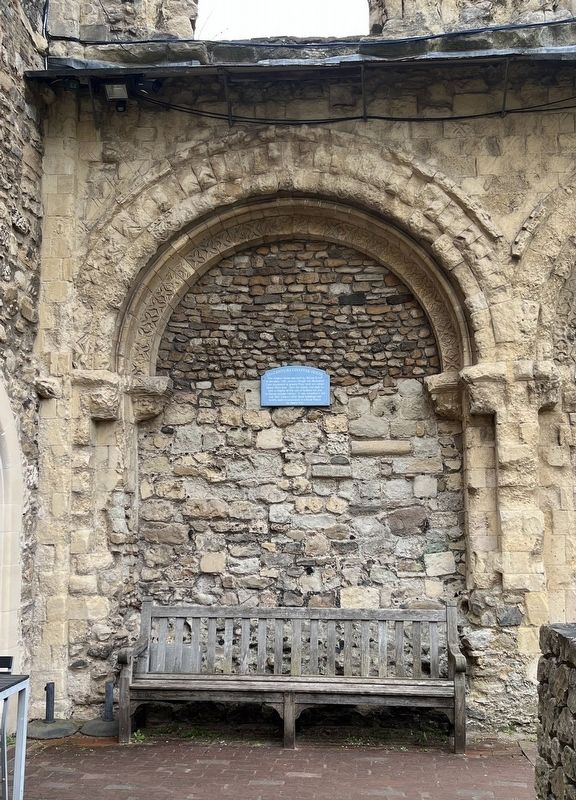
The chapter house was built by Bishop Ernulf in the early 12th. century though the decorated Caen stonework at ground floor level was added about 30yrs later. Here the monks met daily to hear a chapter of the rule of St. Benedict and to discuss . . . — — Map (db m301126) HM
This beautiful doorway gave access to the stairs leading to the monks dormitory. The shafts beside the doorway are of Tournai Marble from Belgium. Above the lintel is a 'Tympanum' on which is carved a scene showing Abraham about to sacrifice Isaac. . . . — — Map (db m303326) HM
King James II of England and VII of Scotland stayed at this house as the guest of Sir Richard Head before embarking for France on the 23rd December 1688 when he finally left England — — Map (db m147191) HM
The castle battlements are part of the castle's defence. Around the top of the outer wall, or parapet, you will see square holes. Strong timber beams were passed through these in order to support 'hourds', a kind of enclosed wooden platform . . . — — Map (db m271830) HM
This "good house" with "nice beds" described by Mr. Jingle in "Pickwick Papers", is also "The Blue Boar" in "Great Expectations". — — Map (db m240342) HM
Near Rochester Castle east of Castle Gardens, on the right when traveling east.
The first stone castle built on this site in 1088 consisted simply of a high wall enclosing a number of timber buildings. The ruins of this wall remain, along with some of the additions and alterations, which increased its strength and usefulness . . . — — Map (db m271876) HM
In his biography of Charles Dickens, published in 1874, John Forster notes "He would himself have preferred to lie in the small graveyard under Rochester Castle wall." Dickens was buried at Westminster Abbey. — — Map (db m303328) HM
On Dock Road at Globe Lane, on the left when traveling north on Dock Road.
City of Rochester Upon Medway
These naval cannon were excavated during the construction of the new river wall at Riverside in 1993. They have been mounted on new carriages designed to closely represent their original carriages.
This cannon is . . . — — Map (db m118355) HM
On Minor Canon Row, on the left when traveling east.
Dame Sybil Thorndike,
Actress,
Freeman of the City of Rochester,
and her brother,
Russell Thorndike,
author,
lived in this house from
1884 until 1892
when their father,
the Rev. A.J.W. Thorndike
was a minor canon at the Cathedral — — Map (db m150831) HM
On High Street, on the right when traveling north.
On this site, between the years 1709-1970, stood Sir Joseph Williamson's Mathematical School where the great actor David Garrick was a pupil in 1737. — — Map (db m239980) HM
Eastgate House
Built by the right worshipful
Sir Peter Buck 1590-1.
"Westgate House" "Pickwick Papers"
"The Nun's House" "Edwin Drood" — — Map (db m152840) HM
On La Providence, High Street, on the left when traveling south.
This stone commemorates the 300th anniversary of the founding of The French Hospital at La Providence for the relief of poor French Protestant refugees. On this site since 1959, the charity's almshouses continue to serve Huguenots and others — — Map (db m240346) HM
On High Street, on the right when traveling north.
This
Guildhall
built AD 1687
on land belonging to the
bridge wardens was at the
expiration of the building
lease subsequently held
by the corporation as
lessees until AD 1864
when the fee simple was
acquired by the city. . . . — — Map (db m315631) HM
On High Street, on the right when traveling north.
In Great Expectations the Guildhall is the place where Pip was bound apprentice to Joe Gargery.
"The Hall was a queer place, I thought, with higher pews in it than a church.' — — Map (db m240381) HM
On Corporation Street, on the left when traveling north.
Rochester Castle
The castle is one of the best-preserved and finest examples of Norman architect in England. This dramatic landmark has one of the tallest keeps in the country, which dominates the skyline.
Guildhall Museum
Housed . . . — — Map (db m315634) HM
Near Rochester Castle east of Castle Gardens, on the right when traveling east.
Towering above you is the great keep of Rochester Castle. At thirty-four and a half metres from ground level to the battlements and twenty-one metres square, its walls are made of Kentish ragstone with a core of rubble. In the centre of the keep is . . . — — Map (db m271878) HM
On Boley Hill (spur towards Minor Canon Row), on the right when traveling south.
Here lived for thirty one years John Fisher, Bishop of Rochester, Chancellor of the University of Cambridge and Cardinal who laid down his life for his faith on Tower Hill June 22nd 1535 — — Map (db m239314) HM
The iron plate outside the footpath marks the spot where stood the last "Justice Tree" in the county.
Pie Powder courts were held here. — — Map (db m147186) HM
Here you can see the evidence which allows us to reconstruct the keep's original approach and entrance. The main door is safely located up on a high first floor. Under the modern stairs you can see stone steps leading up to this doorway . . . — — Map (db m271829) HM
Prior Elias (Circa AD 1214) 'caused to be made the lavatory and frater door'. Made of Merstham (near Reigate) stone and of Purbeck marble, this was the main doorway into the building, in which the monks ate. Behind the modern wall on the left are . . . — — Map (db m301125) HM
On High Street, on the right when traveling south.
This was the home of Mr. Tope, the chief verger of the cathedral in "The Mystery of Edwin Drood". It is the last building mentioned in the writings of Charles Dickens. — — Map (db m303329) HM
On Esplanade north of Baker's Walk, on the left when traveling south.
To the Glory of God
This tablet was erected by local public subscription to record the heroism of
Percy Henry Gordon
of Bermondsey London who while visiting this city on Good Friday April 5th 1912, lost his life in bravely rescuing a . . . — — Map (db m271639) HM
On La Providence west of Corporation Street, on the right when traveling west.
Saint William's Gate in the Priory Wall and through it pilgrims passed to the north transept door of the Cathedral and thence by the north choir aisle to the shrine of Saint William of Perth. Pilgrimages were made to this shrine from the middle of . . . — — Map (db m271637) HM
Restoration House
Built in 1587. It is said that Charles II stayed here on the night of 28th May 1660 at his Restoration.
The "Satis House" of "Great Expectations" — — Map (db m147193) HM
The imposing red brick Elizabethan mansion behind you is Restoration House; it is a unique city mansion house, an amalgamation of two medieval buildings.
A recently discovered document shows that in the 1580s the owner of Restoration House . . . — — Map (db m240347) HM
You are standing on a 19th century reconstruction of a fortified bastion, which was built between 1378 and 1383. It would have overlooked the Rochester entrance to the old bridge over the Medway, which crossed the river above 100 yards upstream of . . . — — Map (db m280378) HM
The riverside area you see before you over the battlement once a marshland intersected by creeks and inlets, which linked close to the Watling Street (current day High Street). In medieval times here was little development next to the river. It . . . — — Map (db m271851) HM
On High Street, on the right when traveling south.
There has been an inn on this site since the early 14th Century. Anne of Cleves, Queen Mary Tudor, King Philip of Spain, Queen Elizabeth I and King Charles I all stayed here, in addition to other distinguished guests including artist William . . . — — Map (db m239312) HM
On Boley Hill at St. Margaret's Street when traveling south on Boley Hill.
During the civil war that broke out shortly after the Magna Carta in 1215, King John himself laid siege to Rochester Castle. It was defended by 100 knights and other ranks hostile to the King, who camped here, probably on Boley Hill, for more . . . — — Map (db m271643) HM
On High Street, on the right when traveling north.
This present building was erected at the sole charge and expense of Sir Cloudsley Shovel, Knight.
AD 1706
He represented this city in three parliaments in the reign of King William the Third and in one parliament in the reign of Queen . . . — — Map (db m285646) HM
On Riverside / Canal Road, on the right when traveling east.
Where you now stand used to be the entrance to the Thames and Medway Canal. Nothing remains of this end of the canal now except a memorial in the name of the road - Canal Road. In its time, it was an engineering wonder which used the latest . . . — — Map (db m301130) HM
These gardens are called The Vines because in the medieval period, the area was cultivated by monks as a vineyard.
In 1077, Gundulf was ordained Bishop of Rochester. He founded the Benedictine Priory of St Andrew the apostle, at Rochester . . . — — Map (db m240345) HM
Near Castle Hill north of Epaul Lane, on the right when traveling south.
This fascinating site can tell us a great deal about life, war, and politics in the early Middle Ages. Much has, however, been lost. A series and panels around the site will help you imagine what has disappeared and make sense of what remains. . . . — — Map (db m271853) HM
The Esplanade is surrounded by lots of thing to see, including the Castle and Bridge, the River Medway, Churchfields, St. Margaret's Church, and a wide variety of wildlife, plants and trees.
Esplanade Gardens
Esplanade Gardens is a . . . — — Map (db m273900) HM