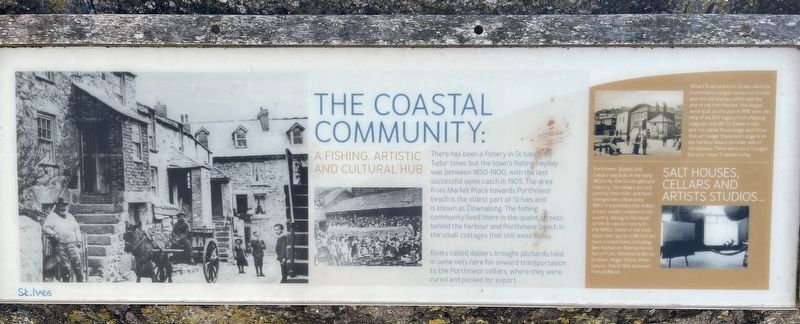
There has been a fishery in St Ives from Tudor times but the town's fishing heyday was between 1850-1900, with the last successful seine catch in 1905. The area from Market Place towards Porthmeor beach is the oldest part of St Ives and is known as . . . — — Map (db m273992) HM
Until at least the late prehistoric times, the Island was literally just that at high tides. Originally it was called 'Pendinnas' meaning 'St. Ia‘s fortified town' - and in the middle ages there was a cliff-castle fortress on the top meadow. . . . — — Map (db m273614) HM
The decline of the mining and fishing industries at the beginning of the 20th century coincided with the start of St Ives' first steps on the road to becoming today's internationally-famous arts colony with the founding of the St Ives Arts Club in . . . — — Map (db m274325) HM
Artist reflecting real life events in the seafaring community -- the wreck of the Alba (1938) and loss of the St Ives lifeboat shown by Alfred Wallis and photo. In each case the lifeboats were destroyed -- Caroline Parsons in 1908 and John and Sarah . . . — — Map (db m273994) HM
In Proud and Grateful memory
of the men of St Ives
who in the World War 1939-1945 &
in the Great War 1914-1918
gave their all and in giving
raised Men's ideals of what
Man may become.
Their name liveth for evermore. — — Map (db m274328) WM
This ancient chapel of St Nicholas, which has stood upon this site from time immemorial, partially destroyed by order of the war office in 1904, was rebuilt and restored to its former condition by Sir Edward Hain, in 1911. Being the coronation year . . . — — Map (db m274327) HM