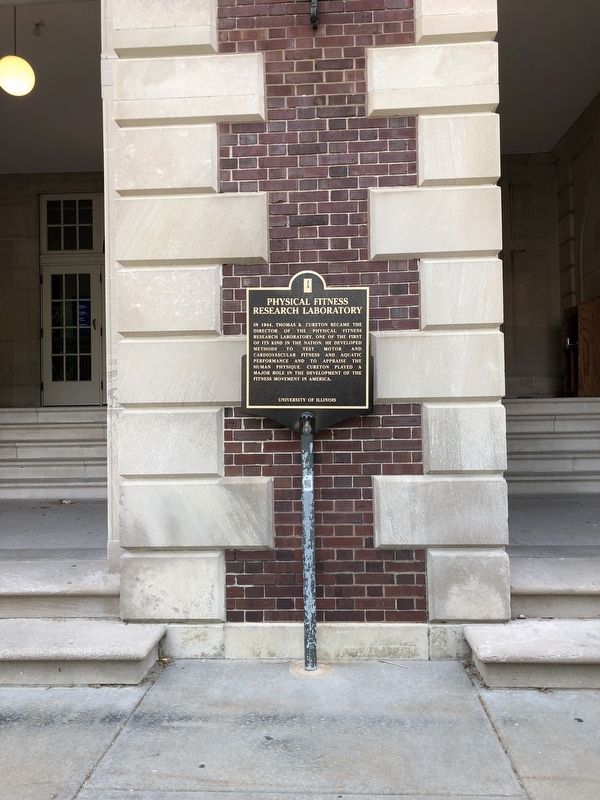
In 1944, Thomas K. Cureton became the
director of the Physical Fitness
Research Laboratory, one of the first
of its kind in the nation. He developed
methods to test motor and
cardiovascular fitness and aquatic
performance and to appraise . . . — — Map (db m225523) HM
Nathan C. Ricker, the first person to graduate in architecture in the United States, established an architectural program here at his alma mater in 1873. Ricker emphasized the application of science and technology to design. He strove to create an . . . — — Map (db m225558) HM
Allen S. Weller led the Urbana campus
to a period of great artistic growth
and innovation from 1954 to 1971. His
imagination and efforts were the
force behind experimentation in the
visual arts, dance, and music, and
the development of . . . — — Map (db m225525) HM
In the early 20th century, Clarence W. Alvord gathered sources for Illinois history, directed the Illinois Historical Survey, edited the collections of the Illinois State Historical Library, wrote histories of colonial Illinois and the Mississippi . . . — — Map (db m225556) HM
In 1949, Wilbur Schramm organized the conference of the National Association of Educational Broadcasters, which laid the philosophical basis for public broadcasting in the United States. From that beginning, grew both National Public Radio (NPR) and . . . — — Map (db m225554) HM
During the mid-twentieth century, two anthropologists made landmark contributions to their field. Julian H. Steward developed cultural ecology, a method for studying cultural change by analyzing the interaction of social life, environment, and . . . — — Map (db m109619) HM
In 1932, Harold R. Wanless introduced
the term cyclothem to describe the
succession of sedimentary rock layers
found in coal-bearing formations. The
understanding of cyclothems remains
an indispensable tool for predicting
the location . . . — — Map (db m225540) HM
Illini Supersweet Corn In 1953, John R. Laughnan discovered that kernels of mutant corn were "unusually sweet." Within eight years, Laughnan had developed the "Illini Supersweet" hybrid that revolutionized the sweet corn industry. . . . — — Map (db m109618) HM
In 1969, Carl Woese began using molecular sequences of RNA to study the evolutionary history of life on Earth, eventually determining the first “tree of life.” This project led, in 1977, to the discovery of a third branch of life: the archaea . . . — — Map (db m225539) HM
Lejaren A. Hiller and Leonard M. Isaacson
created the first substantial computer-
produced musical composition. The
premiere of the “ILLIAC Suite” for string
quartet on August 9, 1956 at the Urbana
campus of the University of Illinois
changed . . . — — Map (db m225597) HM
In 1961, Don L. Bitzer, co-inventor of the plasma display panel, and Chalmers W. Sherwin introduced PLATO, the first computer-based education system, the first time-shared education system, and the home of the first on-line community. By the early . . . — — Map (db m225545) HM
Under the administrations of Phineas L. Windsor (1909-1940) and Robert B. Downs (1943-1971), the library grew from fewer than a million volumes to nearly five million volumes and became one of the world's great libraries. Windsor aggressively built . . . — — Map (db m225557) HM
Combining the administrative and computer experience of Louis N. Ridenour, the mathematical ability of Abraham H. Taub, and the electrical engineering background of Ralph E. Meagher, in 1952 the Digital Computer Laboratory developed ILLIAC I. The . . . — — Map (db m225548) HM
The University of Illinois College of Medicine at Urbana-Champaign
(1971-2022) educated over 4500 physicians, including many
from underrepresented groups in the urban health and
rural medicine programs, who went on to practice in . . . — — Map (db m225538) HM
A leading researcher of clay minerals (which constitute 40% of all sedimentary rock), Professor
Ralph Early Grim discovered the mineral illite and opened a new field of geological study, clay mineralogy. Grim's work led to important advances in . . . — — Map (db m225542) HM
From 1961 to 1981, Professor of Chemistry
Willis H. Flygare developed powerful
new methods to measure the properties
of molecules, culminating in the invention
of the Fourier Transform Microwave
Spectrometer. This apparatus and . . . — — Map (db m225536) HM
Today's swine industry was fundamentally changed by the animal nutrition research of D. Eugene Becker. In the 1950s, he demonstrated that it was possible to ensure swine growth with a simple combination of corn, soybean meal, vitamins and minerals. . . . — — Map (db m225530) HM
Started in 1876, the Morrow Plots are the oldest field experiment in the United States. First known as “Rotation Experiment No. 23” and modeled after trials at Rothamsted, England, the plots were established to study the long-term effects of crop . . . — — Map (db m225531) HM
Shao L. Soo's research at Illinois
from 1959 to 1992 helped clarify
the intricacies in the physics and
equations of motion governing
multiphase flows, in particular
the electric effects in gas/solid
particle flows. Soo's work . . . — — Map (db m225544) HM
Herbert S. Gutowsky showed that
nuclear magnetic resonance could
be used to establish molecular structure
and to measure rates of chemical and
biological reactions and motion in
solids. As a result of his work beginning
in 1948, nuclear . . . — — Map (db m225537) HM
Paul Lauterbur was a pioneer in the
use of nuclear magnetic resonance
(NMR) to visualize molecules, solutions
and solids. He was the first
researcher to produce an image with
NMR. His work led to the development
of magnetic resonance imaging . . . — — Map (db m225599) HM
Joseph M. Hunt was a pioneer in the
study of child development. He provided
experimental evidence for the powerful
and lasting effects of early experience
on the development of intelligence
and personality. Hunt helped to convince
the Kennedy . . . — — Map (db m225580) HM
Nick Holonyak Jr., John Bardeen's first graduate student at Illinois, invented the first practical light-emitting diode (LED) at General Electric before returning in 1963 to Illinois as a faculty member. In 1977, Holonyak and his students . . . — — Map (db m225549) HM
The first public demonstration of
sound recorded simultaneously with
pictures on film took place at the
Urbana campus on June 9, 1922. Joseph
T. Tykociner's double-feature motion
picture included ringing a bell and
reading the Gettysburg . . . — — Map (db m225552) HM
Paul Rolland was the first to use science-based research to consider the role of movement in the acquisition of stringed-instrument performance technique. His movement-centered approach has had world-wide influence in the teaching of children to . . . — — Map (db m225576) HM
Anthony J. Leggett was awarded the
2003 Nobel prize in physics for his
pioneering work in the theory of
superconductors and superfluids.
Leggett's research into zero-
viscosity superfluid liquids gave
science a deeper understanding of
the . . . — — Map (db m225600) HM
Theoretical physicist John Bardeen was the first person to win two Nobel prizes in the same field. His first, in 1956, shared with Walter Brattain and William Shockley, was for the invention of the transistor, the basic component of electronic . . . — — Map (db m225551) HM
Illinois was home to two pioneers
of photosynthesis research. Robert
Emerson and Eugene Rabinowitch made
fundamental discoveries that revealed
the mechanisms for converting light to
chemical energy in photosynthesis.
Rabinowitch applied . . . — — Map (db m225543) HM
Mosaic, the first popular graphical browser for the World Wide Web, was created by Marc L. Andreessen and Eric J. Bina at the National Center for Supercomputing Applications [NCSA]. Upon its 1993 release to the public, Mosaic gave internet users . . . — — Map (db m225547) HM
These three round barns served as model dairy facilities for the University's
20-acre demonstration dairy farm developed in the early 20th century. The
farm's sole purpose was to produce the largest amount of milk per acre at the
lowest possible . . . — — Map (db m225577) HM
From the 1930s through the 1980s Norman D. Levine conducted research on protozoa and other parasitic organisms that cause disease and can be transmitted from animals to humans. His work resulted in advances in the diagnosis, treatment and prevention . . . — — Map (db m225579) HM