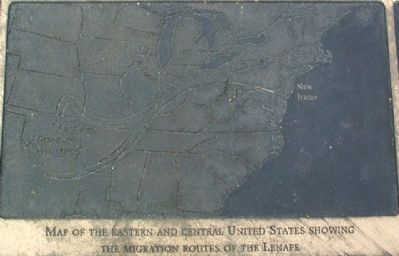
In the 17th and early 18th centuries, while struggling to maintain their lifestyle of hunting, fishing and gathering, the Lenape released their lands to incoming Europeans through sales and treaties. The Europeans unwittingly brought with them . . . — — Map (db m233032) HM
The exterior of the Hancock House is an outstanding example of the patterned brick houses that once dotted the landscape of Salem County, NJ. Modeled after the seventeenth-century building traditions of the Quakers’ English homeland, masons used . . . — — Map (db m21703) HM
As it developed into a center of commerce, law, dining, and entertainment, the City of Burlington’s bustling downtown attracted visitors from Southern New Jersey, Pennsylvania, and beyond. Easily accessible by river, rail, and road, the downtown . . . — — Map (db m79546) HM
The Burlington County Prison Museum is a National Historical Landmark located here in the heart of historic Mount Holly, New Jersey.
Designed by Robert Mills, one of America's first native-born and trained architects, the Burlington County . . . — — Map (db m35420) HM
By the end of the 17th century William Trent, a native of Inverness Scotland, had established himself as a prominent Philadelphia merchant trading in flour, tobacco, rum and molasses, slaves and indentured servants. His shipping interests extended . . . — — Map (db m166141) HM
The City of Burlington is numbered among the oldest and, at one time, the most influential towns in New Jersey. At Holland's behest, Walloon settlers from southern Belgium arrived at present-day Burlington Island in 1624 and their community . . . — — Map (db m253918) HM
This Site was placed in the National
and New Jersey State Historical Registers
in 1979.
The Meeting House, situated at the
intersection of two Indian Trails, is one
of the oldest in Burlington County.
Early Quakers worshipped here . . . — — Map (db m35918) HM
The lands adjoining the Falls of the Delaware River were a natural location for early European settlement, just as they had been a focus of native American occupation. The Falls were little more than a stretch of fast-running shallow water between . . . — — Map (db m4233) HM
Reminiscent of William Styron's novel entitled Sophie's Choice about Nazis in World War II dividing a mother from her children, a small but profound drama played out in 1806 in Caroline County: An enslaved mother named Sydney Still was . . . — — Map (db m199276) HM
Fort Mercer, October 1777
At least 4% of Continental Army soldiers comprised men of African, Native American, or mixed ancestry. In the 1st and 2nd Rhode Island regiments, persons of color amounted to almost 15% of the men. In October 1777, . . . — — Map (db m304293) HM
Formal white abolitionist societies emerged at the end of the 18th century and the Quakers were the first white abolitionists. However, black abolitionism began when the first African was forcibly extracted from his homeland and shipped to . . . — — Map (db m176108) HM
Two approaches to ending slavery
Just two families owned this house for 90 years, each acting differently to end slavery. The Quaker Parrish family had long worked tirelessly toward peaceful abolition. The next owner, William Levis . . . — — Map (db m194879) HM
During the 1800's farmer’s took everything from a from a simple hoe to a thresher “snorting black smoke” into the fields in pursuit of better harvest.
Machines were run by hand, by oxen or horses, and finally by steam . . . — — Map (db m100662) HM
On July 1, 1924, Babe Ruth hit a home run on this Athletic Field in a game between Delanco and the Burlington County All-Stars. Over 5000 baseball fans attended this historical baseball game. — — Map (db m140537) HM
Thin black lines indicate changes in relevance. Between each pair of lines entries are ordered geographically but all have the same relevance.
* Inflectional forms of words are their plurals, singulars, and possessives as well as gramatical tenses and similar variations.