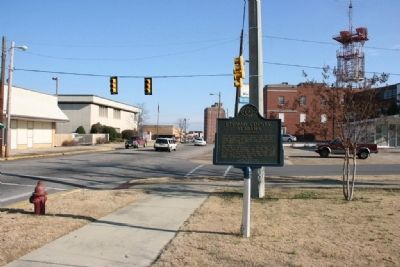
Created by state legislature on December 1, 1868 from territory taken from Cherokee, DeKalb, Marshall, Blount, St. Clair and Calhoun Counties, having originally been formed December 7, 1866 as Baine County in honor of Confederate hero David W. . . . — — Map (db m83735) HM
William Lewis Moore was a white postal worker raised by
grandparents in rural Mississippi. He was a Congress of Racial
Equality (CORE) member who staged lone protests against racial
segregation. He was assassinated at this location during a . . . — — Map (db m281993) HM
During the year of 1890, Capt. James M. Elliott, Jr., the famed riverboat captain and industrialist, began to draw up plans for a new town about two miles west of Gadsden. Elliott's dream was to develop the town as an industrial center and . . . — — Map (db m156368) HM
In the summer of 1784 William Jones and his two young sons were among a group of families from Georgia making their way through this area following the Old High Town Path. They camped here near a large spring and planned to continue their journey . . . — — Map (db m156371) HM
On 6/18/1942 the U.S. took possession of 36,300 acres in Etowah and adjoining St. Clair County to establish Alabama's first Chemical Warfare Center. The area was dedicated on 12/25/1942 and named for U.S. Army M/G William Luther Sibert, first Chief . . . — — Map (db m33304) HM
Lynching in America.
Thousands of Black people were the victims of lynching and racial violence in the United States between 1877 and 1950. The lynching of African Americans during this era was a form of racial terrorism intended to intimidate . . . — — Map (db m116817) HM
This is the site of the family home of Gadsden native General William Luther Sibert who played a major role in the construction of the Panama Canal. While serving in the U.S. Army Corps of Engineers, he was appointed chief engineer for the Atlantic . . . — — Map (db m39253) HM
World War I
Ables, Crawford
Aderholt, Carl
Atwood, Joe I.
Bagley, Hugh
Battles, Fred
Benton, Edwin J.
Berry, C.
Birchfield, Sam
Brewster, Everett
Buffington, Hugh G.
Bullard, Leo
Campbell, Earl C.
Cason, Floyd . . . — — Map (db m53844) WM
On January 25, 1925 the Sisters acquired the 25 - bed Gadsden General Hospital on Chestnut Street and renamed it Holy Name of Jesus Hospital. The Hospital grew under the leadership of the Founders, Father Thomas A. Judge, C. M. and Mother Mary . . . — — Map (db m39141) HM
Established in 1826 as "The Colored Cemetery," this site is
the first and largest African-American cemetery in Gadsden.
In 1918, the Mosaic Templars of America, a fraternal
organization who provided African Americans with death and
burial . . . — — Map (db m167227) HM
White settlers in the hills of Virginia, Kentucky, Tennessee, North Carolina, and South Carolina pushed the Cherokee Indian tribes into North Alabama. The Cherokee in turn encroached upon Creek Territory. There were sporadic battles between the . . . — — Map (db m83738) HM
Thin black lines indicate changes in relevance. Between each pair of lines entries are ordered geographically but all have the same relevance.
* Inflectional forms of words are their plurals, singulars, and possessives as well as gramatical tenses and similar variations.