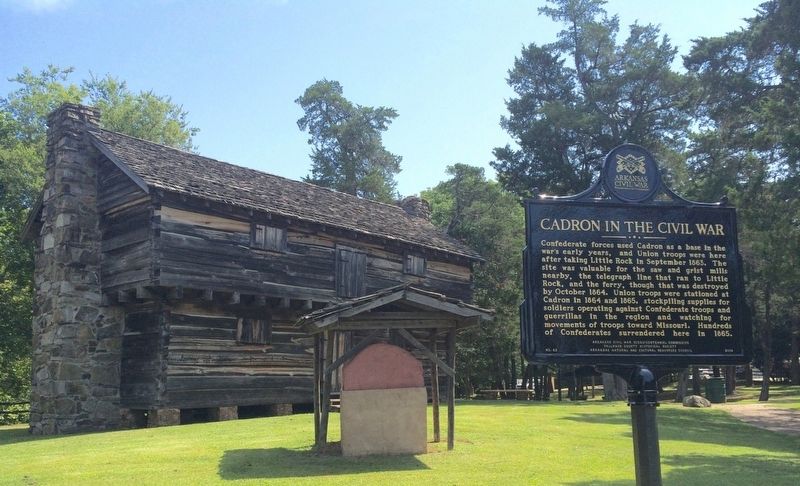
Confederate forces used Cadron as a base in the war’s early years, and Union troops were here after taking Little Rock in September 1863. The site was valuable for the saw and grist mills nearby, the telegraph line that ran to Little Rock, and the . . . — — Map (db m96452) HM
Faulkner County had divided loyalties during the Civil War. Soon after the war started, Col. A.R. Witt helped organize several companies for the 10th Arkansas Infantry (C.S.). After fighting at Shiloh, the 10th was captured at Port Hudson, La. . . . — — Map (db m119987) HM
The first court house in Faulkner County was erected in 1873 on this site, the town of Conway then being known as Conway Station, on the Little Rock and Ft. Smith Railroad. The county was named for “Sandy” Faulkner of “Arkansas Traveler” fame. — — Map (db m229576) HM
Lines Cemetery is the last visible remnant of early communities that existed in the vicinity of Gold Creek south of Conway in the late 19th century. Beginning in the 1870s, families moved into this sparsely populated district; the earliest . . . — — Map (db m290933) HM
Shortly after Arkansas was admitted to the Union in 1836, the Federal government established the Little Rock Arsenal for the storage of munitions and weapons in defense of the frontier. Eventually, more than thirty buildings were constructed on . . . — — Map (db m117241) HM
The idea for the Arkansas River Trail began as early as 1913, with a City of Little Rock plan calling for a series of parks on the banks of the Arkansas River. The trail has been built in pieces, year after year, decade upon decade by committed . . . — — Map (db m208847) HM
The blockhouse is a replica of a structure that was built on this site in the late 18th century. The building was a multiple use structure, but constructed originally for defense purposes. It was used as a trading post, as a residence, and as a . . . — — Map (db m96645) HM
Thin black lines indicate changes in relevance. Between each pair of lines entries are ordered geographically but all have the same relevance.
* Inflectional forms of words are their plurals, singulars, and possessives as well as gramatical tenses and similar variations.