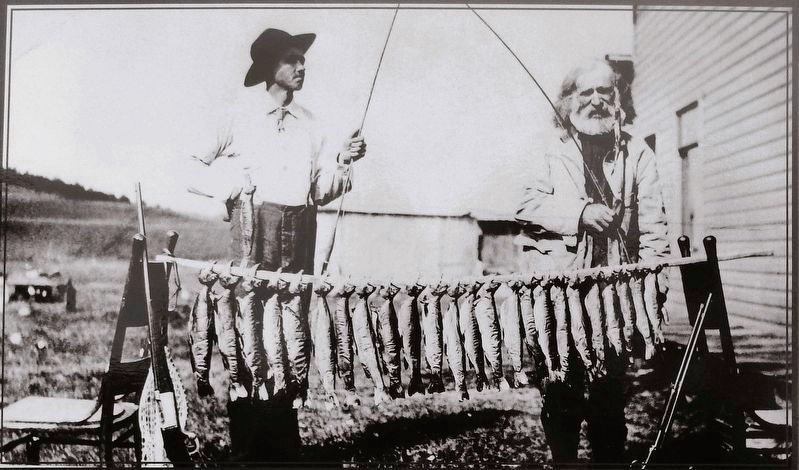
Grand County Tourism Since the opening of Berthoud Pass in 1874, Grand County has been a draw for vacationers and tourists. Ranchers, such as the Cozens Family, or pioneers such as the Kauffman's of Grand Lake, housed early guests. . . . — — Map (db m288197) HM
Grand County Skiing Grand County was one of the first areas in Colorado where people enjoyed the sport of skiing. While mail carriers, loggers and other workers used the "Norwegian Snowshoes" (or skis) as necessary winter . . . — — Map (db m288196) HM
During construction of the Windy Gap pipeline, workers uncovered prehistoric sites of national significance. This discovery temporarily halted construction so that evidence of past human culture could be studied. Before the Windy Gap findings, . . . — — Map (db m311360) HM
She looks tired, worn out after being up most of the night, tending to a sick patient. She's walking home in deep snow on a very cold windy night with her medical bag and railroad lantern. In her younger years she joked about carrying a six gun, . . . — — Map (db m288395) HM
In 1869, a Civil War veteran turned college professor, Major John Wesley Powell, led nine men on the last great exploration of the continental United States. Powell and his men set out from Green River, Wyoming, on May 24, 1869, on a journey to map . . . — — Map (db m295381) HM
In the summer of 1861, Edward Berthoud camped by the hot springs near this bend in the Grand River (it would become the Colorado in the 20th century). Berthoud and his expedition formed the Middle Park Claim Club and made tentative plans for Grand . . . — — Map (db m295384) HM
The Blacksmith Shop was built in 1979 on this site with a combination of logs from shops on the Old Oaks Ranch at the mouth of Troublesome Creek in west Grand County and from the Kinney Ranch four miles east of Hot Sulphur Springs. The forge, . . . — — Map (db m289181) HM
Soldier weather. Bone-jarring exposure to heat, rain, wind, dust, numbing cold, sleet, and snow. Day after day of mind-bending boredom, interspersed with moments of stark terror. These elements chipped away at an infantry soldier on foot or in the . . . — — Map (db m288399) HM
Automobiles Come to Grand Lake (panel 1)
The number of automobiles had become so large that in 1913 the State of Colorado began issuing its first license plates. The 1915 dedication of Rocky Mountain National Park drew 2000 people, . . . — — Map (db m129881) HM
Cozens Ranch Museum Welcome to historic Grand County, known by early explorers as Middle Park. Connect with history by visiting the Heritage Coalition's many historic and cultural sites - from the top of Berthoud Pass, west along Highway 40 to . . . — — Map (db m288193) HM
This building was built specifically for law enforcement purposes and is the oldest incarceration building still existing in Grand County. Previous jails were “cells” constructed within buildings that were used for other purposes. It was first . . . — — Map (db m289066) HM
When the town of Grand Lake was platted in 1881, Grand Avenue was designed to be 100 feet wide. Although traffic congestion was not a problem, extra space was allowed for rodeos and horse races.
The Public Square was often used for community . . . — — Map (db m129840) HM
Scout, pathfinder, guide, mountain man, explorer, fur trader, blacksmith, and merchant; Jim Bridger was all of these. He is regarded as one of America's greatest frontiersmen, and overall, the Rocky Mountain West's most gifted scout. When it came . . . — — Map (db m288400) HM
Rapids Lodge is one of three tourist hotels built between 1900 and 1920. The other two burned. Laps Ish, the owner and builder, sawed all lumber of lodgepole pine. Until about 1935 the lights and some heat for the hotel came from his own water . . . — — Map (db m129852) HM
Entrepreneur P.H. Smith brought his family to Grand County from Kansas. In 1893 he started a sawmill in Grand Lake and acquired several local properties.
A skillful craftsman, P.H. Smith built many significant structures, including the Grand . . . — — Map (db m129883) HM
Homestead, ranch, stagecoach stop, post office, hotel, Jesuit retreat, museum Placed on the National Register of Historic Places by the United States Department of the Interior June 9, 1988 — — Map (db m288200) HM
Taylor Grazing Act
It belonged to everyone—and to no one. It was called free land, and both sheepmen and cattle ranchers wanted a piece of it. In this high, dry plateau country where water and grass are scant, cutthroat competition . . . — — Map (db m116922) HM
Thin black lines indicate changes in relevance. Between each pair of lines entries are ordered geographically but all have the same relevance.
* Inflectional forms of words are their plurals, singulars, and possessives as well as gramatical tenses and similar variations.