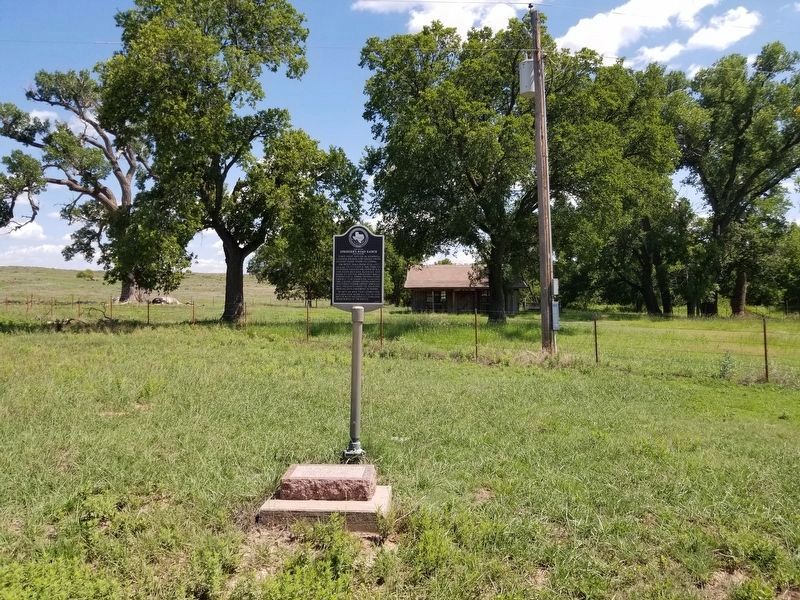
First post office in Hemphill County. Unique for tunnel from dugout home-store to corral.
On 1870's trail from Fort Elliott (35 miles, southwest) to Fort Supply, Indian Territory, to Fort Dodge, Kansas. Established by A. G. Springer; besides . . . — — Map (db m154132) HM
The Cataline community predates Hemphill County’s organization. Families moving to this area established the county’s first school (1885) and church (1887). A post office opened in Feb. 1887, five months before the county organized. In March 1896, . . . — — Map (db m154128) HM
Also known as Prairie Dell Cemetery, this burial ground has served eastern Hemphill county since 1895, when Dora Calhoun, an infant, was interred here. George W. Little, a landowner in the then-thriving Eller Flat community, donated property for . . . — — Map (db m153581) HM
Built in 1890. First permanent public building in both town of Canadian and Hemphill County. Erected under administration of E. E. Polly, first county judge.
Ironically, deception plagued construction of this jail, as building contracts were . . . — — Map (db m93658) HM
Thomas T. McGee, the first sheriff of the town of Canadian, was buried in 1894 on a hill on the east side of town. There were already grave markers there dating back to 1883. McGee's widow, Mary, purchased the land and it became known as the McGee . . . — — Map (db m93642) HM
Born in Massachusetts. Came to Texas, 1888, as Hemphill County's first public school teacher. Often saw Indians darken the schoolroom windows trying to watch her classes recite.
Married Will C. Isaacs in 1892.
Founder and guiding spirit of . . . — — Map (db m55767) HM
In 1915, Hemphill County contracted to erect a bridge to span the Canadian River. Construction of the Canadian River Wagon Bridge was completed in July, 1916. The bridge was comprised of seventeen 153.5 ft. pin-connected Parker through-truss spans; . . . — — Map (db m93636) HM
Thin black lines indicate changes in relevance. Between each pair of lines entries are ordered geographically but all have the same relevance.
* Inflectional forms of words are their plurals, singulars, and possessives as well as gramatical tenses and similar variations.