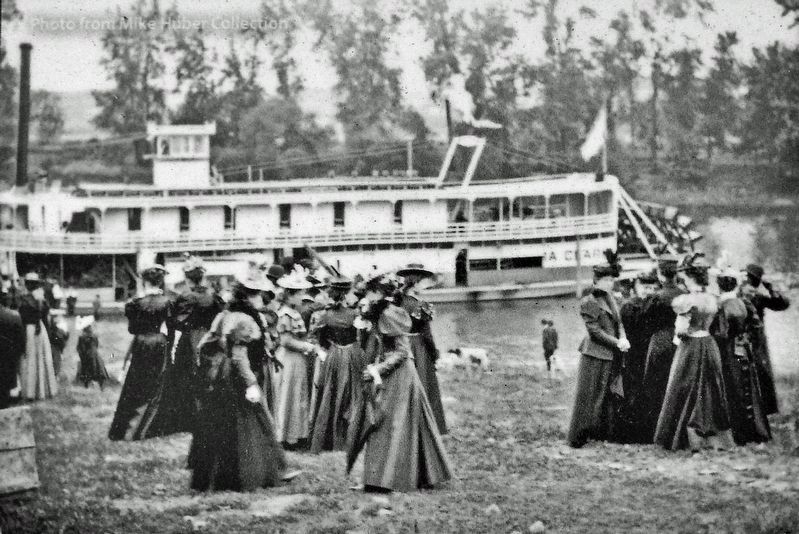
The first steamboat Argo churned the muddy waters of the Rivière Saint-Pierre (St. Peter's River) in 1842, eventually arriving at Sakpe II's village of Tíŋta Otuŋwe. On July 22, 1850, the steamboat Yankee started at the . . . — — Map (db m213095) HM
Murphy's Inn
The foundation before you is all that remains of the stone house and inn built by Richard G. Murphy around 1858. At that time, this property was situated at the crossroads of major river and stagecoach transportation routes. . . . — — Map (db m264193) HM
In 1867 a New York architect sent the plans for a new church in Belle Plaine to Bishop Whipple. The church was built in 1868 on land contributed by Territorial Judge Andrew G. Chatfield, founder of Belle Plaine. The congregation organized in 1858 . . . — — Map (db m65868) HM
In 1856, Anton Philipp of Bavaria, New Prague's first settler, built a dugout log home along the banks of the tributary to Raven Stream. The first Bohemian settlers also built their first homes along the creek later in the same year. The site became . . . — — Map (db m210757) HM
The sound of church bells ringing through town invited people to gather together. As new settlements were established, a church was often one of the first public buildings built. They were as diverse as the settlers who built them, and even the . . . — — Map (db m264670) HM
In 1924, the Davenport, Rock Island and North Western Railway Co. and its co-owners, the Chicago, Milwaukee, St. Paul and Pacific Railroad and the Chicago, Burlington and Quincy Railroad, constructed the Union Passenger Station to replace three . . . — — Map (db m202089) HM
Since 1925, music has drifted along the Davenport levee from the Petersen Memorial Music Pavilion. One of several bandshells in Davenport at the time, the Music Pavilion was the final touch in Davenport's riverfront beautification project known as . . . — — Map (db m202109) HM
Thin black lines indicate changes in relevance. Between each pair of lines entries are ordered geographically but all have the same relevance.
* Inflectional forms of words are their plurals, singulars, and possessives as well as gramatical tenses and similar variations.