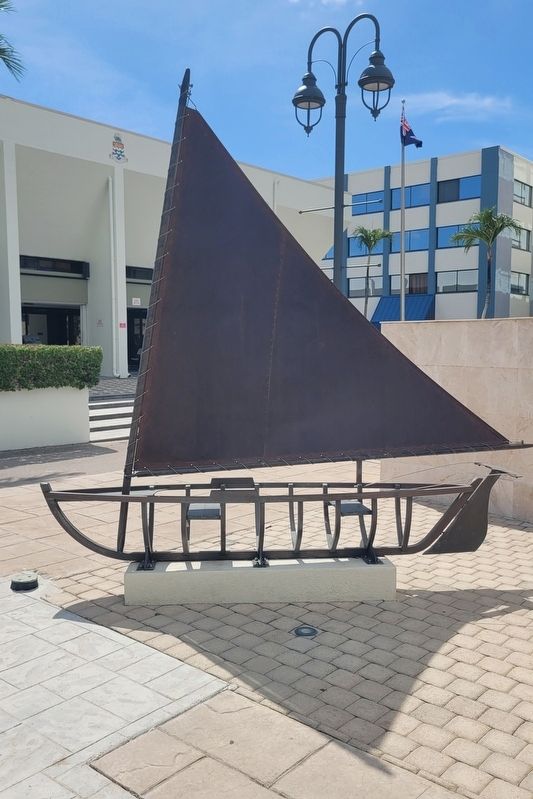
For the first half of the twentieth century, the catboat was integral to the economy of the Cayman Islands and the daily life of Caymanians. Designed primarily for catching turtle far-out at sea and carrying them to schooners for shipment to market, . . . — — Map (db m266531) HM
As many as twenty schooners white sail and white hulls, newly varnished and well greased mast singing like gold in the sun. One hundred or more catboats colored the bluest blue.
Newstar 1990.
Nestling between the Arch and McTaggart . . . — — Map (db m265843) HM WM
Fort George was built sometime around 1790 by Caymanians for the defense of these Islands from attacks by Spanish marauders from Cuba. Little is known about the origin and early history of the Fort. In 1662, the Governor of Jamaica was instructed . . . — — Map (db m265842) HM WM
The Fort Knock building is located in Grand Cayman's original town square, established in the 18th Century as part of the Fort George, which protected the island from invading Spanish marauders. Knock is an Irish reference for a gathering place as . . . — — Map (db m266624) HM
He was respected by all as an exemplary citizen and exceptional civil servant.
Starting out as a 23-year-old clerk, almost four decades of public service career saw him rise through the ranks to become, in 1969, the Cayman Islands' first . . . — — Map (db m266526) HM
A founding father of our nation, he was a pioneering politician, businessman and philanthropist. Yet he is perhaps best remembered as an influential figure in ensuring the Cayman Islands remained a British Crown Colony when Jamaica became . . . — — Map (db m266530) HM
Dedication and selfless service were her hallmarks. A true pioneer, she devoted her life to positive change for these Islands and in particular the advancement of women's rights.
She was the first woman elected to the Cayman Islands Legislative . . . — — Map (db m266529) HM
This very special son of Cayman was one of the most prominent political figures in the Cayman Islands' history.
The first Caymanian attorney to appear before the Privy Council in London, he founded the first political party to succeed at the . . . — — Map (db m266522) HM
A highly respected citizen and an example of the qualities to which young Caymanians should aspire, in 1996, she became the only living person to receive the country's highest honour. This was in recognition of her contribution to the Cayman . . . — — Map (db m266527) HM
Remembered for her outstanding commitment to youth, she was the Cayman Islands' first probation and welfare officer and a lifelong advocate for disadvantaged people.
She became the Islands' sole probation officer in 1963, going on to serve as . . . — — Map (db m266525) HM
A former legislator and statesman, he became one of the Cayman Islands' most outstanding citizens. A man of wisdom, persuasiveness, and sincerity, he represented the district of West Bay in the Legislative Assembly for 55 years, including time spent . . . — — Map (db m266528) HM
A man of vision and drive, he was a major player in the Cayman Islands' political, economic and social landscape.
He entered politics in 1944 as an elected member from East End.
In 1959 under Cayman's first constitution, he was appointed . . . — — Map (db m266523) HM
Our first National Hero was given this honour on 28 June 1994. Though Mr. Jim, as he was known to the community, passed away in 1988, he was regarded by his contemporaries as a visionary who helped to politically lead Cayman into an era of progress . . . — — Map (db m266521) HM
A woman of infinite talent, Leila Ross-Shier was a gifted librarian, prolific writer, composer, accomplished musician, imaginative poet, songstress, incomparable storyteller, community historian, and cultural icon. She was the foremost writer of . . . — — Map (db m266524) HM
During World War II, six lookout posts were set up at strategic points all around the island in the early days; the balcony of the Courts Building (now the National Museum) served as a lookout for the George Town harbor area. Then, around 1943, . . . — — Map (db m265838) HM WM
At George Town there is a small Fort, not very well constructed and in which is mounted three guns but which is by no means well equipped. This place is the most accessible to any Enemy, but it's the only place where vessels of burden can anchor . . . — — Map (db m265844) HM WM
19th August 1948
These 24 women from George Town led the charge for equal rights for women by writing to Commissioner Ivor Otterbein Smith on Election Day 1948 declaring "that it is our intention to exercise our constitutional right to vote . . . — — Map (db m266617) HM
A company of the Jamaican Home Guard was established on Grand Cayman in June 1942 and functioned until the end of World War II in 1945. It consisted of forty-two recruits and two officers.
Joining the Home Guard provided a fulltime occupation for . . . — — Map (db m265850) HM
In August of 1942, there were six strikes by German submarines in the waters of the Caribbean. This level of activity led to the setting-up of a small United States Navy base on Grand Cayman, in George Town opposite the fort and behind the . . . — — Map (db m265851) HM
A petition signed by 358 women from seven districts on Grand Cayman, including 88 from George Town and 27 from Crewe Road, was placed before the Legislative Assembly of Justices and Vestry on 27 May 1957. These women requested "that they should . . . — — Map (db m266623) HM
German submarine activity during World War II peaked in 1942, with several attacks on shipping occurring in the Caribbean Sea alone. One such attack was the sinking of the merchant steam vessel Comayagua on the evening of 14th May 1942 by the . . . — — Map (db m265847) HM WM