Franklin in Macon County, North Carolina — The American South (South Atlantic)
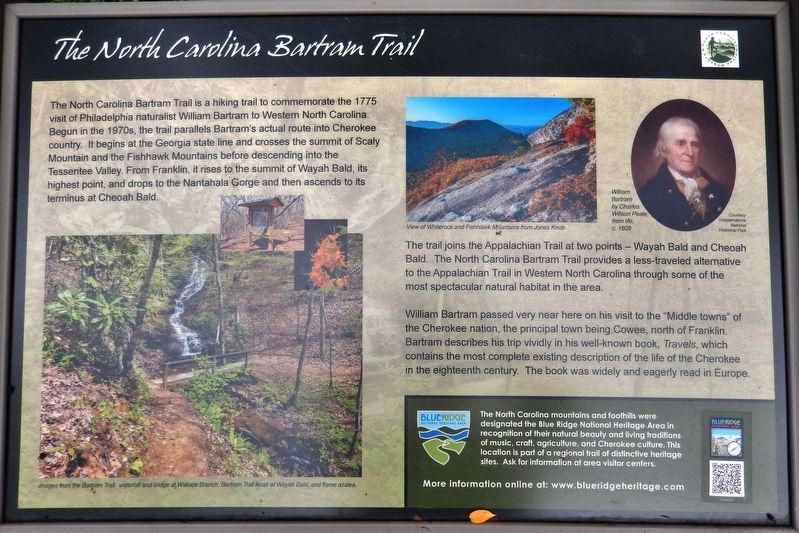
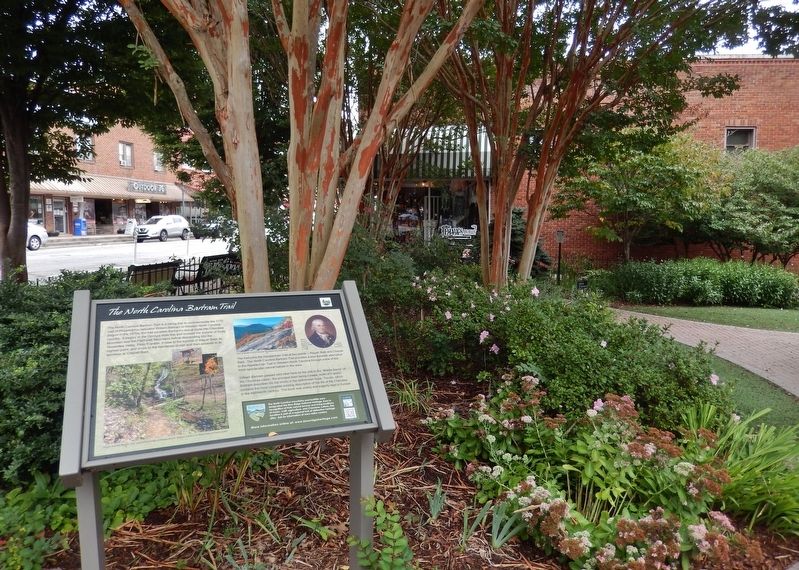
The North Carolina Bartram Trail
Photographed by Cosmos Mariner, September 12, 2018
1. The North Carolina Bartram Trail Marker
The trail joins the Appalachian Trail at two points — Wayah Bald and Cheoah Bald. The North Carolina Bartram Trail provides a less-traveled alternative to the Appalachian Trail in Western North Carolina through some of the most spectacular natural habitat in the area.
William Bartram passed very near here on his visit to the "Middle towns" of the Cherokee nation, the principal town being Cowee, north of Franklin. Bartram describes his trip vividly in his well-known book, Travels, which contains the most complete existing description of the life of the Cherokee in the eighteenth
this page online
More information online at: www.blueridgeheritage.com
Topics and series. This historical marker is listed in these topic lists: Colonial Era • Environment • Exploration • Indigenous Peoples and Communities • Parks & Recreational Areas • Science & Medicine. In addition, it is included in the William Bartram Trails series list. A significant historical year for this entry is 1775.
Location. 35° 10.909′ N, 83° 22.856′ W. Marker is in Franklin, North Carolina, in Macon County. It is at the intersection of Phillips Street and West Main Street (Business U.S. 441), on the right when traveling north on Phillips Street. Marker is located along the walkway in the Garden Club plaza which occupies the southeast corner of the intersection.
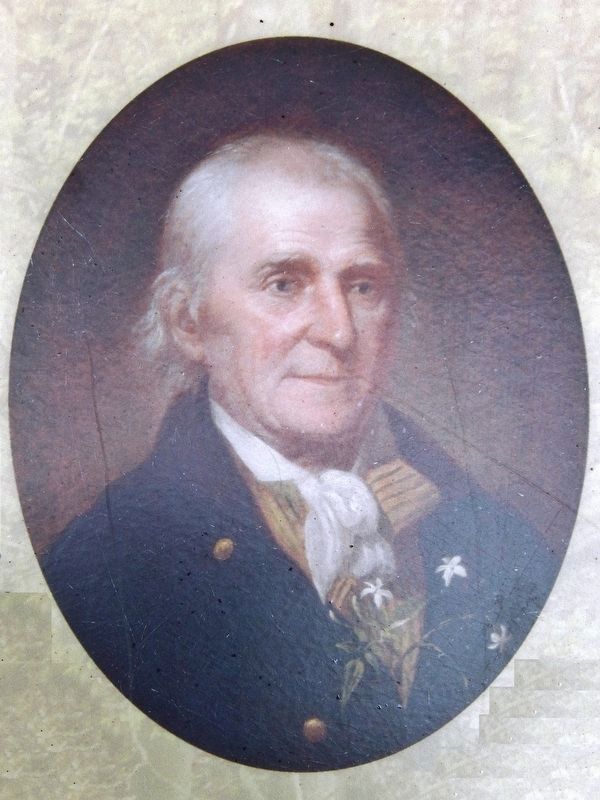
Courtesy of Independence National Historical Park
2. Marker detail: William Bartram portrait by Charles Willson Peale, from life, c. 1808

Regionally, this marker is in andspecifically he Mountains in the Golden Corner. It is also in the American South, specifically in the Upper South, in Appalachia, and specifically in Southern Appalachia. Globally, it is in North America, the Western Hemisphere, the Western World, and the Anglosphere. Historically, it finds itself in what was once the original Cherokee Nation, the territory of the Mississippian Culture, one of the original Thirteen Colonies, one of the Confederate States of America, and the Antebellum South.
Other nearby markers. At least 8 other markers are within walking distance of this marker: William Bartram Naturalist (within shouting distance of this marker); Built in 1908 (within shouting distance of this marker); Built in 1921 (within shouting distance of this marker); Battle of Echoe (within shouting distance of this marker); Women Mica Workers (within shouting distance of this marker); Macon County Confederate Memorial (within shouting distance of this
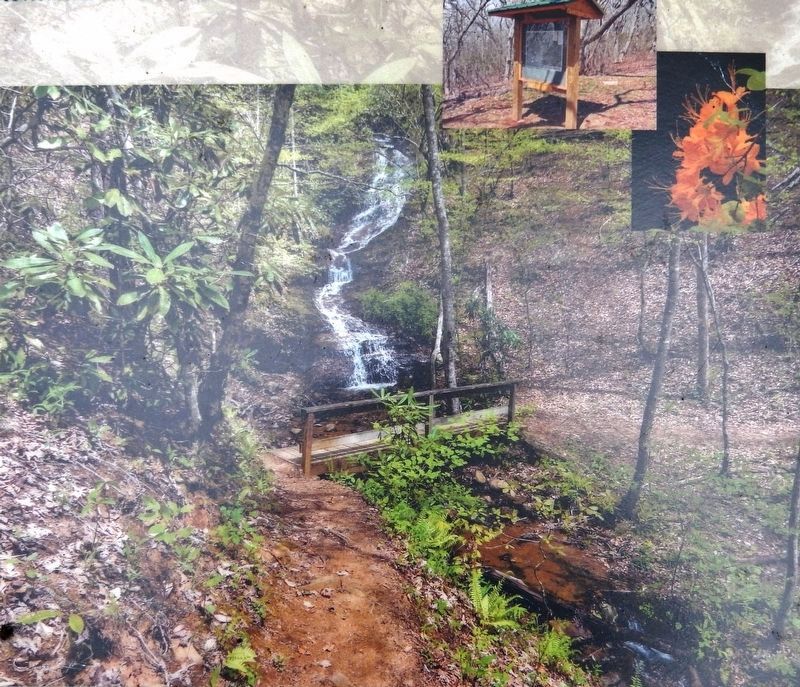
3. Marker detail: Images from the Bartram trail
Waterfall and bridge at Wallace Branch, Bartram Trail kiosk at Wayah Bald, and flame azalea.
More about this marker. Marker is a large metal composite plaque, mounted horizontally on waist-high posts.
Related markers. Click here for a list of markers that are related to this marker. The North Carolina Bartram Trail & Blue Ridge Heritage Trail
Also see . . .
1. North Carolina Bartram Trail. Philadelphia-born naturalist William Bartram was among the most well-known of the early naturalists, botanists and explorers of his day. He traveled throughout the southeast from 1773 to 1777 and wrote exact, vivid descriptions of the plants and animals he saw and the Native Americans he encountered. In 1791, he published these writings under the title Bartram’s Travels, which has been published continuously and remains in print today in a number of world languages. (Submitted on September 12, 2018, by Cosmos Mariner of Cape Canaveral, Florida.)
2. Travels of William Bartram. Travels of William Bartram is the familiar title by which
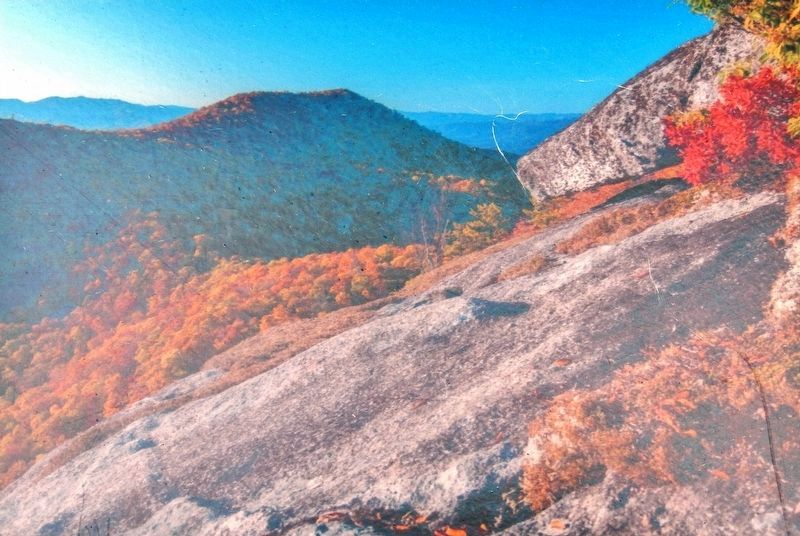
4. Marker detail: View of Whiterock and Fishhawk Mountains from Jones Knob
Photographed by Cosmos Mariner, September 12, 2018
5. The North Carolina Bartram Trail Marker (wide view; Garden Club park in background)
Credits. This page was last revised on September 15, 2018. It was originally submitted on September 12, 2018, by Cosmos Mariner of Cape Canaveral, Florida. This page has been viewed 939 times since then and 59 times this year. Photos: 1, 2, 3, 4, 5. submitted on September 12, 2018, by Cosmos Mariner of Cape Canaveral, Florida. • Andrew Ruppenstein was the editor who published this page.
