Prospect Park in Delaware County, Pennsylvania — The American Northeast (Mid-Atlantic)
Darby Creek Then and Now
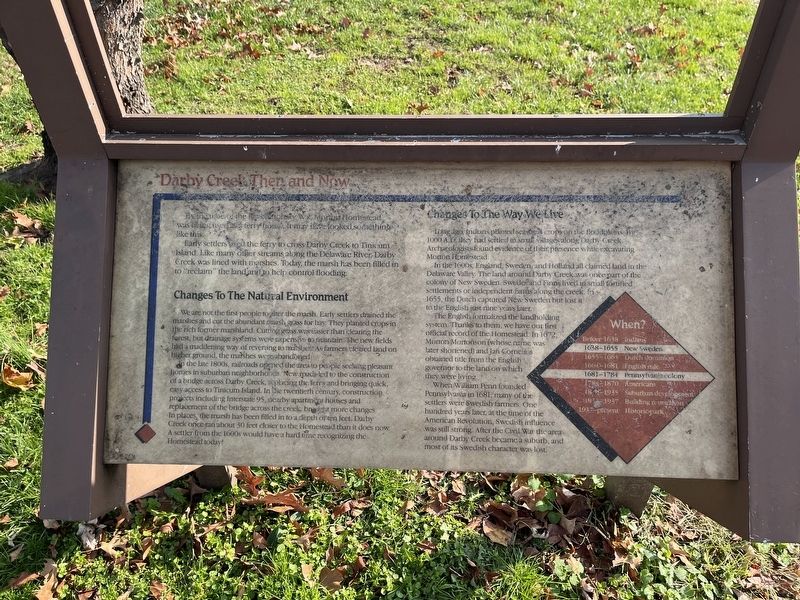
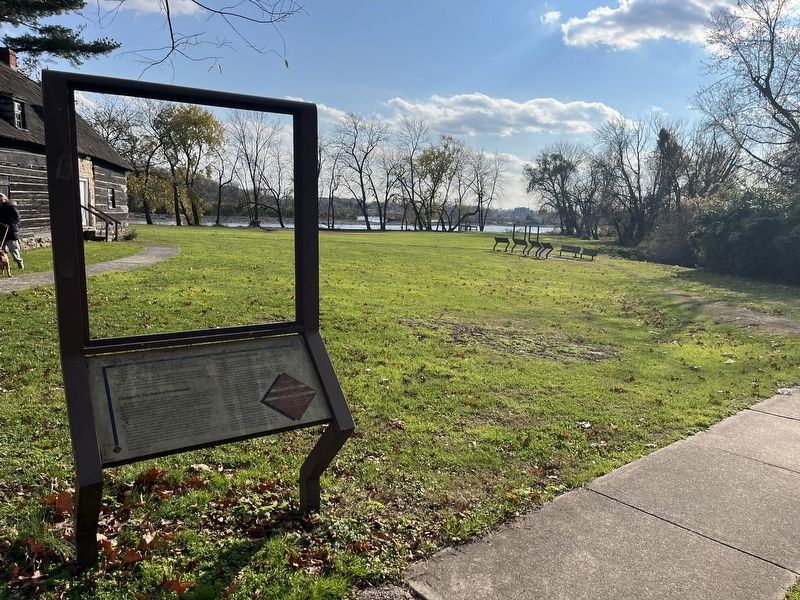
By the time of the Revolutionary War, Morton Homestead was being used as a ferry house. It may have looked something like this. Early settlers used the ferry to cross Darby Creek to Tinicum Island. Like many other streams along the Delaware River, Darby Creek was lined with marshes. Today, the marsh has been filled in to "reclaim" the land and to help control flooding.
Changes To The Natural Environment
We are not the first people to alter the marsh. Early settlers drained the marshes and cut the abundant marsh grass for hay. They planted crops in the rich former marshland. Cutting grass was easier than clearing the forest, but drainage systems were expensive to maintain. The new fields had a maddening way of reverting to marshes. As farmers cleared land on higher ground, the marshes were abandoned.
In the late 1800s, railroads opened the area to people seeking pleasant homes in suburban neighborhoods. New roads led to the construction of a bridge across Darby Creek, replacing the ferry and bringing quick, easy access to Tinicum Island. In the twentieth century, construction projects including Interstate 95, nearby
this page online
Changes To The Way We Live
Long ago, Indians planted seasonal crops on the floodplains. By 1000 A.D. they had settled in small villages along Darby Creek. Archaeologists found evidence of their presence while excavating Morton Homestead.
In the 1600s, England, Sweden, and Holland all claimed land in the Delaware Valley. The land around Darby Creek was once part of the colony of New Sweden. Swedes and Finns lived in small fortified settlements or independent farms along the creek. In 1655, the Dutch captured New Sweden but lost it to the English just nine years later.
The English formalized the landholding system. Thanks to them, we have our first official record of the Homestead. In 1672, Morton Mortonson (whose name was later shortened) and Jan Cornelius obtained title from the English governor to the land on which they
When William Penn founded Pennsylvania in 1681, many of the settlers were Swedish farmers. One hundred years later, at the time of the American Revolution, Swedish influence was still strong. After the Civil War the area around Darby Creek became a suburb, and most of its Swedish character was lost.
When? Before 1638: Indians
1638 - 1655: New Sweden
1655 - 1664: Dutch dominion
1664 - 1681: English rule
1681 - 1784: Pennsylvania colony
1784 - 1870: Americans
1870 - 1935: Suburban development
1935 - 1937: Building restoration
1937 - present: Historic park
Topics. This historical marker is listed in these topic lists: Agriculture • Colonial Era • Environment • Indigenous Peoples and Communities • Industry & Commerce • Railroads & Streetcars • Roads & Vehicles • Settlements & Settlers • Waterways & Vessels.
Location. This marker has been replaced by another marker nearby. It was located near 39° 52.629′ N, 75° 18.334′ W. Marker was in Prospect Park, Pennsylvania, in Delaware County. It could be reached from Wanamaker Avenue (Pennsylvania Route 420) 0.2 miles south of Lafayette Avenue, on the right when traveling south. Touch for map. Marker was at or near this postal address: 100 Lincoln Ave, Prospect Park PA 19076, United States of America. Touch for directions.

Regionally, this marker was in Southeast Pennsylvania and in Greater Philadelphia. It was also in the American Northeast and in the Mid-Atlantic. Globally, it was in North America, the Western Hemisphere, the Western World, and the Anglosphere. Historically, it found itself in what was once the Haudenosaunee (Iroquois) Confederacy, New Netherland, and one of the original Thirteen Colonies.
Other nearby markers. At least 8 other markers are within walking distance of this location: Welcome (here, next to this marker); John Morton– Signer of the Declaration of Independence (a few steps from this marker); Morton Homestead (within shouting distance of this marker); A Change For the Worse? (within shouting distance of this marker); Welcome to the Morton Homestead (within shouting distance of this marker); a different marker also named Welcome to the Morton Homestead (within shouting distance of this marker); a different marker also named Darby Creek Then and Now (within shouting distance of this marker); a different marker also named Darby Creek Then and Now (within shouting distance of this marker). Touch for a list and map of all markers in Prospect Park.
Other markers no longer nearby. Welcome to The Morton Homestead (was here, next to this marker but has been replaced with another marker now near it); A Morton Mystery (was within shouting distance of this marker but has been replaced with another marker now near it); The First Building (was within shouting distance of this marker but has been replaced with another marker now near it); The Second Building (was within shouting distance of this marker but has been replaced with another marker now near it); a different marker also named Morton Homestead (was within shouting distance of this marker but has been replaced with another marker now near it); Even History Changes (was within shouting distance of this marker but has been replaced with another marker now near it).
Credits. This page was last revised on March 26, 2026. It was originally submitted on November 19, 2022, by Devry Becker Jones of Washington, District of Columbia. This page has been viewed 904 times since then and 105 times this year. Photos: 1. submitted on November 19, 2022, by Devry Becker Jones of Washington, District of Columbia. 2. submitted on November 20, 2022, by Devry Becker Jones of Washington, District of Columbia.
