Summerville in Chattooga County, Georgia — The American South (South Atlantic)
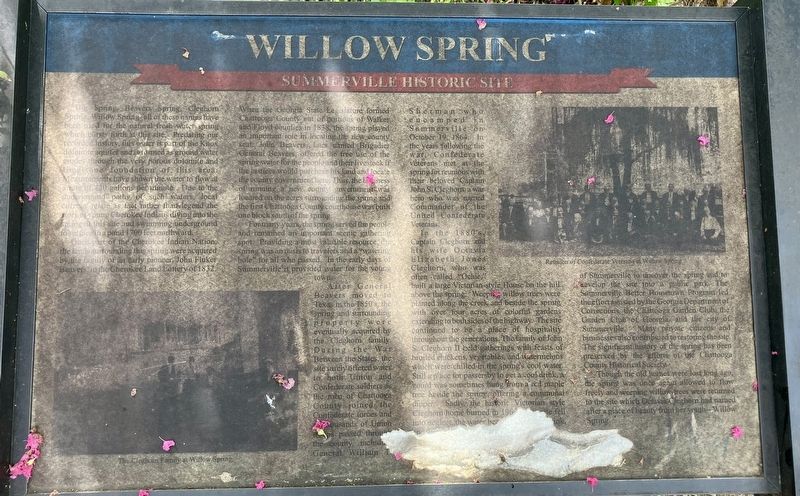
Willow Spring
Summerville Historic Site
Photographed by Tracy Andersen Roberts, July 25, 2026
1. Willow Spring Marker
Once part of the Cherokee Indian Nation, the lands surrounding this spring were acquired by the family of an early pioneer, John Fluker Beavers, in the Cherokee Land Lottery of 1832. When the Georgia State Legislature formed Chattooga County out of portions of Walker and Floyd counties in 1838, the spring played an important role in locating the new county seat. John Beavers, later named Brigadier General Beavers, offered the free use of the spring water for the people
this page online
For many years, the spring served the people and remained an important scenic gathering spot. Providing a most valuable resource, the spring was an oasis to travelers and a "watering hole" for all who passed. In the early days of Summerville it provided water for the young town.
After General Beavers moved to Texas in the 1850's, the spring and surrounding property were eventually acquired by the Cleghorn family. During the War Between the States, the site surely offered water to both Union and Confederate soldiers as the men of Chattooga County joined the Confederate forces and as thousands of Union troops passed through the county, including General William T. Sherman who encamped in Summerville on October 19, 1864. In the years following the war, Confederate veterans met at the spring for reunions with their beloved Captain John S. Cleghorn, a war
Photographed by Tracy Andersen Roberts, July 25, 2026
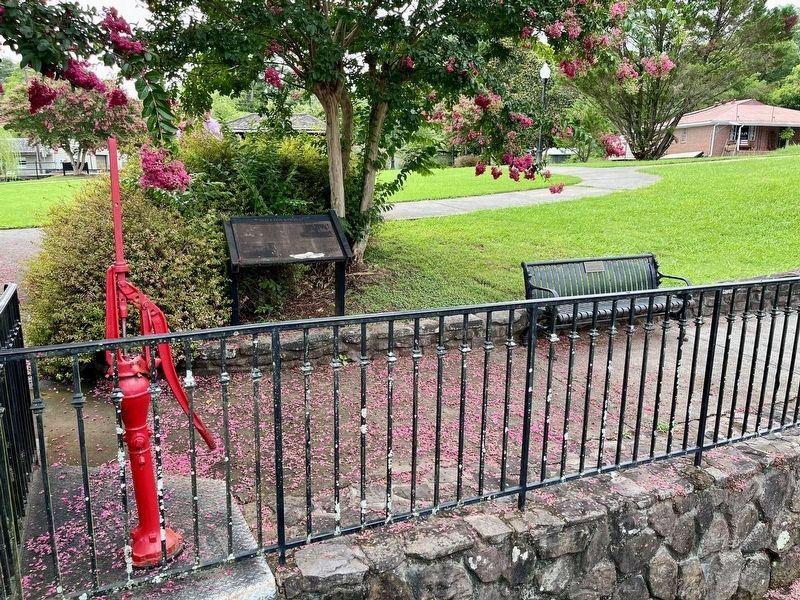
2. marker shown to the right of spring pump with fencing surrounding spring pool in foreground
In the 1880's, Captain Cleghorn and his wife Octavia Elizabeth Jones Cleghorn, who was often called "Ochie," built a large Victorian-style House on the hill above the spring. Weeping willow trees were planted along the creek and beside the spring with over four acres of colorful gardens extending to both sides of the highway. The site continued to be a place of hospitality throughout the generations. The family of John S. Cleghorn II held gatherings with feasts of broiled chickens, vegetables, and watermelons which were chilled in the spring's cool water. Still a place for passersby to get a cool drink, a gourd was sometimes hung from a red maple tree beside the spring, offering a communal dipper. Sadly, the historic Victorian style Cleghorn home burned in 1967. The site fell into neglect, the water became unsafe to drink, and the spring was covered by boards.
In 2001, the Georgia Department of Community Affairs awarded a grant to the city of Summerville to uncover the spring and to develop the site into a public park. The Summerville Better Hometown Program led
Photographed by Tracy Andersen Roberts, July 25, 2026
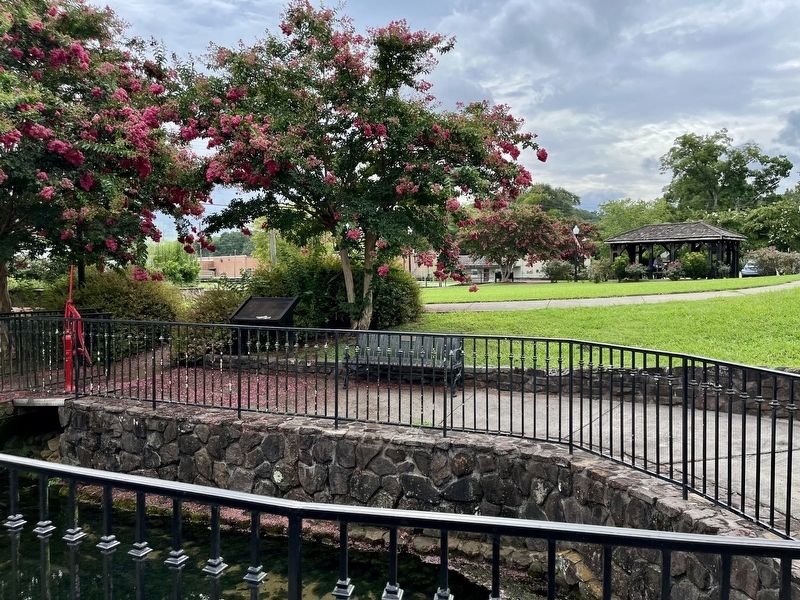
3. marker shown with Willow Spring in foreground and Willow Spring Park buildings in background
Though the old homes were lost long ago, the spring was once again allowed to flow freely and weeping willow trees were returned to the site which Octavia Cleghorn had named after a place of beauty from her youth-- Willow Spring.
(captions)
The Cleghorn Family at Willow Spring
Reunion of Confederate Veterans at Willow Spring
Topics. This historical marker is listed in these topic lists: Environment • Indigenous Peoples and Communities • Parks & Recreational Areas • Settlements & Settlers • War, US Civil • Waterways & Vessels. A significant historical year for this entry is 1838.
Location. 34° 28.935′ N, 85° 20.831′ W. Marker is unreadable. Marker is in Summerville, Georgia, in Chattooga County. It can be reached from West First Avenue west of Commerce Street, on the right when traveling west. Located in Willow Springs Park. Touch for map. Marker is at or near this postal address: 48 W First Ave, Summerville GA 30747, United States of America. Touch for directions.

Regionally, this marker is in the Mountains. It is also in the American South and specifically in the Deep South. Globally, it is in North America, the Western Hemisphere, the Western World, and the Anglosphere. Historically, it finds itself in what was once the original Cherokee Nation, the territory of the Mississippian Culture, one of the original Thirteen Colonies, one of the Confederate States of America, and the Antebellum South.
Other nearby markers. At least 8 other markers are within 6 miles of this location, measured as the crow flies: Chattooga County (about 700 feet away, measured in a direct line); The Couey House (approx. 0.2 miles away); Summerville, Georgia (approx. 0.2 miles away); Boyles Yard Turntable Named Summerville Railroad Turntable (approx. ¼ mile away); Trion Factory (approx. 4.2 miles away); First Cotton Mill In Northwest Georgia (approx. 5 miles away); a different marker also named Trion Factory (approx. 5.1 miles away); A Snapshot of Cherokee Life (approx. 5.3 miles away). Touch for a list and map of all markers in Summerville.
Also see . . .
1. Chattooga Historical Society: "Memories of Summerville’s Very Early Years by Mrs. J.W. Johnson".
The town was laid off first to be built where the Lyerly Fruit Co. now stands but they decided to move it because of the big spring ( Willow Spring) which was given to the town by General John Beavers. Practically all the people got their water there. There were only four houses between J.M .Bellah’s and J.V. Wheeler’s.(Submitted on July 25, 2026, by Tracy Andersen Roberts of Atlanta, Georgia.)
2. Chattooga County Government: "Willow Spring Park".
Willow Spring Park, with its distinctive Willow Trees, is located at the intersection of Highway-27 and First Street. The park was built to commemorate the importance of the spring to the foundation of Summerville. When John Beavers ceded land to Chattooga County after the county's founding, he selected the area for the county seat based on the availability of water from Willow Spring. The park has a pavilion, picnic tables, and a small walking track.(Submitted on July 25, 2026, by Tracy Andersen Roberts of Atlanta, Georgia.)
Credits. This page was last revised on October 12, 2026. It was originally submitted on July 25, 2026, by Tracy Andersen Roberts of Atlanta, Georgia. This page has been viewed 62 times since then. Photos: 1, 2, 3. submitted on July 25, 2026, by Tracy Andersen Roberts of Atlanta, Georgia. • Bernard Fisher was the editor who published this page.
