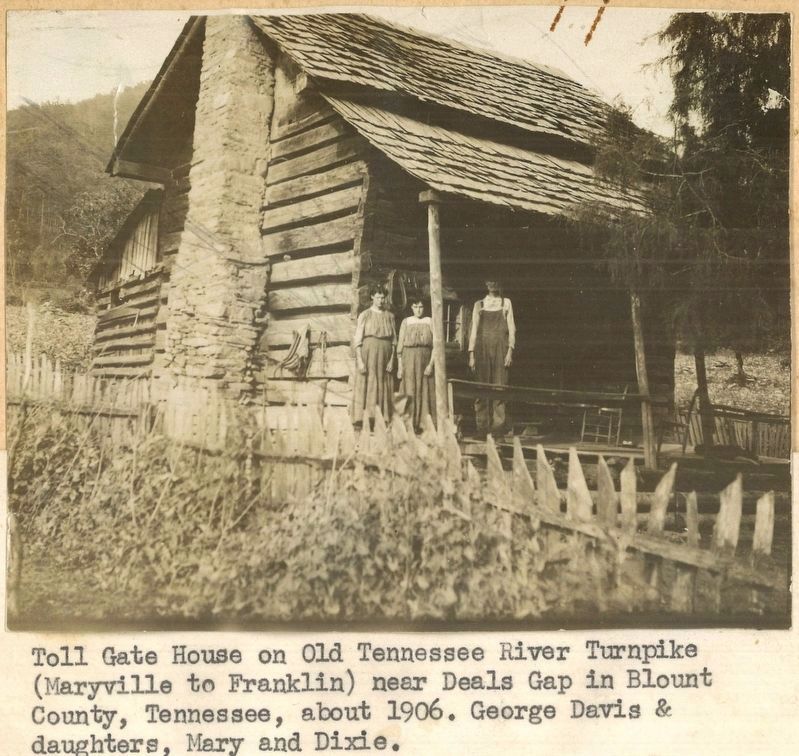
The chimney nearby marks the location of a tollhouse on the Tennessee
River Turnpike, which operated in 1829. Connecting Blount County, Tenn.,
with Macon County, N.C., across the Great Smokies, it was an important
route in livestock commerce . . . — — Map (db m264840) HM
Black's Fort History
from History of Southwest Virginia, 1746-1786
Washington County 1777-1870
by
Lewis Preston Summers
In 1760, what was to become Abingdon received its first name, Wolf Hills, from Daniel Boone after his hunting party was . . . — — Map (db m210058) HM
William B. Scott, Sr., a free Black, migrated to East Tennessee in 1847 after increased racial tension in North Carolina. He made harnesses and saddles in Blount County’s Quaker community of Friendsville until the Civil War. In Knoxville, during . . . — — Map (db m107600) HM
The need for improved methods of importing supplies and exporting local products had for some time been recognized by farmers and merchants of East Tennessee who, of necessity, relied on horse drawn freight wagons or rafts and barges. In 1852, the . . . — — Map (db m100872) HM
Born in Blount County, Tennessee, Andrew Jackson Montgomery came to Texas in 1819 with the James Long Expedition. In 1823, as the first known settler in Montgomery County, he opened a trading post at the crossing of two Indian trails. From his . . . — — Map (db m169881) HM
Originally constructed along Lost Creek, Union County, this mill was built by James Rice. After migrating from North Carolina to Sharp’s Station in 1790, “Uncle Jim” and his sons completed construction of the grist mill in the autumn of 1798. . . . — — Map (db m259108) HM
Alcoa High School began participating in athletics, as the Red Tornadoes, in the fall of 1924. The gymnasium was added in 1927. Alcoa High School played its home basketball games there until 1954.
Captions (clockwise from top . . . — — Map (db m195370) HM
Citizen of Blount County 1806-1818
Enlisted at Maryville in War 1812
Congressman from Tennessee 1823-1827
Governor of Tennessee 1827-1829
Liberator of Texas San Jacinto April 21,1836
President Republic of Texas 1836-1838, 1841-1844 . . . — — Map (db m150794) HM
The Dallas Community in Blount County was settled in the mid-1800s
after the Second Creek War (1836-1837). Settlers built general
merchandise stores, a blacksmith shop, a Methodist Church, and
a cemetery later known as Bethlehem Cemetery. Local . . . — — Map (db m307414) HM
While traveling south with his troops, General Andrew Jackson camped at the fork of the river in 1813. General Jackson carved his name in a locust tree naming this area Locust Fork. In 1817, the Hanby family came from Virginia and settled in this . . . — — Map (db m50125) HM
Maryville and Blount County were both founded on July 11, 1795 – nearly a year before Tennessee became a state. Maryville was founded around John Craig’s Fort (Fort Craig), which was built in the 1780s for protection from Indian attacks. The fort . . . — — Map (db m299703) HM
Fort Dickerson came under attack only once during the Civil War. in a prelude to the 1863 Siege of Knoxville, Federal and Confederate cavalry fought for possession of these heights. Its lofty presence, however, served as a deterrent until the end of . . . — — Map (db m4316) HM
1820-1889 seat of Blount County, a county older than the State.
Named for Tennessee Governor W. G. Blount who sent Andrew Jackson to aid Alabama settlers in Creek Indian War, 1812-1814.
Indian Chief Bear Meat lived here at crossing of . . . — — Map (db m156445) HM
Knox County
Established 1792; named in honor of
Maj. Gen. Henry Knox
Washington's Chief of Artillery in the Revolutionary War. Secretary of War in Washington's Cabinet. One of the founders and first secretary of the Society of the . . . — — Map (db m109332) HM
On November 4, 1863, Confederate Gen. James Longstreet led two reinforced divisions from Chattanooga to attack Union Gen. Ambrose E. Burnside's garrison at Knoxville. Burnside confronted Longstreet below Knoxville, then withdrew on November 12. . . . — — Map (db m100512) HM
Members of the Religious Society of Friends (Quakers) came to Blount County in the 1790s looking for a place to worship in peace. Hardworking and industrious, opposing war and slavery, they developed the land and founded the prosperous settlements . . . — — Map (db m81361) HM
During the antebellum period, Blount County supported abolitionism. In 1822, local Quakers and other residents formed an abolitionist society, and in the decades following, local clergymen preached against the evils of slavery. When the county . . . — — Map (db m69452) HM
Thin black lines indicate changes in relevance. Between each pair of lines entries are ordered geographically but all have the same relevance.
* Inflectional forms of words are their plurals, singulars, and possessives as well as gramatical tenses and similar variations.