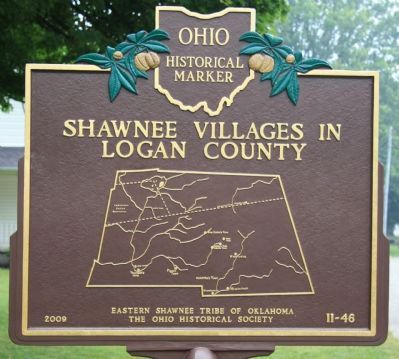
"Shawnee Nation in Logan County"
From the 1770s until 1832, the Logan County area was the homeland to much of the Shawnee Nation. Ten villages known as the Upper Mad River towns included the homes of influential leaders Moluntha, Black . . . — — Map (db m34083) HM
1920s
In the 1920s, a sentiment was applied to U.S. history promoting a romantic veneration of early America's past. This movement, now referred to as "Colonial Revival," popularized historic markers.
The Ohio Revolutionary Memorial . . . — — Map (db m307104) HM
After the 1786 destruction of the Upper Mad River Shawnee villages, some Mekoches migrated northwest to a bountiful area known as the Grand Glaize along the Maumee River. Others relocated to Indiana, Missouri, and Kansas. However, the cruelty of . . . — — Map (db m307098) HM
Dehumanized in History Texts
Kentuckians remembered Logan's raid as a successful campaign that contributed to opening the Ohio territory for American settlement. Building on the ideology of continental expansion that began with the first . . . — — Map (db m307103) HM
The Indian Lake Region was inhabited by Native American Indian cultures long before white settlers. The Shawnee, Cherokee and Wyandot Tribes were the primary inhabitants, The Algonquin, Delaware and Ottawa tribes also had settlements nearby. Many of . . . — — Map (db m104209) HM
Civil War
Brown, Wilson, W. Co. F, 21st Ohio Infantry, Private, Army. Born; December 25, 1837 in Logan County, Ohio. Entered service in Wood County, Ohio. Died; December 25th, 1916, in Toledo, Ohio. Buried at New Belleville Ridge Cemetery, . . . — — Map (db m160385) WM
At the end of the Ice Age, about 9000 years ago, people hunted wooly mammoths and ancient bison on the plains of what is now Kansas. They used spears and atlatls, or throwing sticks, and they made beautiful stone points from native flint. They . . . — — Map (db m66121) HM